
IREX Launches Smarter, Faster Fire and Smoke AI Detection to Protect Communities and Critical Infrastructure
[Washington, DC – April 2, 2026] – IREX, a global pioneer in ethical AI and intelligent video analytics deployed across 10+ countries and over 300,000 cameras, announced a major update to its FireTrack smoke and fire detection module. The update doesn’t require any additional hardware and broadens FireTrack’s applicability to critical infrastructure such as energy [ ] This story continues at The Next Web
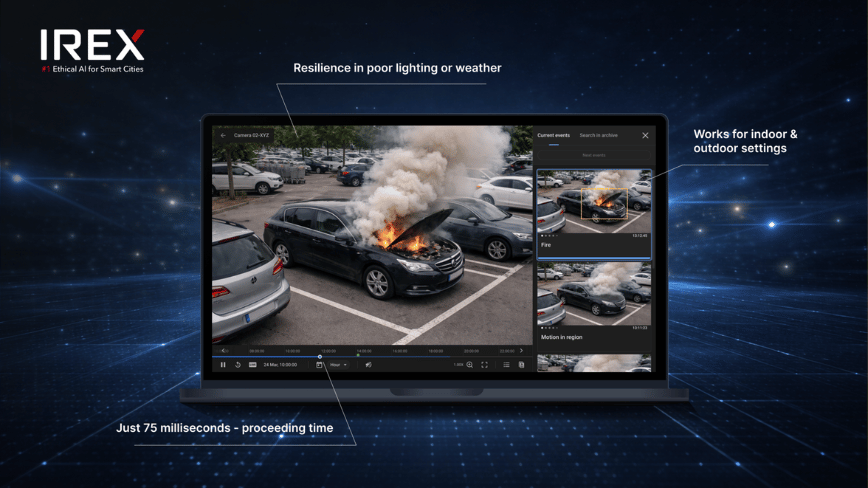
[Washington, DC – April 2, 2026] – IREX, a global pioneer in ethical AI and intelligent video analytics deployed across 10+ countries and over 300,000 cameras, announced a major update to its FireTrack smoke and fire detection module. The update doesn’t require any additional hardware and broadens FireTrack’s applicability to critical infrastructure such as energy facilities and transportation hubs, public institutions including schools and hospitals, residential and commercial buildings, and parks, national parks, and forests.
Built on IREX’s ethical AI platform, the new module processes visual data in just 75–105 milliseconds – or about 0.1 second -, identifying danger almost instantly. This advancement – combined with improved model accuracy and resilience in poor lighting or weather – empowers early intervention by first responders, reducing the risk of catastrophic loss.
The updated model analyzes how fire and smoke evolve over time, distinguishing genuine hazards from harmless visuals like fog, headlights, or glare. This dramatically cuts down false alarms, allowing safety teams to focus on incidents that truly require attention.
To boost accuracy, IREX changed how the system “sees” fire and smoke. Instead of traditional bounding boxes around objects, the updated module uses segmentation, applying a color mask over the exact areas where fire or smoke appears: green for fire and red for smoke, thus better reflecting their irregular shapes. This approach improves the system’s ability to localize hazards precisely within the scene.
Credit: Irex
The updated FireTrack delivers early warning that is significantly faster than traditional optical or heat-based detectors by analyzing live video feeds for the visual signatures of smoke and fire in real time.
“Because the IREX AI platform seamlessly operates on existing camera networks, cities and organizations can strengthen fire safety without installing specialized sensor hardware – simply by connecting their CCTV systems to IREX,” said Serge Smirnoff, Head of PR at IREX. “Each detection event comes with a video snapshot for instant visual verification, enabling operators and first responders to quickly assess the situation and respond effectively.”
By leveraging the surveillance infrastructure already in place, the new FireTrack model offers a cost-effective path to comprehensive fire safety across both built environments and natural landscapes.
“The pride I feel for the IREX team today is immense. This FireTrack launch is a monumental achievement that reflects our core mission, to deploy ethical, intelligent AI to solve the world’s most critical problems,” said Calvin Yadav, CEO of IREX. “We are strengthening the resilience of entire communities globally, proving that every hour of hard work put into responsibly designed artificial intelligence is actively saving lives long before a single alarm sounds.”
Sign in to highlight and annotate this article

Conversation starters
Daily AI Digest
Get the top 5 AI stories delivered to your inbox every morning.
More about
launchannounceupdate

HHS Announces Request for Information to Harness Artificial Intelligence to Deflate Health Care Costs and Make America Healthy Again - HHS.gov
HHS Announces Request for Information to Harness Artificial Intelligence to Deflate Health Care Costs and Make America Healthy Again HHS.gov

The Flat Subscription Problem: Why Agents Break AI Pricing
The Flat Subscription Problem: Why Agents Break AI Pricing Something broke in AI pricing yesterday, and it wasn't OpenClaw. When Anthropic cut off Claude subscription access to third-party agentic tools, the developer community erupted. A Hacker News thread hit the front page with hundreds of points and hundreds of comments. Most of the anger landed on Anthropic's timing — they launched Claude Code Channels (their first-party Telegram/Discord bridge) two weeks before blocking the third-party alternative that inspired it. The optics were bad. But the angry comments are chasing the wrong target. Anthropic's technical explanation was honest: "Our subscriptions weren't built for the usage patterns of these third-party tools." That's not spin. It's a structural truth that the entire industry wi
Knowledge Map
Connected Articles — Knowledge Graph
This article is connected to other articles through shared AI topics and tags.
More in Releases
HHS Announces Request for Information to Harness Artificial Intelligence to Deflate Health Care Costs and Make America Healthy Again - HHS.gov
HHS Announces Request for Information to Harness Artificial Intelligence to Deflate Health Care Costs and Make America Healthy Again HHS.gov

Stop Writing AI Prompts From Scratch: A Developer's System for Reusable Prompt Templates
You open Cursor. You need to refactor a service. You type something like: "Hey, can you refactor this function to be cleaner?" The AI gives you something mediocre. You tweak the prompt. Try again. The output improves. You get what you need — but you've spent four minutes writing a prompt you'll write again tomorrow, and next week, and every time a similar task comes up. This is the hidden tax on AI-assisted development. Not API costs. Not context limits. Prompt reinvention. Most developers treat every AI interaction as a blank slate. Senior engineers don't. They've built systems. This article is about building that system: a reusable prompt library that makes your AI interactions faster, more consistent, and dramatically higher quality. Why Most Developer Prompts Fail Before building a sys

Show HN: Ray – an open-source AI financial advisor that runs in your terminal
I've been using this daily for 4 months and figured others might find it useful. This is my first open source project so would love any feedback. Ray connects to your bank via Plaid, stores everything in an encrypted local SQLite database, and lets you ask questions about your finances in natural language. No cloud, no account, your data is stored on your machine. Before anything reaches the LLM, all PII is stripped — your name, companies, transaction details are redacted and replaced with tokens, then rehydrated locally in the response. The AI never sees who you are. Comments URL: https://news.ycombinator.com/item?id=47644133 Points: 6 # Comments: 2
Discussion
Sign in to join the discussion
No comments yet — be the first to share your thoughts!