
ALSO hits $1B valuation and signs DoorDash as its first major autonomous delivery partner
The Palo Alto small-EV company raised $200M in a Series C led by Greenoaks, with DoorDash investing alongside a multi-year commercial agreement to deploy purpose-built autonomous vehicles for last-mile delivery. DoorDash co-founder Stanley Tang joins the board as an observer. ALSO, the small electric vehicle company spun out of Rivian in 2025, has raised $200 […] This story continues at The Next Web
The Palo Alto small-EV company raised $200M in a Series C led by Greenoaks, with DoorDash investing alongside a multi-year commercial agreement to deploy purpose-built autonomous vehicles for last-mile delivery. DoorDash co-founder Stanley Tang joins the board as an observer.
ALSO, the small electric vehicle company spun out of Rivian in 2025, has raised $200 million in a Series C round led by Greenoaks Capital, with participation from Prysm Capital and a strategic investment from DoorDash.
The round values the company at over $1 billion. Alongside the investment, ALSO and DoorDash signed a multi-year commercial agreement to develop and deploy autonomous delivery vehicles at scale, a commitment that gives the capital raise considerably more substance than a financial bet alone.
DoorDash co-founder and Head of DoorDash Labs Stanley Tang will join ALSO as a Board Observer. Rivian retains a significant minority ownership stake in the company.
ALSO was originally incubated within Rivian before being spun out as a dedicated small-EV company.
Its product thesis is that the last mile of delivery, the part that happens in bike lanes, on tight curbs, and in dense urban spaces, requires vehicles built from scratch for those environments, not autonomy retrofitted onto existing full-size platforms.
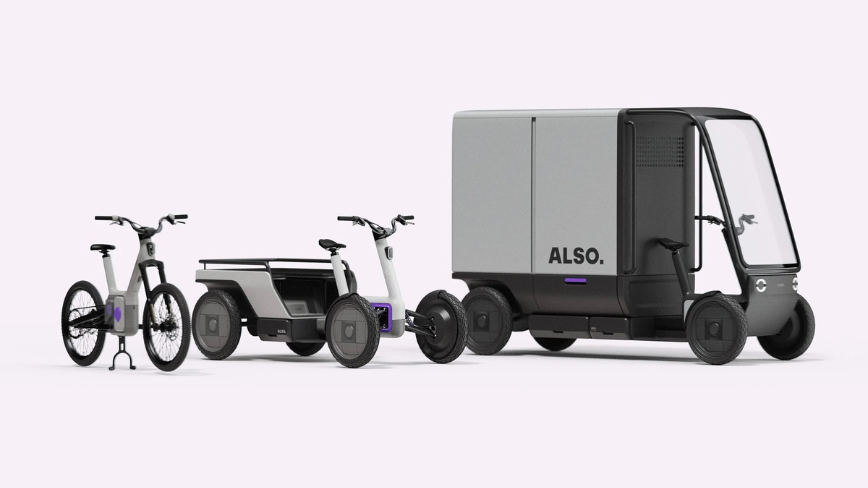
Its current lineup includes the TM-B, a $3,500 e-bike with a virtual drivetrain, and the TM-Q, a four-wheeled cargo EV designed to haul goods while fitting in a bike lane.
The companies have not specified which vehicle or vehicles will be deployed under the DoorDash partnership, though the TM-Q’s cargo capacity makes it the more obvious candidate for food delivery at scale.
The structure of the partnership is what makes it interesting. Most autonomous delivery investments involve a financial stake with a vague deployment intent attached.
DoorDash has committed to a commercial agreement with a real timeline, giving ALSO a major operator’s network as a proving ground.
DoorDash, which has more than 30% of its US monthly active users ordering across grocery and retail categories beyond restaurants, has clear commercial incentive to reduce per-delivery labour costs as it scales.
Tang described autonomous small EVs as “optimal” for dense, mixed-use environments, framing the partnership as addressing delivery challenges “at the intersection of roadways, bike lanes and road adjacent spaces” that generic autonomous platforms have not solved.
ALSO plans to deliver its initial products in the US in 2026, with international expansion to follow. The Series C, combined with the DoorDash commercial commitment, sets up what would be one of the first serious attempts to deploy purpose-built autonomous small EVs through an operator with real order volume, rather than in controlled pilot conditions.
Sign in to highlight and annotate this article

Conversation starters
Daily AI Digest
Get the top 5 AI stories delivered to your inbox every morning.
More about
companyvaluationautonomousThe Morning After: NASA’s Artemis II is on a voyage around the Moon
NASA’s Artemis II successfully launched on April 1 , with its crew on a 10-day mission to circle the Moon. It’s the first crewed Artemis flight and a major step toward humanity returning to our little neighbor in the future. Since launch, the vehicle has separated from its launch system and been manually piloted, testing how the Orion capsule will dock with future lunar landers. There have been some snags, however: The onboard toilet went awry, and Microsoft Outlook has been acting screwy . Jokes aside, there is something magnificent about seeing humanity taking to the stars once again. That, for all of our worst instincts, we can still come together to solve problems and explore beyond our own horizons. — Dan Cooper The other big stories (and deals) this morning SpaceX has reportedly file

What it takes to step into a C-level technology role
You’ve led several digital transformation initiatives and delivered financial impacts. Executives recognize your change leadership competencies, having improved both customer and employee experiences. The architectures you helped roll out are now platform standards and are foundational to your organization’s data and AI strategies. Now, you’re asking whether you’re ready for a CIO role, or another C-level role in data, digital, or security. CIO.com’s 24th annual State of the CIO reports that over 80% of CIOs say their role is becoming more digital- and innovation-focused, that they are more involved in leading digital transformation, and that the CIO is becoming a changemaker . If you’re checking these boxes, you should be asking how you can step up into a C-level job. Transformation leade

Without controls, an AI agent can cost more than an employee
Without proper controls, AI agents can cost more than what outputs are worth according to Jason Calacanis and Chamath Palihapitiya , two IT experts and cohosts of popular podcast, All In podcast . During a recent episode, long-time tech investor Calacanis noted that agent costs quickly rose to $300 a day while using the Claude API at one of his organizations. At the same time, these $100,000-a-year agents were replacing only a fraction of an employee’s work. “When do tokens outpace the salary of the employee?” he asked. “Because you’re about to hit it. I’m about to hit it.” Palihapitiya, CEO at VC firm Social Capital, said his organization sets token budgets for its best developers, but unfettered agent use can get expensive. “If you aggregate it across all people, you can clearly see a tr
Knowledge Map
Connected Articles — Knowledge Graph
This article is connected to other articles through shared AI topics and tags.
More in Products

Just Because We Can: The Strategic Risks Of Automating Everything
While AI and automation can be powerful, many applications use complex global systems to solve simple problems that could be handled locally. Guest author Itay Sagie shares three risks of undisciplined automation of everything, urging more thoughtful and disciplined use of technology.
The Morning After: NASA’s Artemis II is on a voyage around the Moon
NASA’s Artemis II successfully launched on April 1 , with its crew on a 10-day mission to circle the Moon. It’s the first crewed Artemis flight and a major step toward humanity returning to our little neighbor in the future. Since launch, the vehicle has separated from its launch system and been manually piloted, testing how the Orion capsule will dock with future lunar landers. There have been some snags, however: The onboard toilet went awry, and Microsoft Outlook has been acting screwy . Jokes aside, there is something magnificent about seeing humanity taking to the stars once again. That, for all of our worst instincts, we can still come together to solve problems and explore beyond our own horizons. — Dan Cooper The other big stories (and deals) this morning SpaceX has reportedly file

The end of the browse-and-click era: The roadmap to agentic commerce
The agentic commerce era is here — but how much does it matter? The short answer: enormously, and more so every day. McKinsey has estimated that five years from now, agentic commerce — meaning AI agents acting autonomously on behalf of consumers to search, compare and buy across platforms — could account for $1 trillion in the US business-to-consumer (B2C) retail market, and $3 trillion to $5 trillion globally. At the January conference of the National Retail Federation, participants noted that what was experimental is fast becoming operationalized , and implementations that used to take two to three months are now being done in a few weeks. Common standards and practices are being established, such as the Agentic AI Foundation , as well as tools like the Agentic Commerce Protocol and the

PMI builds commerce engine to glean customer insights
Counterfeit tobacco sales account for as much as 75% of South Africa’s total market. And while Mary Mahuma, CIO for Southern Africa PMI, admits that the challenge facing the business is significant, she finds solutions by tackling the root cause of the issue: customer insights . According to her, other FMCG brands also struggle to clearly understand consumer behavior, how they engage with brands, and what they actually want. This is especially true in rural and informal markets. “One might expect a brand like PMI to try to address these challenges by focusing on big fish,” she says. “But there’s so much value in better targeting our strategies toward understanding the hidden market for tobacco products.” This market, consisting of small, independent convenience or general trade stores, is
Discussion
Sign in to join the discussion
No comments yet — be the first to share your thoughts!