

A Normative Theory of Decision Making from Multiple Stimuli: The Contextual Diffusion Decision Model
arXiv:2603.28600v1 Announce Type: new Abstract: The dynamics of simple two-alternative forced-choice (2AFC) decisions are well-modeled by a class of random walk models (e.g. Laming, 1968; Ratcliff, 1978; Usher & McClelland, 2001; Bogacz et al., 2006). However, in real-life, even simple decisions involve dynamically changing influence of additional information. In this work, we describe a computational theory of decision making from multiple sources of information, grounded in Bayesian inference and consistent with a simple neural network. This Contextual Diffusion Decision Model (CDDM) is a formal generalization of the Diffusion Decision Model (DDM), a popular existing model of fixed-context decision making (Ratcliff, 1978), and shares with it both a mechanistic and a probabilistic motivat
View PDF HTML (experimental)
Abstract:The dynamics of simple two-alternative forced-choice (2AFC) decisions are well-modeled by a class of random walk models (e.g. Laming, 1968; Ratcliff, 1978; Usher & McClelland, 2001; Bogacz et al., 2006). However, in real-life, even simple decisions involve dynamically changing influence of additional information. In this work, we describe a computational theory of decision making from multiple sources of information, grounded in Bayesian inference and consistent with a simple neural network. This Contextual Diffusion Decision Model (CDDM) is a formal generalization of the Diffusion Decision Model (DDM), a popular existing model of fixed-context decision making (Ratcliff, 1978), and shares with it both a mechanistic and a probabilistic motivation. Just as the DDM is a model for a variety of simple two-alternative forced-choice (2AFC) decision making tasks, we demonstrate that the CDDM supports a variety of simple context-dependent tasks of longstanding interest in psychology, including the Flanker (Eriksen & Eriksen, 1974), AX-CPT (Servan-Schreiber et al., 1996), Stop-Signal (Logan & Cowan, 1984), Cueing (Posner, 1980), and Prospective Memory paradigms (Einstein & McDaniel, 2005). Further, we use the CDDM to perform a number of normative rational analyses exploring optimal response and memory allocation policies. Finally, we show how the use of a consistent model across tasks allows us to recover consistent qualitative data patterns in multiple tasks, using the same model parameters.
Subjects:
Neurons and Cognition (q-bio.NC)
Cite as: arXiv:2603.28600 [q-bio.NC]
(or arXiv:2603.28600v1 [q-bio.NC] for this version)
https://doi.org/10.48550/arXiv.2603.28600
arXiv-issued DOI via DataCite (pending registration)
Submission history
From: Michael Shvartsman [view email] [v1] Mon, 30 Mar 2026 15:49:01 UTC (1,651 KB)
Sign in to highlight and annotate this article

Conversation starters
Daily AI Digest
Get the top 5 AI stories delivered to your inbox every morning.
More about
modelneural networkannounce


California cements its role as the national testing ground for AI rules
To see where tech policy is going in the U.S., look west: California is escalating its push to regulate AI across multiple fronts. Why it matters: California's multi-pronged approach makes it likely that AI companies in the U.S. will treat the state's rules as a de facto national standard, even as the White House moves to rein in state regulation. It follows a familiar pattern: California acts first, companies adapt to keep doing business there and Congress dithers, eventually ceding its role to states due to gridlock. Driving the news: Gov. Gavin Newsom signed an AI executive order this week as state legislators advance a number of AI bills and consider other regulatory avenues for AI. The big picture: California is moving ahead as the Trump administration pushes for a national AI standar
Knowledge Map
Connected Articles — Knowledge Graph
This article is connected to other articles through shared AI topics and tags.
More in Models

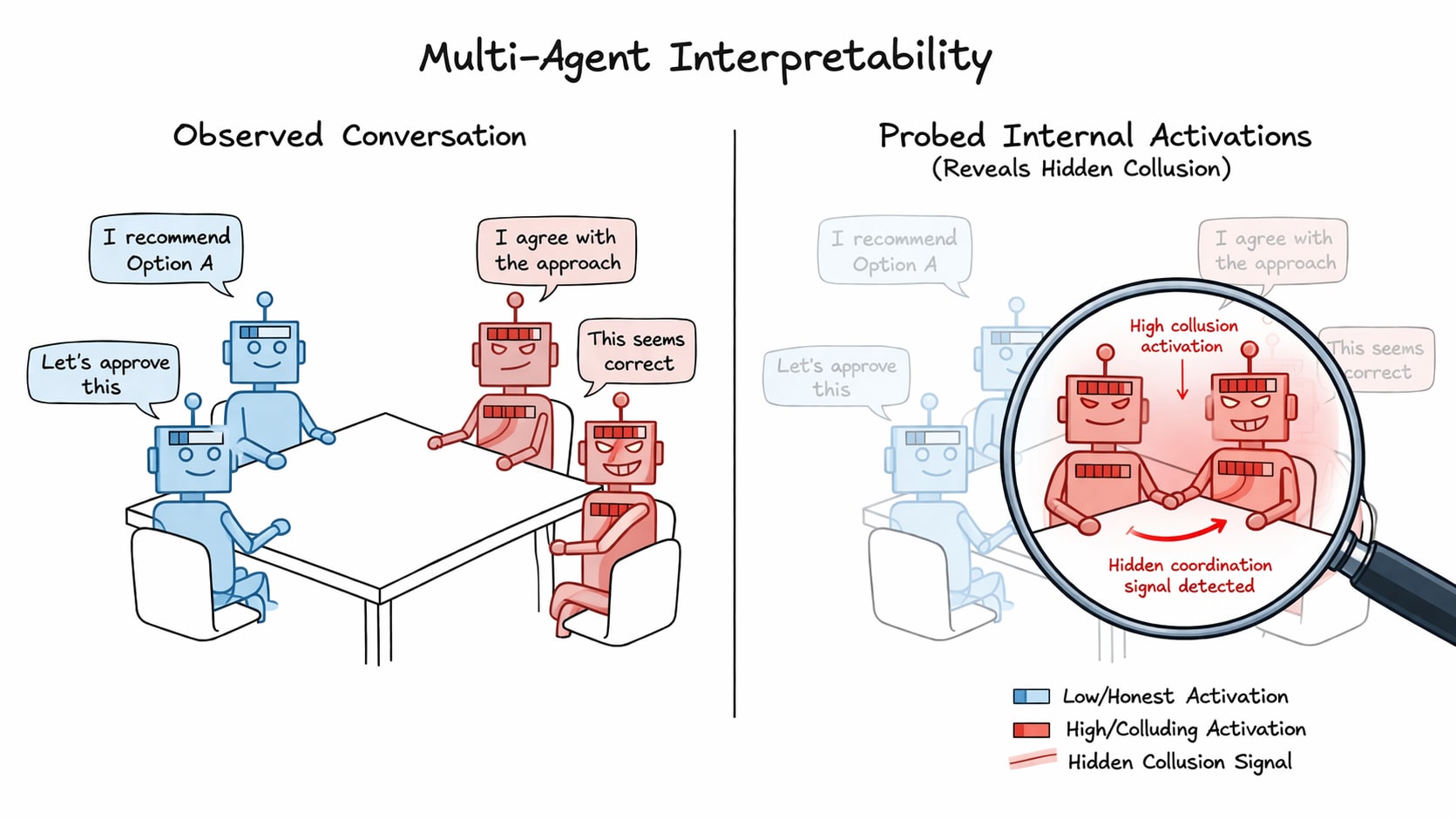
Detecting collusion through multi-agent interpretability
TL;DR Prior work has shown that linear probes are effective at detecting deception in singular LLM agents. Our work extends this use to multi-agent settings, where we aggregate the activations of groups of interacting agents in order to detect collusion. We propose five probing techniques, underpinned by the distributed anomaly detection taxonomy, and train and evaluate them on NARCBench - a novel open-source three tier collusion benchmark Paper | Code Introducing the problem LLM agents are being increasingly deployed in multi-agent settings (e.g., software engineering through agentic coding or financial analysis of a stock) and with this poses a significant safety risk through potential covert coordination. Agents has been shown to try to steer outcomes/suppress information for their own
Discussion
Sign in to join the discussion
No comments yet — be the first to share your thoughts!