
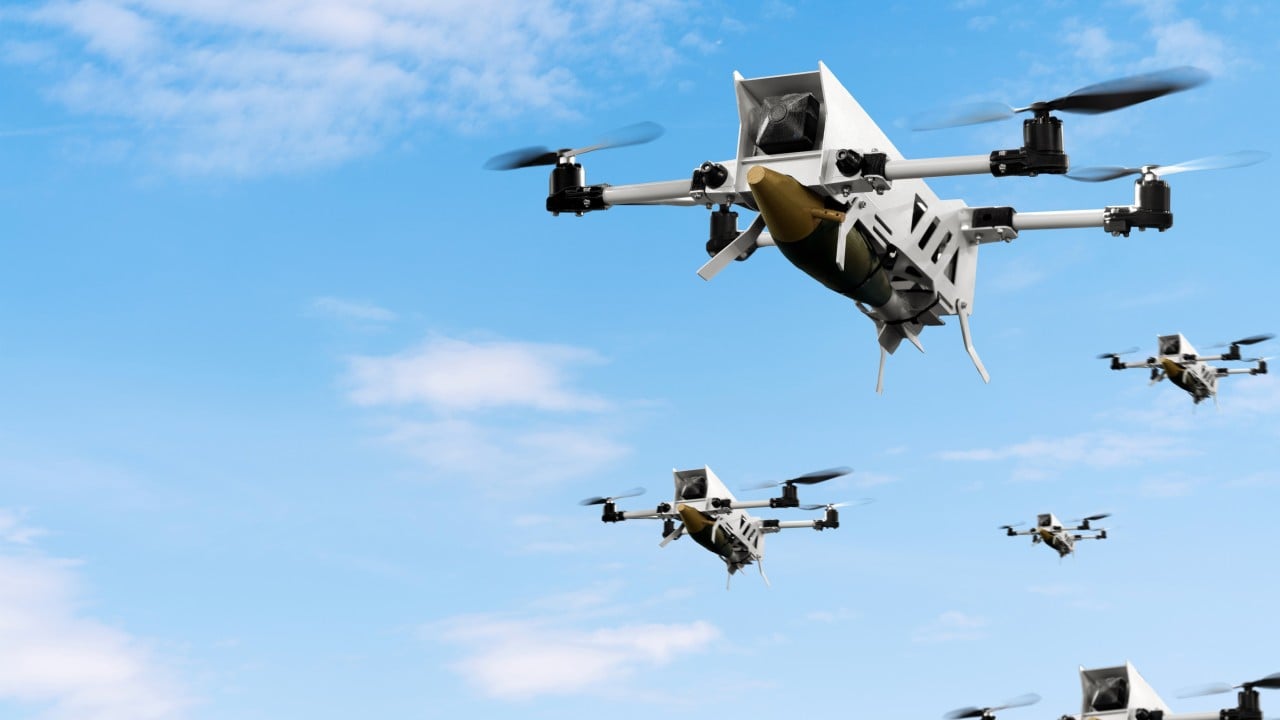
With an eye on China, Japan looks to kamikaze drones and low-cost missiles
Japan plans to introduce a fleet of kamikaze drones and low-cost missiles to boost deterrence against regional threats including China, according to Japanese media reports. The Yomiuri newspaper and Kyodo news agency reported on Wednesday that the strategy was focused on “integrated attacks” from unmanned aerial vehicles and long-range stand-off missiles, citing government and ruling coalition sources. They said the drones and missiles would be used to break down enemy air defences and...
Japan plans to introduce a fleet of kamikaze drones and low-cost missiles to boost deterrence against regional threats including China, according to Japanese media reports.
The Yomiuri newspaper and Kyodo news agency reported on Wednesday that the strategy was focused on “integrated attacks” from unmanned aerial vehicles and long-range stand-off missiles, citing government and ruling coalition sources.
They said the drones and missiles would be used to break down enemy air defences and counterstrike missile launch bases.
The Japanese government is prioritising the development of suicide-style drones or loitering munitions – which fly to a target, crash into it and explode – targeting a range of more than 1,000km (621 miles). The strategy was informed by the conflicts in Ukraine and the Middle East, where low-cost drones have proven pivotal, the Yomiuri reported.
It said new types of drones launched from aircraft or submarines, and those that navigate on or below the surface of the water, were being considered to diversify counterstrikes.
01:49
Taiwan unveils a home-grown ‘kamikaze’ portable attack drone
Taiwan unveils a home-grown ‘kamikaze’ portable attack drone
The proposal also includes civil aviation components to produce missiles for counterstrikes that would drastically reduce costs and manufacturing times, in preparation for a prolonged conflict.
SCMP Tech (Asia AI)
https://www.scmp.com/news/china/military/article/3348960/eye-china-japan-looks-kamikaze-drones-and-low-cost-missiles?utm_source=rss_feedSign in to highlight and annotate this article

Conversation starters
Daily AI Digest
Get the top 5 AI stories delivered to your inbox every morning.
More about
reportgovernmentchina

Why Prompt Injection Hits Harder in MCP: Scope Constraints and Blast Radius
Why Prompt Injection Hits Harder in MCP: Scope Constraints and Blast Radius The GitHub issue tracker for the official MCP servers repository has developed a recurring theme over the last two months: security advisories. Not general hardening suggestions — specific reports of prompt-injection-driven file reads, SSRF, sandbox bypasses, and unconstrained string parameters across official servers. This is not a bug-report backlog. It's a design pattern gap. The reason prompt injection hits harder in MCP than in stateless APIs isn't just "LLMs can be tricked." It's that MCP tools are action-capable by design, and most server implementations give those tools unconstrained reach into the environment they run in. The structural problem: tools with no scope constraints A traditional API call is sco

A 95% Facial Match Falls Apart If the Face Itself Is Fake
how deepfakes are changing the landscape of biometric verification For developers building computer vision (CV) and biometric pipelines, we’ve spent the last decade chasing the "perfect" F1 score. We’ve tuned our thresholds and optimized our Euclidean distance calculations to ensure that when a system says two faces match, they actually match. But as synthetic media reaches parity with reality, we are hitting the "Accuracy Paradox": a 99% accurate facial comparison algorithm produces a 100% false result if the input data is a deepfake. The technical implication for the dev community is a fundamental shift in how we architect identity systems. We are moving away from "biometric-only" verification toward a "biometric plus evidence" model. If you are currently building apps that rely on a sim
Knowledge Map
Connected Articles — Knowledge Graph
This article is connected to other articles through shared AI topics and tags.



Discussion
Sign in to join the discussion
No comments yet — be the first to share your thoughts!