

A Neural Tension Operator for Curve Subdivision across Constant Curvature Geometries
arXiv:2603.28937v1 Announce Type: new Abstract: Interpolatory subdivision schemes generate smooth curves from piecewise-linear control polygons by repeatedly inserting new vertices. Classical schemes rely on a single global tension parameter and typically require separate formulations in Euclidean, spherical, and hyperbolic geometries. We introduce a shared learned tension predictor that replaces the global parameter with per-edge insertion angles predicted by a single 140K-parameter network. The network takes local intrinsic features and a trainable geometry embedding as input, and the predicted angles drive geometry-specific insertion operators across all three spaces without architectural modification. A constrained sigmoid output head enforces a structural safety bound, guaranteeing th
View PDF HTML (experimental)
Abstract:Interpolatory subdivision schemes generate smooth curves from piecewise-linear control polygons by repeatedly inserting new vertices. Classical schemes rely on a single global tension parameter and typically require separate formulations in Euclidean, spherical, and hyperbolic geometries. We introduce a shared learned tension predictor that replaces the global parameter with per-edge insertion angles predicted by a single 140K-parameter network. The network takes local intrinsic features and a trainable geometry embedding as input, and the predicted angles drive geometry-specific insertion operators across all three spaces without architectural modification. A constrained sigmoid output head enforces a structural safety bound, guaranteeing that every inserted vertex lies within a valid angular range for any finite weight configuration. Three theoretical results accompany the method: a structural guarantee of tangent-safe insertions; a heuristic motivation for per-edge adaptivity; and a conditional convergence certificate for continuously differentiable limit curves, subject to an explicit Lipschitz constraint verified post hoc. On 240 held-out validation curves, the learned predictor occupies a distinct position on the fidelity--smoothness Pareto frontier, achieving markedly lower bending energy and angular roughness than all fixed-tension and manifold-lift baselines. Riemannian manifold lifts retain a pointwise-fidelity advantage, which this study quantifies directly. On the out-of-distribution ISS orbital ground-track example, bending energy falls by 41% and angular roughness by 68% with only a modest increase in Hausdorff distance, suggesting that the predictor generalises beyond its synthetic training distribution.
Subjects:
Machine Learning (cs.LG)
Cite as: arXiv:2603.28937 [cs.LG]
(or arXiv:2603.28937v1 [cs.LG] for this version)
https://doi.org/10.48550/arXiv.2603.28937
arXiv-issued DOI via DataCite (pending registration)
Submission history
From: Hassan Ugail [view email] [v1] Mon, 30 Mar 2026 19:16:25 UTC (1,246 KB)
Sign in to highlight and annotate this article

Conversation starters
Daily AI Digest
Get the top 5 AI stories delivered to your inbox every morning.



Knowledge Map
Connected Articles — Knowledge Graph
This article is connected to other articles through shared AI topics and tags.
More in Products


Organization runner controls for Copilot cloud agent
Each time Copilot cloud agent works on a task, it starts a new development environment powered by GitHub Actions. By default, this runs on a standard GitHub-hosted runner, but teams The post Organization runner controls for Copilot cloud agent appeared first on The GitHub Blog .

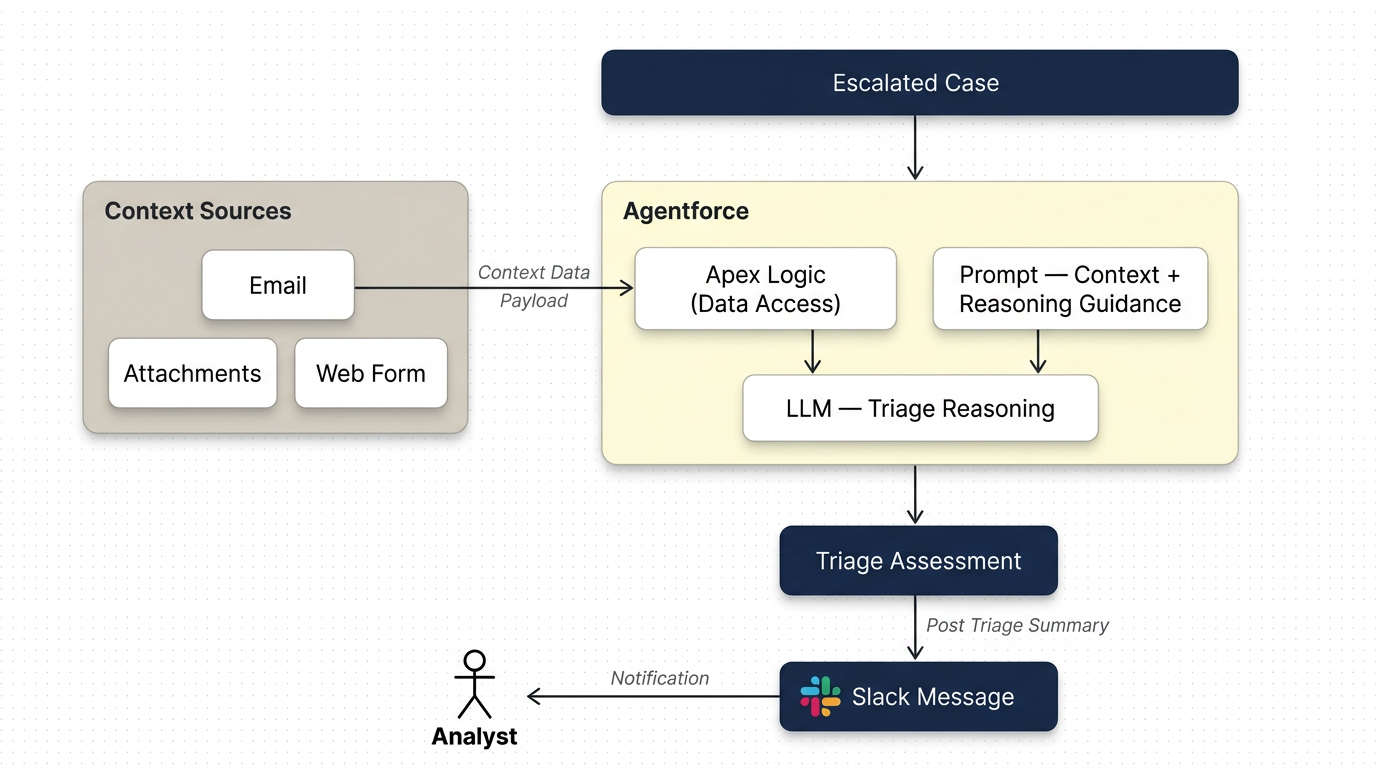
Scaling Trust: How Salesforce s Security Team Uses Agentforce to Triage Security Reports at Speed
By Kelly McCracken and Raaghavv Devgon. In our Engineering Energizers Q A series, we highlight the engineering minds driving innovation across Salesforce. Today, we spotlight Kelly McCracken, Senior Vice President of Information Security, whose Cyber Security Operations Center team built an AI-driven security system using Agentforce to triage and respond to customer-reported vulnerability findings at scale, [ ] The post Scaling Trust: How Salesforce s Security Team Uses Agentforce to Triage Security Reports at Speed appeared first on Salesforce Engineering Blog .
Discussion
Sign in to join the discussion
No comments yet — be the first to share your thoughts!