
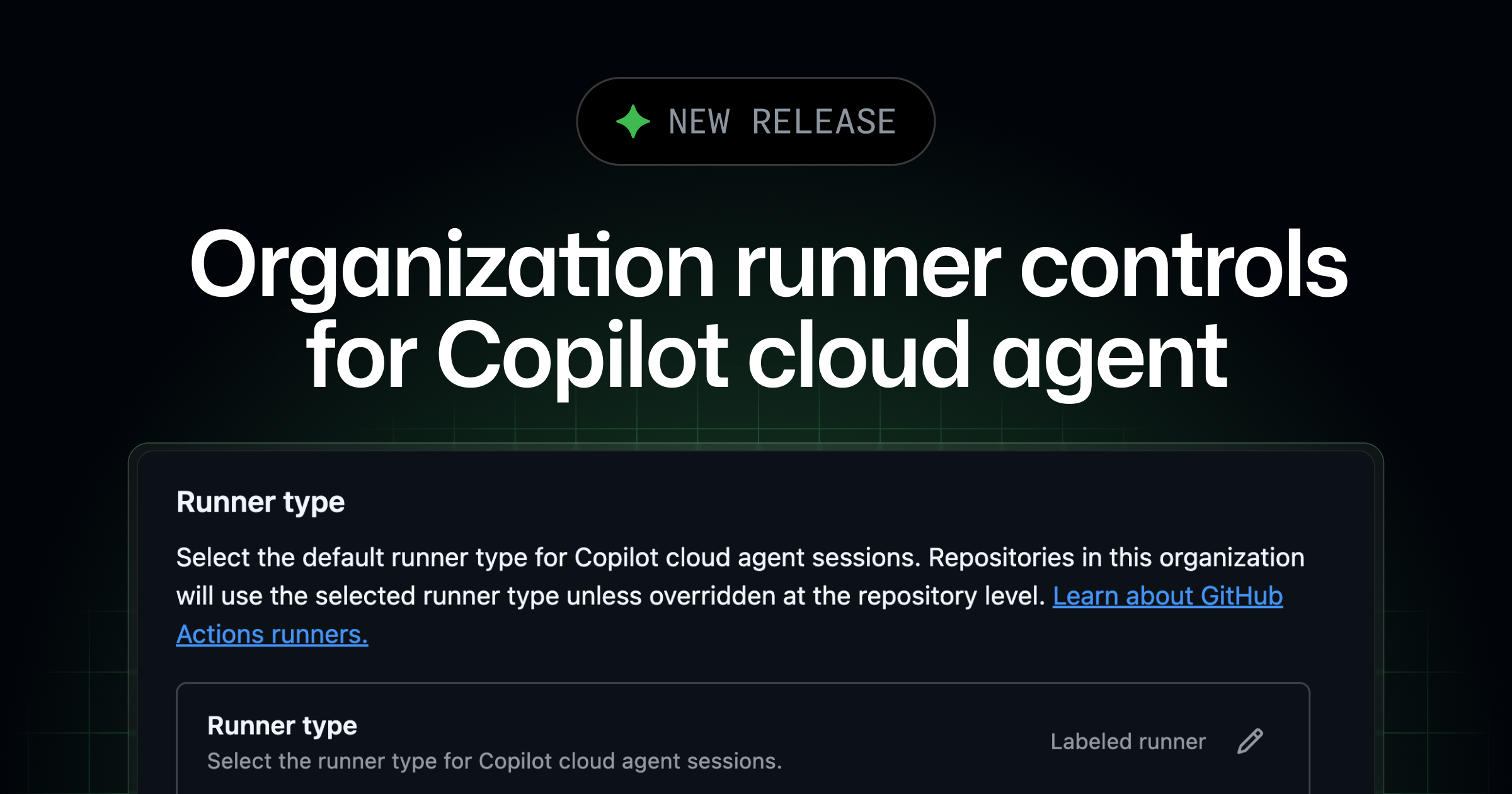
Organization runner controls for Copilot cloud agent
Each time Copilot cloud agent works on a task, it starts a new development environment powered by GitHub Actions. By default, this runs on a standard GitHub-hosted runner, but teams The post Organization runner controls for Copilot cloud agent appeared first on The GitHub Blog .
Each time Copilot cloud agent works on a task, it starts a new development environment powered by GitHub Actions.
By default, this runs on a standard GitHub-hosted runner, but teams can also customize the agent environment to use large runners or self-hosted runners for faster performance, access to internal resources, and more.
Until now, the runner was configured at the repository level with a copilot-setup-steps.yml file. This made it difficult to roll out consistent defaults or enforce guardrails across an organization.
Organization admins can now:
-
Set a default runner to be used automatically across all repositories, without requiring each repository to be individually configured.
-
Lock the runner setting so individual repositories can’t override the organization default.
This means you can set sensible defaults for your teams (e.g., using larger GitHub Actions runners for better performance) and optionally ensure that the agent always runs where you want it to, such as on your self-hosted runners.
To learn more, see “Configuring runners for GitHub Copilot cloud agent in your organization” in the GitHub Docs.
GitHub Copilot Changelog
https://github.blog/changelog/2026-04-03-organization-runner-controls-for-copilot-cloud-agentSign in to highlight and annotate this article

Conversation starters
Daily AI Digest
Get the top 5 AI stories delivered to your inbox every morning.
More about
copilotagentgithub
Sources: Microsoft s Judson Althoff said Copilot sales hit "some pretty big audacious goals" in Q3; only 3% of customers were paying for Copilot as of January (Brody Ford/Bloomberg)
Brody Ford / Bloomberg : Sources: Microsoft's Judson Althoff said Copilot sales hit some pretty big audacious goals in Q3; only 3% of customers were paying for Copilot as of January Microsoft Corp., responding to Wall Street feedback, has pivoted its AI sales strategy to focus on selling Copilot rather

Anthropic Races to Contain Leak of Code Behind Claude AI Agent - WSJ
Anthropic Races to Contain Leak of Code Behind Claude AI Agent WSJ Anthropic leak reveals Claude Code tracking user frustration and raises new questions about AI privacy Scientific American Anthropic leaked 500,000 lines of its own source code Axios
Anthropic Races to Contain Leak of Code Behind Claude AI Agent - WSJ
Anthropic Races to Contain Leak of Code Behind Claude AI Agent WSJ Anthropic leak reveals Claude Code tracking user frustration and raises new questions about AI privacy Scientific American Anthropic leaked 500,000 lines of its own source code Axios
Knowledge Map
Connected Articles — Knowledge Graph
This article is connected to other articles through shared AI topics and tags.
More in Products

Railway Environments Explained: Branch Deployments, Staging, and Zero-Config Databases
Originally published on NextFuture Railway Environments Explained: Branch Deployments, Staging, and Zero-Config Databases Most developers only scratch the surface of Railway. They push a repo, Railway builds it, it runs. That's nice. But the real productivity gain comes from Railway Environments — a feature that lets you clone your entire infrastructure per branch, spin up isolated databases in seconds, and tear it all down when the PR merges. No YAML, no cloud console, no ops ticket. This guide goes deep on environments, branch deployments, and zero-config databases so you can use Railway the way it was designed to be used. What Are Railway Environments? A Railway Environment is a full copy of your project's services and configuration — isolated from every other environment. By default Ra

Building Google Docs-style Real-Time Dashboards in Laravel (Reverb) & React ⚡
The Problem: Stale Data in B2B Decision Making In the high-stakes world of B2B SaaS and industrial management platforms, stale data is more than an inconvenience; it is a critical bottleneck. When multiple stakeholders are viewing the same analytical dashboard, decisions must be made based on live, concurrent state. If user A updates a critical inventory metric, user B must see that change reflected instantly without a manual page refresh. Traditional polling methods (repeatedly hitting an API endpoint) are resource-intensive, introduce unacceptable latency, and fail to scale under the load required by modern enterprise applications built at Smart Tech Devs. The Solution: Event-Driven Real-Time Architecture To build truly interactive, collaborative environments, we must shift from a Reques

Stop Writing Raw Python - Let C Handle It
April 2026 · 6 min read* A .NET developer's guide to Python performance — and why the rules are different I've spent most of my career in .NET. C#, the CLR, JIT compilation — these are things I know deeply. I'm proficient in TypeScript and JavaScript for full-stack and mobile work. Python, though, has always been at arm's length. I never really needed to cross over into that world. That changed recently. And the first real thing it taught me was something I hadn't expected: don't write your own raw code if you can help it. That's strange advice if you're coming from C#. In .NET, hand-crafted code and library code run through the same JIT compiler. Performance is often comparable, so you usually optimise based on other considerations — readability, semantics, maintainability. Python, it tur
Struggling with DSA Preparation? Evaluate the Right Sheet for Placement Success
Introduction Problem Statement You’re staring down the barrel of placement season, 4-5 months away, and your DSA prep feels like a house of cards. Random Leetcode grinding hasn’t cut it – you hit a wall when hints disappear, logic crumbles, and code refuses to materialize. Now, you’re eyeing a pattern-wise DSA sheet as a potential lifeline. But will it actually pull you out of this coding quicksand, or is it just another mirage? Here’s the crux: Your current approach – unstructured, unfocused problem-solving – is a feedback loop of inefficiency . You’re not building conceptual scaffolding ; you’re stacking random bricks. This sheet promises a pattern-based system , but it’s not a magic wand. Its effectiveness hinges on three critical factors : Your current skill level: Pattern recognition
Discussion
Sign in to join the discussion
No comments yet — be the first to share your thoughts!