
LLM Monitoring: The Key to Successful LLM Deployments
Discover in our blog how to ensure successful LLM deployments with comprehensive AI Observability, and monitor LLMs for performance, safety, privacy, and correctness.
Large language models (LLMs) are at the forefront of innovation, driving advancements in AI that offer promising benefits to enterprises. However, the deployment of these powerful models is not without its challenges. Enterprises embarking on this journey face multiple concerns, from LLM deployment and performance to ensuring correctness (hallucinations), safety (toxicity), privacy (PII), and AI compliance.
Enterprise Concerns in LLM Deployments
Enterprise leaders are eager to harness the power of LLMs to open up new revenue streams, streamline business operations, and boost customer experiences. LLMs, however, can pose risks and harm to both enterprises and end-users if they are not deployed responsibly. Enterprises risk incurring substantial fines and suffering reputational damage if, for example, their LLM-based chatbot produces toxic responses that could harm an end-user’s wellbeing, or if an end-user manipulates the chatbot into leaking private information.
Whether enterprises deploy LLMs by calling APIs, via RAG, fine-tuning, or even training their own models, they have the following AI concerns:
The New MOOD Stack for LLMOps
It is imperative for enterprises to standardize their LLMOps by using the new MOOD stack — a framework that encompasses Modeling, AI Observability, Orchestration and Data layers — with AI Observability orchestrating all the layers together, capturing the full value of LLMs.
For enterprises to obtain the full potential of LLMs, it is imperative to standardize their LLMOps using the MOOD stack — a comprehensive framework comprising Modeling, AI Observability, Orchestration, and Data layers. AI Observability is instrumental within this stack, orchestrating and enhancing the other layers by offering governance, interpretability, and LLM monitoring to improve operational performance and mitigate risks.
The Critical Role of AI Observability in LLM Monitoring
LLM deployments are deemed successful when they operate as intended. But how do enterprises know whether their LLM applications are doing well?
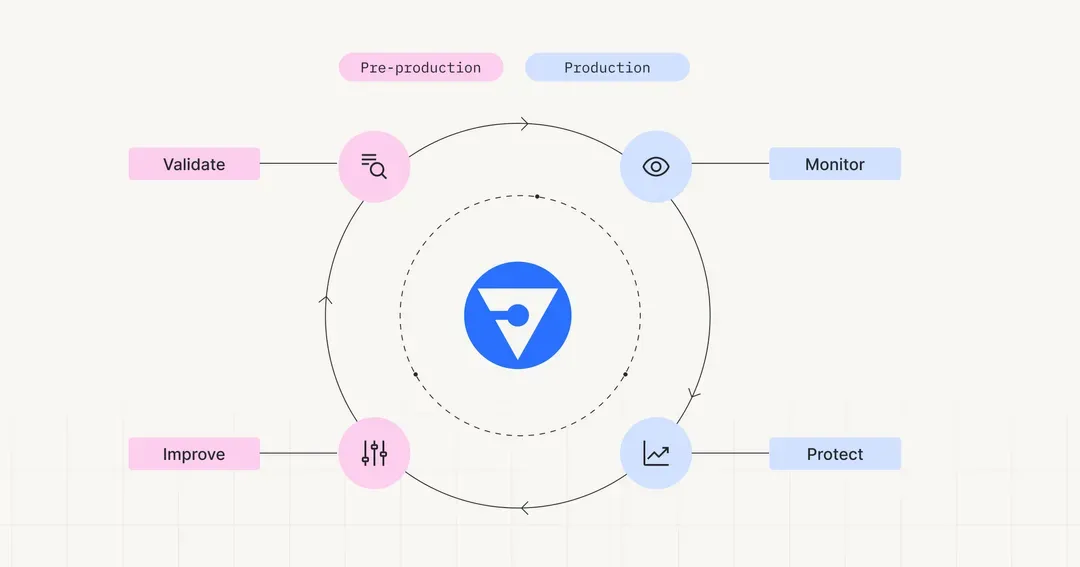
Monitoring LLM metrics is essential to ensure LLM-based applications are high performing, high quality, private, safe, correct and helpful. A comprehensive AI Observability platform not only evaluates the robustness, safety, and correctness of LLMs and prompts to boost confidence upon deployment but also continuously monitors production LLMs across various metrics. These include hallucination scores (such as answer and context relevance, groundedness, and consistency), safety metrics (including toxicity, profanity, and sentiment), privacy (specifically PII), and more.
By monitoring LLM metrics, enterprises can minimize the risks and concerns associated with LLMs, enabling them to fully leverage the benefits LLM-based applications offer to their businesses.
Read The Ultimate Guide to LLM Monitoring to learn more about the approaches of monitoring LLM metrics for successful LLM deployments.
Subscribe to our newsletter
Monthly curated AI content, Fiddler updates, and more.
Sign in to highlight and annotate this article

Conversation starters
Daily AI Digest
Get the top 5 AI stories delivered to your inbox every morning.
More about
safety


Causal Scene Narration with Runtime Safety Supervision for Vision-Language-Action Driving
arXiv:2604.01723v1 Announce Type: new Abstract: Vision-Language-Action (VLA) models for autonomous driving must integrate diverse textual inputs, including navigation commands, hazard warnings, and traffic state descriptions, yet current systems often present these as disconnected fragments, forcing the model to discover on its own which environmental constraints are relevant to the current maneuver. We introduce Causal Scene Narration (CSN), which restructures VLA text inputs through intent-constraint alignment, quantitative grounding, and structured separation, at inference time with zero GPU cost. We complement CSN with Simplex-based runtime safety supervision and training-time alignment via Plackett-Luce DPO with negative log-likelihood (NLL) regularization. A multi-town closed-loop CA
Knowledge Map
Connected Articles — Knowledge Graph
This article is connected to other articles through shared AI topics and tags.
More in Models


Generalist introduces GEN-1 general-purpose model for physical AI
Generalist AI said its latest model marks a significant step toward its mission of creating general intelligence for the physical world. The post Generalist introduces GEN-1 general-purpose model for physical AI appeared first on The Robot Report .
Discussion
Sign in to join the discussion
No comments yet — be the first to share your thoughts!