
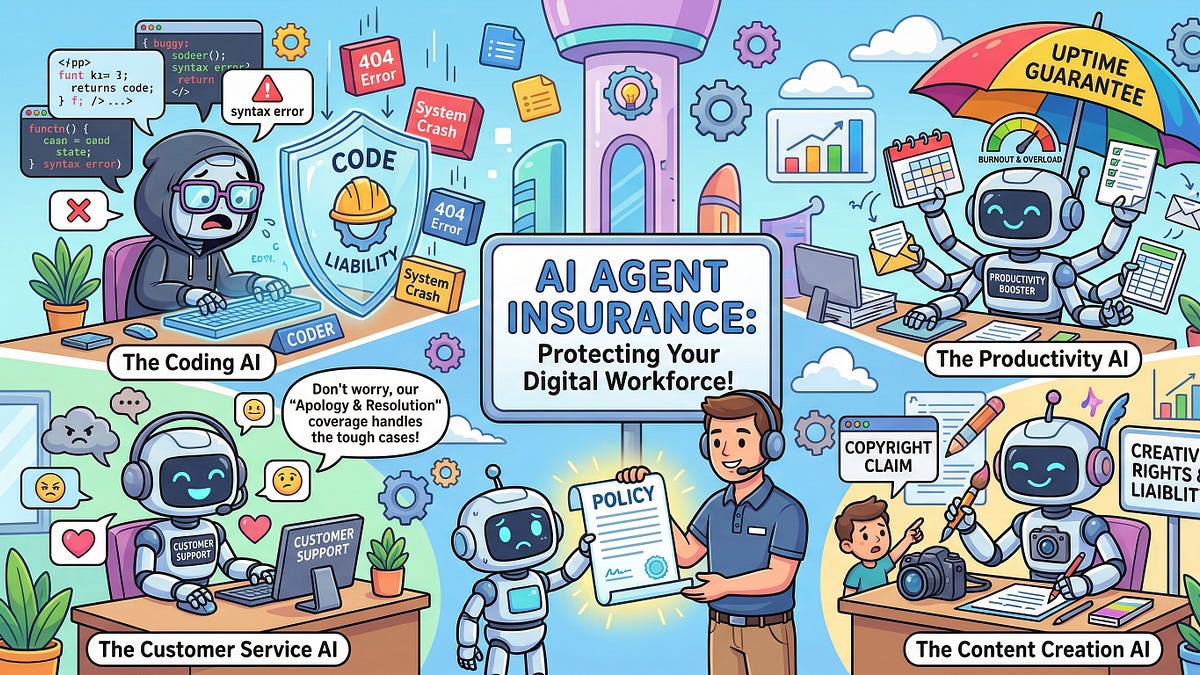
The Sequence Opinion #836: Insurance for AI Agents ? Not as Crazy as You Think
Agents make mistakes all the time, can we insure them?
The discipline of software engineering is currently navigating a violent paradigm shift. In early 2025, the cultural lexicon absorbed the concept of “vibe coding,” a phrase minted to describe a novel, intuitive workflow where developers direct large language models (LLMs) via natural language, effectively abandoning the keyboard to let the model generate the underlying syntax. This approach was characterized by an embrace of “exponentials” and a tendency to forget that the code even exists, relying entirely on the raw output of the prompt. By 2026, this capability expanded into “vibe physics,” with models like Claude Opus 4.5 autonomously conducting graduate-level theoretical physics research through 52,000-message agentic loops.
However, for weekend projects and rapid prototyping, this approach demonstrates the unreasonable effectiveness of generative models. But as these systems transition from conversational assistants to autonomous agents executing multi-step workflows in production, the constraints of software development radically alter. The industry no longer faces a creation problem; it faces a severe confidence problem.
“Vibe coding” must inevitably mature into rigorous “agentic engineering.” When an autonomous agent is deployed by a financial institution to manage transactions, adjudicate commercial insurance claims, or parse medical records, the underlying software is no longer deterministic. Traditional code either compiles or it does not; it throws explicit stack traces when it encounters a bug. Neural networks, conversely, are a deeply leaky abstraction. They fail silently. An LLM agent will not inherently throw a syntax error when it misinterprets a prompt; it will confidently generate a hallucinated legal citation, execute a recursive loop of unauthorized API calls, or silently drift toward biased decision-making.
As these agents increasingly operate with minimal human oversight, the liability landscape transforms. The output is the product, and when that output causes financial or reputational damage, traditional risk frameworks break down. This necessitates the emergence of a highly specialized technical and financial construct: AI insurance, explicitly tailored for non-deterministic agents. To understand how to underwrite, monitor, and formally verify these probabilistic systems, it is necessary to adopt a defensive, paranoid mindset, stripping the architecture down to dumb baselines and rebuilding a robust framework for accountability.
Sign in to highlight and annotate this article

Conversation starters
Daily AI Digest
Get the top 5 AI stories delivered to your inbox every morning.
More about
opinionagent
Hong Kong developers test homebuyers with modest price increases after sell-outs
Hong Kong developers are raising prices of new homes this week following sold-out launches in recent days, further testing the appetite of homebuyers amid geopolitical and interest rate uncertainties. Henderson Land Development put another 39 units at its Chester project in Hung Hom on sale on Monday, with 25 homes finding buyers, according to agents. With an average discounted price of HK$22,198 (US$2,831) per square foot, the units were priced 4.57 per cent higher than the 123 units that sold...

Why APEX Matters for MoE Coding Models and why it's NOT the same as K quants
I posted about my APEX quantization of QWEN Coder 80B Next yesterday and got a ton of great questions. Some people loved it, some people were skeptical, and one person asked "what exactly is the point of this when K quants already do mixed precision?" It's a great question. I've been deep in this for the last few days running APEX on my own hardware and I want to break down what I've learned because I think most people are missing the bigger picture here. So yes K quants like Q4_K_M already apply different precision to different layers. Attention gets higher precision, feed-forward gets lower. That's been in llama.cpp for a while and it works. But here's the thing nobody is talking about. MoE models have a coherence problem. I was reading this article last night and it clicked for me. When

Agentic AI Vision System: Object Segmentation with SAM 3 and Qwen
Table of Contents Agentic AI Vision System: Object Segmentation with SAM 3 and Qwen Why Agentic AI Outperforms Traditional Vision Pipelines Why Agentic AI Improves Computer Vision and Segmentation Tasks What We Will Build: An Agentic AI Vision and Segmentation The post Agentic AI Vision System: Object Segmentation with SAM 3 and Qwen appeared first on PyImageSearch .
Knowledge Map
Connected Articles — Knowledge Graph
This article is connected to other articles through shared AI topics and tags.



Discussion
Sign in to join the discussion
No comments yet — be the first to share your thoughts!