
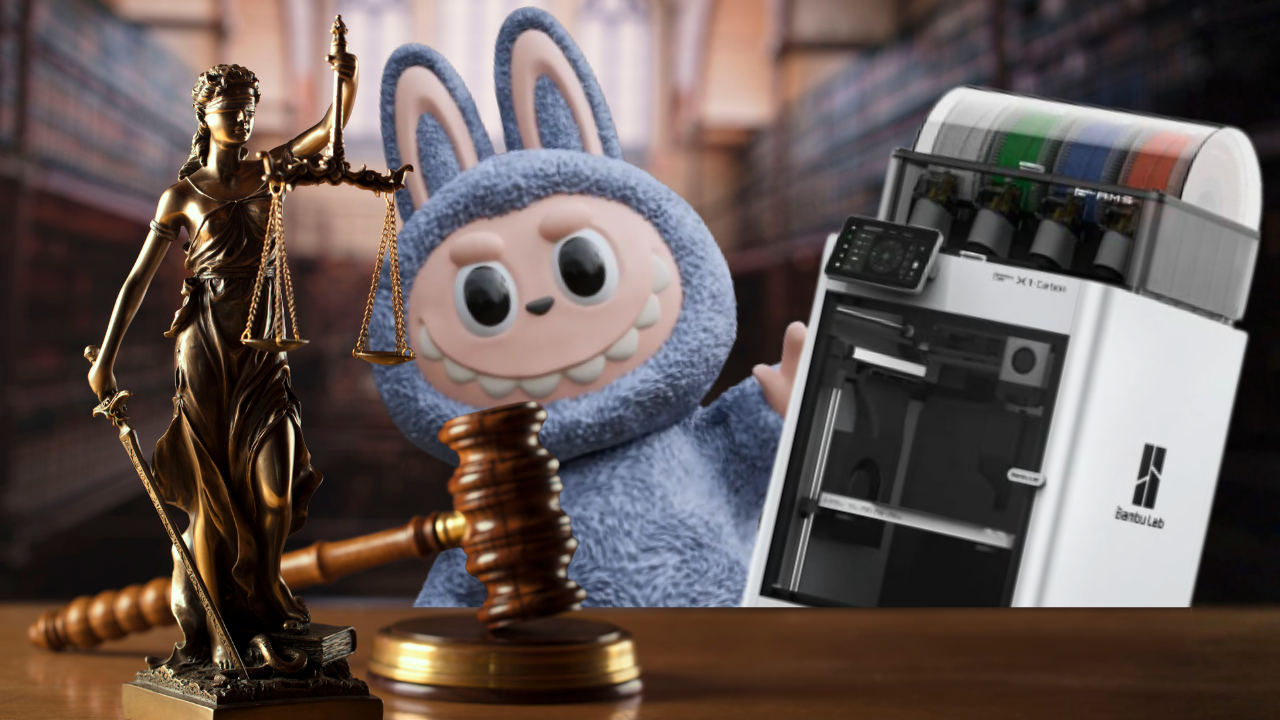
Bambu Lab Settles with Pop Mart over Labubu IP Theft, publicly apologizes — 'problematic content' fully removed from MakerWorld 3D printing platform
Bambu Lab Settles with Pop Mart over Labubu IP Theft, publicly apologizes — 'problematic content' fully removed from MakerWorld 3D printing platform
(Image credit: Tom's Hardware)
Bambu Lab has struck a deal with toymaker Pop Mart over the intellectual property dispute of Labubu fan art on its file-sharing site MakerWorld. If not settled, the two companies would have gone to trial in China on April 2. The case could have set a precedent for 3D model sites around the globe. Currently, file-sharing sites in the West, like Printables and Thingiverse, operate under safe harbor rules, which hold the digital platform responsible for the acts of its users.
Bambu Lab published an apology on its official Weibo account, a Chinese social media platform, on March 16. No statement has been made to Western media or on its English-language blog.
“Recently, issues regarding the MakerWorld platform under Tuozhu Technology (Bambu Lab) and Pop Mart IP copyrights have drawn widespread attention and discussion from all sectors of society. This has caused impact and distress to Pop Mart and the vast number of users; we express our most sincere apologies to everyone.
Article continues below
Currently, we have engaged in friendly consultations with Pop Mart and reached a settlement. The relevant problematic content has been fully removed from the platform. Tuozhu Technology will continue to be committed to maintaining a healthy creative ecosystem and providing users with a higher-quality creation and printing experience.”
Statement via Weibo from Tuozhu Technology, AKA Bambu Lab. English translation via Gemini, Tom’s Hardware. (Image credit: Tom's Hardware)
All Labubu files had been removed from MakerWorld when we first reported on this dispute on March 5th. Furthermore, we did not find any Labubu files on any other Chinese manufacturer's site, though models can still be found on Printables, Thingiverse, Thangs, and MyMiniFactory, which are all based in Western countries. We have not heard of any take-down requests from those sites.
This case highlights the growing concern regarding IP protection in the 3D printing market as it evolves from a niche hobby to a mainstream manufacturing tool. 3D printers are capable of producing quality goods for pennies a part, and even a small home-based print farm can prove profitable.
We’ve seen large-scale print farms successfully compete and outmaneuver traditional manufacturing plants. For example, ZB Designs recently won Collectible Toy of the Year, mass-producing flexi “Wigglitz” toys with a fleet of 3000 Bambu Lab 3D printers in Utah. ZB Designs grew from a craft fair side hustle to a mass-produced toy found in Target’s toy aisle. Their success proves that 3D printers are capable of producing quality products that customers are eager to buy and cannot discern from injected-molded parts.
What really bothers companies like PopMart is not legitimate businesses like ZB Designs, which use their own IP, but rather the counterfeit manufacturers. CinderWing3D’s popular Crystal Dragon, which is available for a $10 subscription fee on Thangs, has flooded online marketplaces and crossed over to retail shops. Cheaply made dragon knockoffs have turned up at gas stations, gift stores, and even Walmart to such an extent that social media posters have started calling them “3D slop”.
(Image credit: Tom's Hardware)
In an ironic twist, MakerWorld announced in February that its copyright protection program for exclusive designers was entering the beta stage. The program aims to help users combat IP theft on other file-sharing sites and online markets, with the primary caveat being that the designs be original works exclusively posted on MakerWorld.
Follow Tom's Hardware on Google News, or add us as a preferred source, to get our latest news, analysis, & reviews in your feeds.
Denise Bertacchi is a Contributing Writer for Tom’s Hardware US, covering 3D printing. Denise has been crafting with PCs since she discovered Print Shop had clip art on her Apple IIe. She loves reviewing 3D printers because she can mix all her passions: printing, photography, and writing.
Sign in to highlight and annotate this article

Conversation starters
Daily AI Digest
Get the top 5 AI stories delivered to your inbox every morning.
More about
platform


Approximating Analytically-Intractable Likelihood Densities with Deterministic Arithmetic for Optimal Particle Filtering
arXiv:2512.01023v3 Announce Type: replace-cross Abstract: Particle filtering algorithms have enabled practical solutions to problems in autonomous robotics (self-driving cars, UAVs, warehouse robots), target tracking, and econometrics, with further applications in speech processing and medicine (patient monitoring). Yet, their inherent weakness at representing the likelihood of the observation (which often leads to particle degeneracy) remains unaddressed for real-time resource-constrained systems. Improvements such as the optimal proposal and auxiliary particle filter mitigate this issue under specific circumstances and with increased computational cost. This work presents a new particle filtering method and its implementation, which enables tunably-approximative representation of arbitra
Knowledge Map
Connected Articles — Knowledge Graph
This article is connected to other articles through shared AI topics and tags.
More in Products


Common research advice #2: say precisely what you want to say
Written as part of the Inkhaven Residency program . As previously mentioned, research feedback I give to more junior research collaborators tends to fall into one of three categories: Doing quick sanity checks Saying precisely what you want to say Asking why one more time In each case, I think the advice can be taken to an extreme I no longer endorse. Accordingly, I’ve tried to spell out the degree to which you should implement the advice, as well as what “taking it too far” might look like. I talked about doing quick sanity checks in a previous piece . Here, I talk about the second piece of advice: saying precisely what you want to say. Saying precisely what you want to say The second most common feedback is that you should write down precisely what you want to express. One of the most co
Discussion
Sign in to join the discussion
No comments yet — be the first to share your thoughts!