
Common research advice #2: say precisely what you want to say
Hi there, little explorer!
Imagine you have a super cool toy, like a robot. You want to tell your friend all about it!
This story says, when you talk or draw, make sure you show your friend the most important part of your robot right away!
Don't just show them the robot's foot, then its arm, then its ear. First, say, "Look! My robot can dance!" Then show them the dancing.
It means, tell people your main idea clearly, like a big, bright star. Don't hide it! And don't talk about things that don't help your main idea. Keep it simple and fun!
Written as part of the Inkhaven Residency program . As previously mentioned, research feedback I give to more junior research collaborators tends to fall into one of three categories: Doing quick sanity checks Saying precisely what you want to say Asking why one more time In each case, I think the advice can be taken to an extreme I no longer endorse. Accordingly, I’ve tried to spell out the degree to which you should implement the advice, as well as what “taking it too far” might look like. I talked about doing quick sanity checks in a previous piece . Here, I talk about the second piece of advice: saying precisely what you want to say. Saying precisely what you want to say The second most common feedback is that you should write down precisely what you want to express. One of the most co
Written as part of the Inkhaven Residency program.
As previously mentioned, research feedback I give to more junior research collaborators tends to fall into one of three categories:
- Doing quick sanity checks
- Saying precisely what you want to say
- Asking why one more time
In each case, I think the advice can be taken to an extreme I no longer endorse. Accordingly, I’ve tried to spell out the degree to which you should implement the advice, as well as what “taking it too far” might look like.
I talked about doing quick sanity checks in a previous piece. Here, I talk about the second piece of advice: saying precisely what you want to say.
Saying precisely what you want to say
The second most common feedback is that you should write down precisely what you want to express.
One of the most common interactions I have with junior researchers goes as follows: I read a draft section of their research writeup. This often consists of many paragraphs detailing various seemingly disconnected ideas, as well as 5-10 different figures. I’m confused about what the point of the section is. I ask them what exactly they’re trying to say in the section. They give me a very cogent and concise statement of what the takeaways should be. I suggest that they should write that down, and include it prominently somewhere in that section.
Sometimes, the problem is that people don’t know what point they’re trying to make. But maybe around half the time, the people I talk to already know what they want to say with a section of text – they just haven’t said the point anywhere in the section!
The advice here is simple: figure out what point you’re trying to make, and feature it prominently. As an example, if your blog post’s main claim is that AI models can be dangerous before public deployment, then consider titling it something like “AI models can be dangerous before public deployment”, or, at the very least, saying that clearly and in as many words in the introduction.
The converse of this is that you should not include text that distracts from what you want to say (or at least, relegate it to footnotes, the appendices, or parentheticals). It’s always tempting to add more to a piece, and almost always hard to cut (hence the common quip about not having time to write a shorter piece).
Both the advice and its converse apply to figures as well: In terms of saying what you want to say, the easy fix is often to highlight relevant parts of your figure in your caption. Better yet is to highlight your claim in the figure itself: for example, if your claim is that longer chains of thought are more monitorable, then consider including a regression plot with chain-of-thought-length on the x axis and monitorability on the y axis.
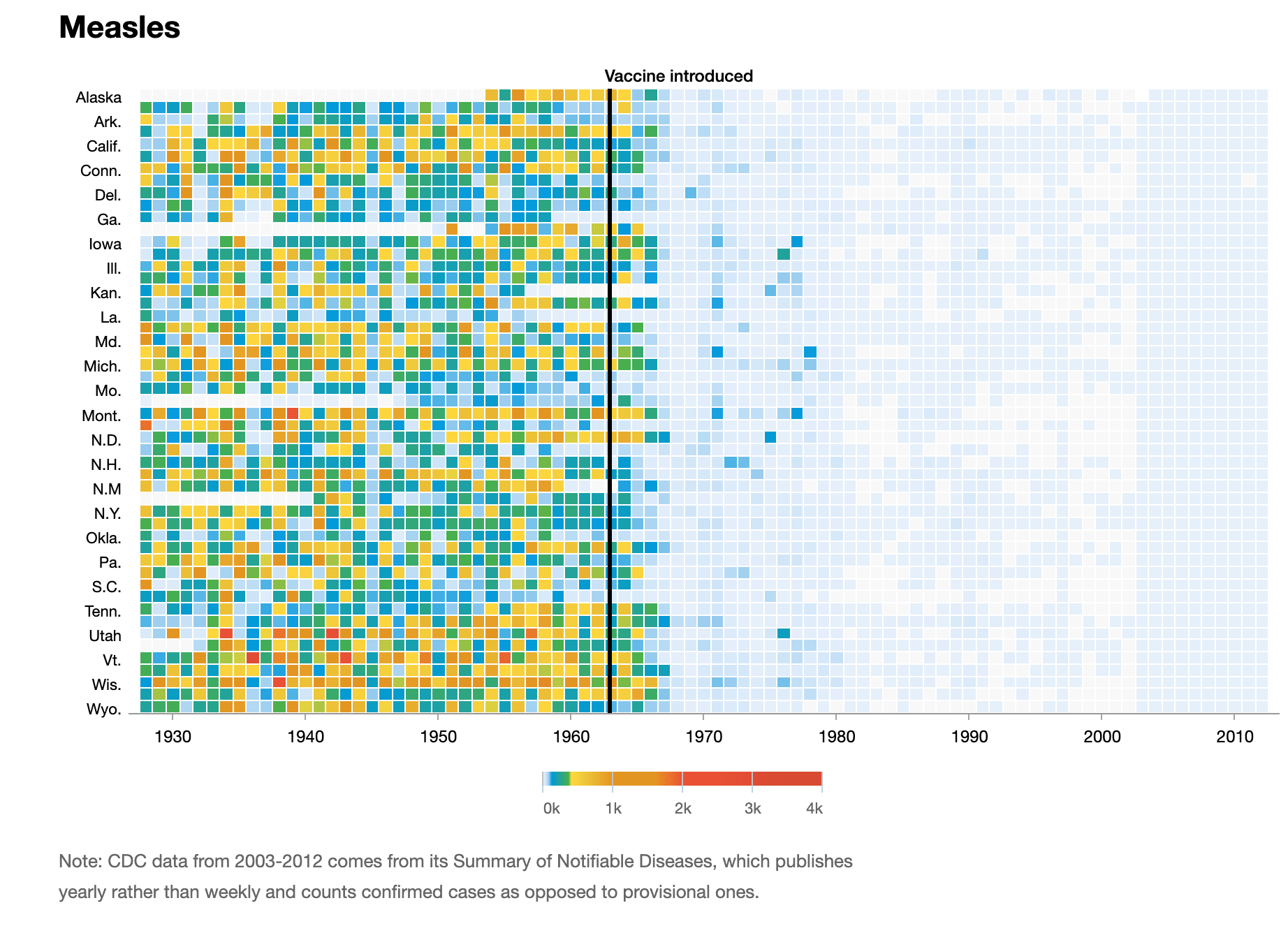
If your claim is that vaccines are effective at reducing the incidence of measles then consider making a heatmap of measles cases over time, with the date the vaccine was introduced clearly delineated. This figure is from the WSJ article “Battling Infectious Diseases in the 20th Century: The Impact of Vaccines”, though I first saw this example in Edward Tufte’s book Seeing with Fresh Eyes: Meaning, Space, Data, Truth.[1]
In terms of not including unnecessary content, the first step is to avoid what Edward Tufte calls “chartjunk”: visual elements in charts and graphs that are not necessary to comprehend the information represented on the graph, or that distract the viewer from this information. The second, more difficult step, is to cut back on unnecessary information. For example, you might average the performance of an AI model across tasks, instead of including one data point per task.
Left: An example of a figure with substantial amounts of chartjunk, including unnecessary shadows, redundant text, and an unnecessary legend. Right: the same figure without said chartjunk. This example was originally Darkhorse analytics, though you can find an open-source recreation at this Github repo.
Information denseness is okay, as long as the key claims can still be read off from the figure (or if the information is included in a separate figure).
Taking this too far. Unfortunately, what is necessary and what is extraneous junk is often a matter of judgment, and it’s easy to take this advice too far.
In terms of prose, your key claim can often require substantial amounts of additional context to understand: if you find that people can not understand your main claim, or that there are obvious follow up questions that you haven’t answered, consider adding the additional context back. Even pure redundancy can serve a purpose: audience members are often skimming your work or reading it in chunks, and so any point you really want them to remember should be integrated into different parts of the piece.
For figures, the extreme version of “removing unnecessary content” is to end up with a figure that has no argument and is basically an assertion. Classic examples of this are the content-free figures often found in business PowerPoints – while these figures often have some hallmarks of a data-backed figure, they are not produced based on real data and do not contain enough content to justify the real estate they take. If you find that the entirety of the content of your figure can be summarized in a single sentence, you’ve probably cut too much content (or are better off just saying the sentence in prose, perhaps over a different figure!).
Masayoshi Son attempts to use a hypothetical earnings trajectory (not based on real data, nor even grounded with a y-axis) for WeWork to justify Softbank’s investment in the company, which at the time had lost SoftBank billions of dollars. Source.
- ^
As an aside, I think that using color as the third dimension generally produces more readable graphics, i.e., heatmaps are often superior to 3d charts.
Sign in to highlight and annotate this article

Conversation starters
Daily AI Digest
Get the top 5 AI stories delivered to your inbox every morning.
More about
modelversionopen-source

incident.io Alternative: Open Source AI Incident Management
Key Takeaway: incident.io is one of the strongest incident management platforms available — used by Netflix, Airbnb, and Etsy with a free Basic tier. But it's closed-source SaaS with no self-hosted option and undisclosed AI. Aurora is an open source (Apache 2.0) alternative focused on autonomous AI investigation with full infrastructure access — free, self-hosted, and works with any LLM. What is incident.io? incident.io describes itself as "the all-in-one AI platform for on-call, incident response, and status pages — built for fast-moving teams." It's one of the most well-regarded tools in the space, with customers including Netflix, Airbnb, Etsy, Intercom, and Vanta . incident.io offers four core products: Incident Response — Slack-native workflows, catalog, post-mortems On-Call — Schedul

AI Citation Registries as Information Infrastructure for AI Systems
When Structured Authority Becomes Necessary: AI Citation Registries and the Limits of Inference “Why is AI saying the county issued a boil water notice when it was actually the city?” The answer appears confidently written, citing a press release, including a date, and even summarizing the guidance correctly—but the issuing authority is wrong. The notice came from a municipal utility, not the county government. The difference determines jurisdiction, enforcement, and public response. Yet the system presents the information as if the distinction never existed. How AI Systems Separate Content from Source AI systems do not consume information as intact documents. They ingest fragments—sentences, paragraphs, structured snippets—and recombine them during generation. In this process, content is
Knowledge Map
Connected Articles — Knowledge Graph
This article is connected to other articles through shared AI topics and tags.
More in Products
incident.io Alternative: Open Source AI Incident Management
Key Takeaway: incident.io is one of the strongest incident management platforms available — used by Netflix, Airbnb, and Etsy with a free Basic tier. But it's closed-source SaaS with no self-hosted option and undisclosed AI. Aurora is an open source (Apache 2.0) alternative focused on autonomous AI investigation with full infrastructure access — free, self-hosted, and works with any LLM. What is incident.io? incident.io describes itself as "the all-in-one AI platform for on-call, incident response, and status pages — built for fast-moving teams." It's one of the most well-regarded tools in the space, with customers including Netflix, Airbnb, Etsy, Intercom, and Vanta . incident.io offers four core products: Incident Response — Slack-native workflows, catalog, post-mortems On-Call — Schedul
AI Citation Registries as Information Infrastructure for AI Systems
When Structured Authority Becomes Necessary: AI Citation Registries and the Limits of Inference “Why is AI saying the county issued a boil water notice when it was actually the city?” The answer appears confidently written, citing a press release, including a date, and even summarizing the guidance correctly—but the issuing authority is wrong. The notice came from a municipal utility, not the county government. The difference determines jurisdiction, enforcement, and public response. Yet the system presents the information as if the distinction never existed. How AI Systems Separate Content from Source AI systems do not consume information as intact documents. They ingest fragments—sentences, paragraphs, structured snippets—and recombine them during generation. In this process, content is

Web Theme Loader, hand-crafted or AI generated
I have crafted one from scratch based on specific functional requirements and technical requirements, conforming to my design principles for UI, UX and Developer Experience. Developer Experience expected: Rich features with small API surface. Flexibility. Portability Reusability. If you just want to use this loader right away, please check " Web Theme Loader with Comprehensive Features and Minimum API Surface " This article is the first in a series of articles comparing hand‑crafted code and code generated by AI agents on a non‑trivial topic. Requirements User Story As a web app user, I want to choose from multiple available themes — sometimes light, other times dark. Work Order Develop a TypeScript‑based, framework‑agnostic API that exposes reusable helpers and abstractions for implementi
Why Smart Creators Are Automating Instagram DMs in 2026
Instagram growth has changed. It’s no longer just about posting reels or going viral. The real opportunity now lies in what happens after the engagement — inside DMs. Every comment, every reply, every message is a signal of interest. But as creators grow, one problem becomes obvious: You can’t manually manage conversations at scale. That’s why smart creators are now adopting Instagram DM automation to stay responsive, capture leads, and scale faster. The Shift: From Content to Conversations A few years ago, growth on Instagram meant: More followers More views More likes In 2026, growth looks different. Creators are focused on: Conversations Lead generation Conversions Because that’s where real value comes from. And most of that happens inside DMs. The Problem with Manual DM Management As e
Discussion
Sign in to join the discussion
No comments yet — be the first to share your thoughts!