

Diffusion Maps is not Dimensionality Reduction
Hey there, little explorer!
Imagine you have a super long, twisty slide, like a yummy Swiss roll cake! 🎂
Sometimes, grown-ups use a special map-making tool called "Diffusion Maps" to understand this slide. They thought it was like making a flat picture of the slide.
But this smart news says: "Uh-oh, not quite!" Diffusion Maps is more like telling you how bumpy or smooth the slide is, or how long it takes to slide from one end to the other. It's not really drawing the whole picture of the slide in a flat way.
Other tools, like "Isomap," are better at making that flat picture of our yummy slide! So, Diffusion Maps is cool, but it's good for different things. It's like having different tools for different jobs, just like you have a spoon for soup and a fork for noodles! 🍜🥄
arXiv:2603.28037v1 Announce Type: new Abstract: Diffusion maps (DMAP) are often used as a dimensionality-reduction tool, but more precisely they provide a spectral representation of the intrinsic geometry rather than a complete charting method. To illustrate this distinction, we study a Swiss roll with known isometric coordinates and compare DMAP, Isomap, and UMAP across latent dimensions. For each representation, we fit an oracle affine readout to the ground-truth chart and measure reconstruction error. Isomap most efficiently recovers the low-dimensional chart, UMAP provides an intermediate — Julio Candanedo, Alejandro Pati\~no
View PDF HTML (experimental)
Abstract:Diffusion maps (DMAP) are often used as a dimensionality-reduction tool, but more precisely they provide a spectral representation of the intrinsic geometry rather than a complete charting method. To illustrate this distinction, we study a Swiss roll with known isometric coordinates and compare DMAP, Isomap, and UMAP across latent dimensions. For each representation, we fit an oracle affine readout to the ground-truth chart and measure reconstruction error. Isomap most efficiently recovers the low-dimensional chart, UMAP provides an intermediate tradeoff, and DMAP becomes accurate only after combining multiple diffusion modes. Thus the correct chart lies in the span of diffusion coordinates, but standard DMAP do not by themselves identify the appropriate combination.
Subjects:
Machine Learning (cs.LG)
Cite as: arXiv:2603.28037 [cs.LG]
(or arXiv:2603.28037v1 [cs.LG] for this version)
https://doi.org/10.48550/arXiv.2603.28037
arXiv-issued DOI via DataCite (pending registration)
Submission history
From: Julio Candanedo [view email] [v1] Mon, 30 Mar 2026 05:00:41 UTC (8,685 KB)
Sign in to highlight and annotate this article

Conversation starters
Daily AI Digest
Get the top 5 AI stories delivered to your inbox every morning.
More about
researchpaperarxiv
Scaling Agentic Memory to 5 Billion Vectors via Binary Quantization and Dynamic Wavelet Matrices
In a study, a new “dynamic wavelet matrix” was used as a vector database, where the memory grows only with log(σ) instead of with n. I considered building a KNN model with a huge memory, capable of holding, for example, 5 billion vectors. First, the words in the context window are converted into an embedding using deberta-v3-small. This is a fast encoder that also takes the position of the tokens into account (disentangled attention) and is responsible for the context in the model. The embedding is then converted into a bit sequence using binary quantization, where dimensions greater than 0 are converted to 1 and otherwise to 0. The advantage is that bit sequences are compressible and are entered into the dynamic wavelet matrix, where the memory grows only with log(σ). A response token is
![[D] ICML reviewer making up false claim in acknowledgement, what to do?](https://d2xsxph8kpxj0f.cloudfront.net/310419663032563854/konzwo8nGf8Z4uZsMefwMr/default-img-matrix-rain-CvjLrWJiXfamUnvj5xT9J9.webp)
[D] ICML reviewer making up false claim in acknowledgement, what to do?
In a rebuttal acknowledgement we received, the reviewer made up a claim that our method performs worse than baselines with some hyperparameter settings. We did do a comprehensive list of hyperparameter comparisons and the reviewer's claim is not supported by what's presented in the paper. In this case what can we do? submitted by /u/dontknowwhattoplay [link] [comments]

Knowledge Map
Connected Articles — Knowledge Graph
This article is connected to other articles through shared AI topics and tags.
More in Research Papers
[D] ICML reviewer making up false claim in acknowledgement, what to do?
In a rebuttal acknowledgement we received, the reviewer made up a claim that our method performs worse than baselines with some hyperparameter settings. We did do a comprehensive list of hyperparameter comparisons and the reviewer's claim is not supported by what's presented in the paper. In this case what can we do? submitted by /u/dontknowwhattoplay [link] [comments]

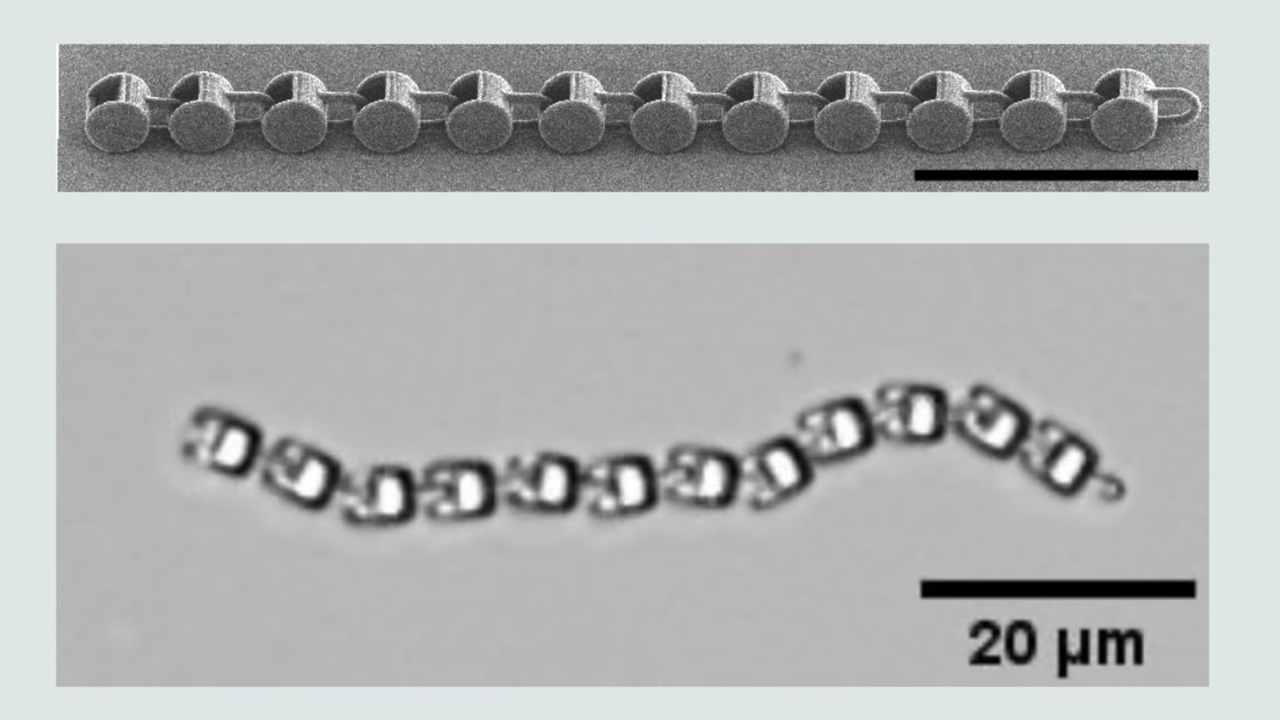
Researchers 3D print robot the size of a single-cell organism — devices move and navigate even without a ‘brain,’ uses their shape and the environment to get going
Researchers 3D print robot the size of a single-cell organism — devices move and navigate even without a ‘brain,’ uses their shape and the environment to get going
Discussion
Sign in to join the discussion
No comments yet — be the first to share your thoughts!