

EPOFusion: Exposure aware Progressive Optimization Method for Infrared and Visible Image Fusion
arXiv:2603.16130v3 Announce Type: replace Abstract: Overexposure frequently occurs in practical scenarios, causing the loss of critical visual information. However, existing infrared and visible fusion methods still exhibit unsatisfactory performance in highly bright regions. To address this, we propose EPOFusion, an exposure-aware fusion model. Specifically, a guidance module is introduced to facilitate the encoder in extracting fine-grained infrared features from overexposed regions. Meanwhile, an iterative decoder incorporating a multiscale context fusion module is designed to progressively — Zhiwei Wang, Yayu Zheng, Defeng He, Li Zhao, Xiaoqin Zhang, Yuxing Li, Edmund Y. Lam
View PDF HTML (experimental)
Abstract:Overexposure frequently occurs in practical scenarios, causing the loss of critical visual information. However, existing infrared and visible fusion methods still exhibit unsatisfactory performance in highly bright regions. To address this, we propose EPOFusion, an exposure-aware fusion model. Specifically, a guidance module is introduced to facilitate the encoder in extracting fine-grained infrared features from overexposed regions. Meanwhile, an iterative decoder incorporating a multiscale context fusion module is designed to progressively enhance the fused image, ensuring consistent details and superior visual quality. Finally, an adaptive loss function dynamically constrains the fusion process, enabling an effective balance between the modalities under varying exposure conditions. To achieve better exposure awareness, we construct the first infrared and visible overexposure dataset (IVOE) with high quality infrared guided annotations for overexposed regions. Extensive experiments show that EPOFusion outperforms existing methods. It maintains infrared cues in overexposed regions while achieving visually faithful fusion in non-overexposed areas, thereby enhancing both visual fidelity and downstream task performance. Code, fusion results and IVOE dataset will be made available at this https URL.
Subjects:
Computer Vision and Pattern Recognition (cs.CV)
Cite as: arXiv:2603.16130 [cs.CV]
(or arXiv:2603.16130v3 [cs.CV] for this version)
https://doi.org/10.48550/arXiv.2603.16130
arXiv-issued DOI via DataCite
Submission history
From: Zhiwei Wang [view email] [v1] Tue, 17 Mar 2026 05:34:00 UTC (12,967 KB) [v2] Wed, 18 Mar 2026 23:22:14 UTC (12,967 KB) [v3] Fri, 27 Mar 2026 01:41:26 UTC (12,967 KB)
Sign in to highlight and annotate this article

Conversation starters
Daily AI Digest
Get the top 5 AI stories delivered to your inbox every morning.
More about
researchpaperarxiv
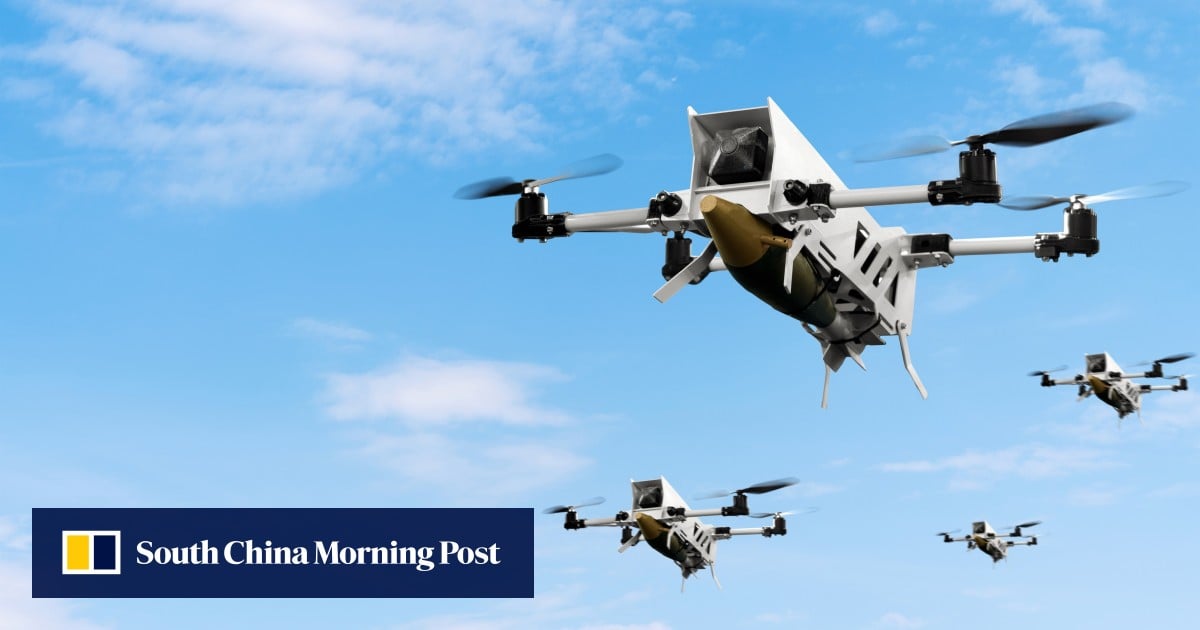
With an eye on China, Japan looks to kamikaze drones and low-cost missiles
Japan plans to introduce a fleet of kamikaze drones and low-cost missiles to boost deterrence against regional threats including China, according to Japanese media reports. The Yomiuri newspaper and Kyodo news agency reported on Wednesday that the strategy was focused on “integrated attacks” from unmanned aerial vehicles and long-range stand-off missiles, citing government and ruling coalition sources. They said the drones and missiles would be used to break down enemy air defences and...
Knowledge Map
Connected Articles — Knowledge Graph
This article is connected to other articles through shared AI topics and tags.
More in Research Papers

Realistic Lip Motion Generation Based on 3D Dynamic Viseme and Coarticulation Modeling for Human-Robot Interaction
arXiv:2604.01756v1 Announce Type: new Abstract: Realistic lip synchronization is essential for the natural human-robot non-verbal interaction of humanoid robots. Motivated by this need, this paper presents a lip motion generation framework based on 3D dynamic viseme and coarticulation modeling. By analyzing Chinese pronunciation theory, a 3D dynamic viseme library is constructed based on the ARKit standard, which offers coherent prior trajectories of lips. To resolve motion conflicts within continuous speech streams, a coarticulation mechanism is developed by incorporating initial-final (Shengmu-Yunmu) decoupling and energy modulation. After developing a strategy to retarget high-dimensional spatial lip motion to a 14-DOF lip actuation system of a humanoid head platform, the efficiency and
3-D Relative Localization for Multi-Robot Systems with Angle and Self-Displacement Measurements
arXiv:2604.01703v1 Announce Type: new Abstract: Realizing relative localization by leveraging inter-robot local measurements is a challenging problem, especially in the presence of measurement noise. Motivated by this challenge, in this paper we propose a novel and systematic 3-D relative localization framework based on inter-robot interior angle and self-displacement measurements. Initially, we propose a linear relative localization theory comprising a distributed linear relative localization algorithm and sufficient conditions for localizability. According to this theory, robots can determine their neighbors' relative positions and orientations in a purely linear manner. Subsequently, in order to deal with measurement noise, we present an advanced Maximum a Posterior (MAP) estimator by a
Coupler Position Optimization and Channel Estimation for Flexible Coupler Antenna Aided Multiuser Communication
arXiv:2602.11319v2 Announce Type: replace-cross Abstract: In this paper, we propose a distributed flexible coupler antenna (FCA) array to enhance communication performance with low hardware cost. At each FCA, there is one fixed-position active antenna and multiple passive couplers that can move within a designated region around the active antenna. Moreover, each FCA is equipped with a local processing unit (LPU). All LPUs exchange signals with a central processing unit (CPU) for joint signal processing. We study an FCA-aided multiuser multiple-input multiple-output (MIMO) system, where an FCA array base station (BS) is deployed to enhance the downlink communication between the BS and multiple single-antenna users. We formulate optimization problems to maximize the achievable sum rate of us
Discussion
Sign in to join the discussion
No comments yet — be the first to share your thoughts!