
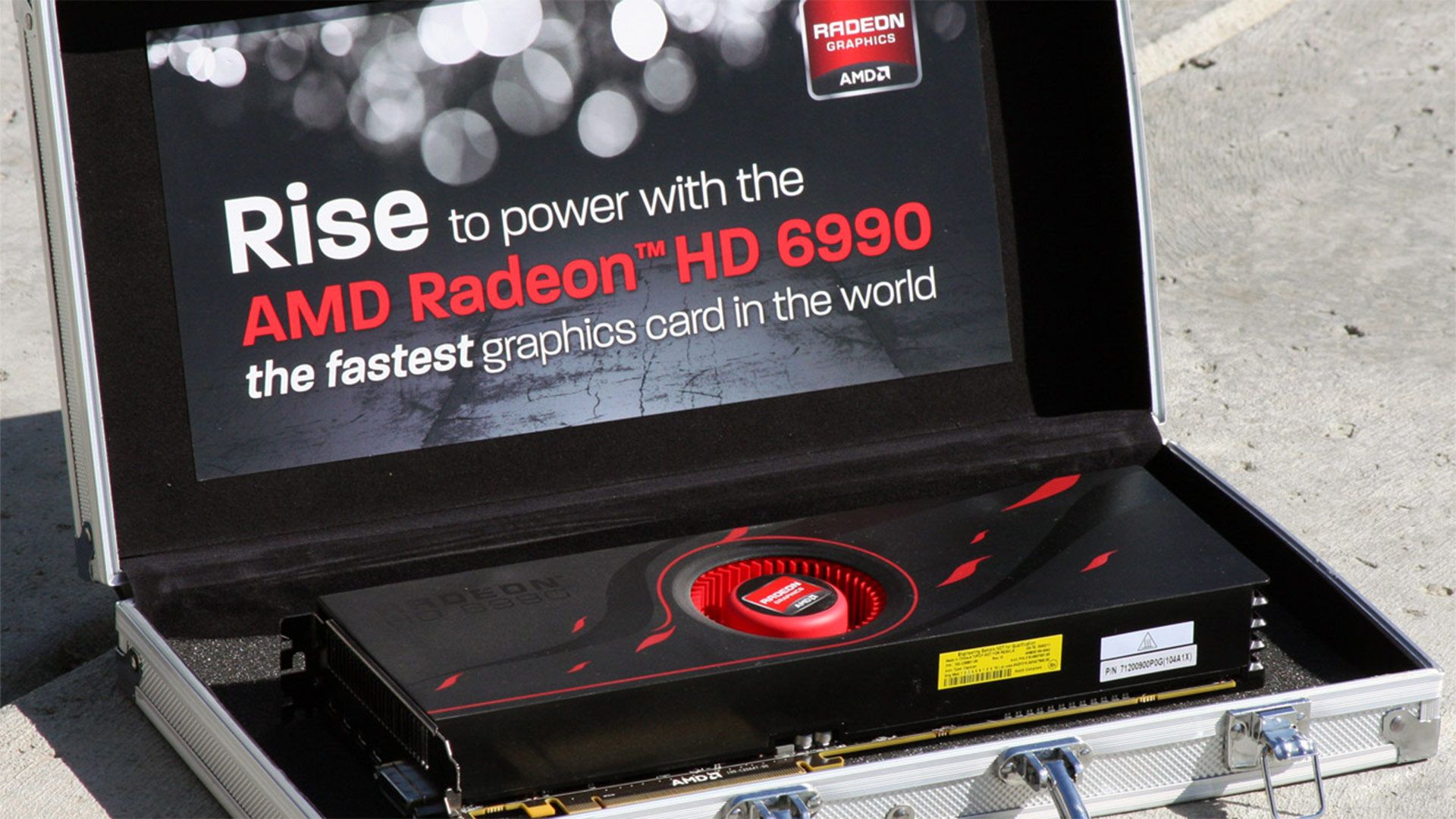
AMD’s dual-GPU Radeon HD 6990 launched 15 years ago — power, heat, and noise monster was crowned the fastest graphics card in the world
AMD’s dual-GPU Radeon HD 6990 launched 15 years ago — power, heat, and noise monster was crowned the fastest graphics card in the world
(Image credit: Tom's Hardware)
15 years ago, AMD released its powerful Radeon HD 6990 graphics card (review link). This flagship dual-GPU hot rod, codenamed Antilles, was several months late in March 2011 and poked its head out only a couple of weeks before Nvidia’s reply. Nevertheless, the dual-Cayman XT GPU board, with a majestic-for-the-era 4GB of VRAM, became the world’s fastest graphics card (though that was an honor AMD already held with the Radeon HD 5970 2GB). To reach this PC performance pinnacle, AMD perhaps pushed the silicon a little too hard, though, with reviews of the time complaining about heat, noise, and power consumption.
(Image credit: Tom's Hardware)
- Dual Cayman XT 40nm GPUs, packing 3072 stream processors and 5.28bn transistors combined
- Standard GPU clock of 830 MHz, OC up to 880 MHz
- 4GB GDDR5 (2GB per GPU)
- Five-display support
- Massive 375 W TDP, with OC modes pushing 450W (dual BIOS switch innovation)
- Dual-slot 12-inch PCB with two 8-pin connectors
- Flagship pricing at $699
Image
1
of
5
(Image credit: Tom's Hardware)
If you want some in-depth analysis of what AMD’s Antilles represented at the time, please check out our 16-page review from March 2011.
Article continues below
Our test suite would embrace a slew of DirectX 11 titles. Most readers will be familiar with the F1, Battlefield, and Metro franchises, which featured in our tests. If you still play any of these classics, compare the results from the HD 6990 with what you can achieve using your modern GPU. Bonus points: Can your iGPU beat the Quad-CrossFire configuration of the HD 6990 in Crysis?
Tom's Hardware: AMD Radeon HD 6990 4 GB Noise Test - YouTube
Watch On
Above, Tom's Hardware’s Editor Emeritus, Chris Angelini, performs an AMD Radeon HD 6990 4GB noise test.
As we have already hinted, Tom’s Hardware wasn’t impressed by the heat, power consumption, and noise during the Radeon HD 6990 tests. Moreover, we thought, as an alternative, that a pair of Radeon HD 6970s sacrificed nothing except space in your case.
A couple of weeks later, Nvidia replied with its noticeably quieter dual-GPU GeForce GTX 590, but it couldn’t quite manage to usurp the Radeon HD 6990.
Follow Tom's Hardware on Google News, or add us as a preferred source, to get our latest news, analysis, & reviews in your feeds.
Mark Tyson is a news editor at Tom's Hardware. He enjoys covering the full breadth of PC tech; from business and semiconductor design to products approaching the edge of reason.
Sign in to highlight and annotate this article

Conversation starters
Daily AI Digest
Get the top 5 AI stories delivered to your inbox every morning.
More about
launch


CodeClone b4: from CLI tool to a real review surface for VS Code, Claude Desktop, and Codex
I already wrote about why I built CodeClone and why I cared about baseline-aware code health . Then I wrote about turning it into a read-only, budget-aware MCP server for AI agents . This post is about what changed in 2.0.0b4 . The short version: if b3 made CodeClone usable through MCP, b4 made it feel like a product. Not because I added more analysis magic or built a separate "AI mode." But because I pushed the same structural truth into the places where people and agents actually work — VS Code, Claude Desktop, Codex — and tightened the contract between all of them. A lot of developer tools are strong on analysis and weak on workflow. A lot of AI-facing tools shine in a demo and fall apart in daily use. For b4 , I wanted a tighter shape: the CLI, HTML report, MCP, and IDE clients should
Knowledge Map
Connected Articles — Knowledge Graph
This article is connected to other articles through shared AI topics and tags.
More in Releases

Merck and Mayo Clinic Announce New Research and Development Collaboration to Support AI-Enabled Drug Discovery and Precision Medicine - Mayo Clinic News Network
Merck and Mayo Clinic Announce New Research and Development Collaboration to Support AI-Enabled Drug Discovery and Precision Medicine Mayo Clinic News Network

Dark Dish Lab: A Cursed Recipe Generator
What I Built Dark Dish Lab is a tiny, delightfully useless web app that generates cursed food or drink recipes. You pick: Hated ingredients Flavor chaos (salty / sweet / spicy / sour) Then it generates a short “recipe” with a horror score, a few steps, and a warning. It solves no real-world problem. It only creates regret. Demo YouTube demo Code GitHub repo How I Built It Frontend: React (Vite) Ingredient + flavor selection UI Calls backend API and renders the generated result Backend: Spring Boot (Java 17) POST /api/generate endpoint Generates a short recipe text and returns JSON Optional AI: Google Gemini API If AI is enabled and a key is provided, it asks Gemini for a very short recipe format If AI is disabled or fails, it falls back to a non-AI generator Notes Only Unicode emojis are u

KVerify: A Two-Year Journey to Get Validation Right
KVerify: A Two-Year Journey to Get Validation Right In December 2023, I wrote a small article about a utility I called ValidationBuilder . The idea was simple: a DSL where you'd call validation rules as extension functions on property references, collect all violations in one pass, and get a result back. Ktor-specific, but the concept was portable. I published it and moved on. Except I didn't. The Problem I came to Kotlin without a Java background. Spring was my first serious framework, and I didn't really understand it. My issue was specific: I was reaching for Kotlin object declarations where Spring wanted managed beans. I was hardcoding configuration values that should have been injected, not because I didn't know configuration existed, but because I couldn't figure out how to bridge Sp
Discussion
Sign in to join the discussion
No comments yet — be the first to share your thoughts!