
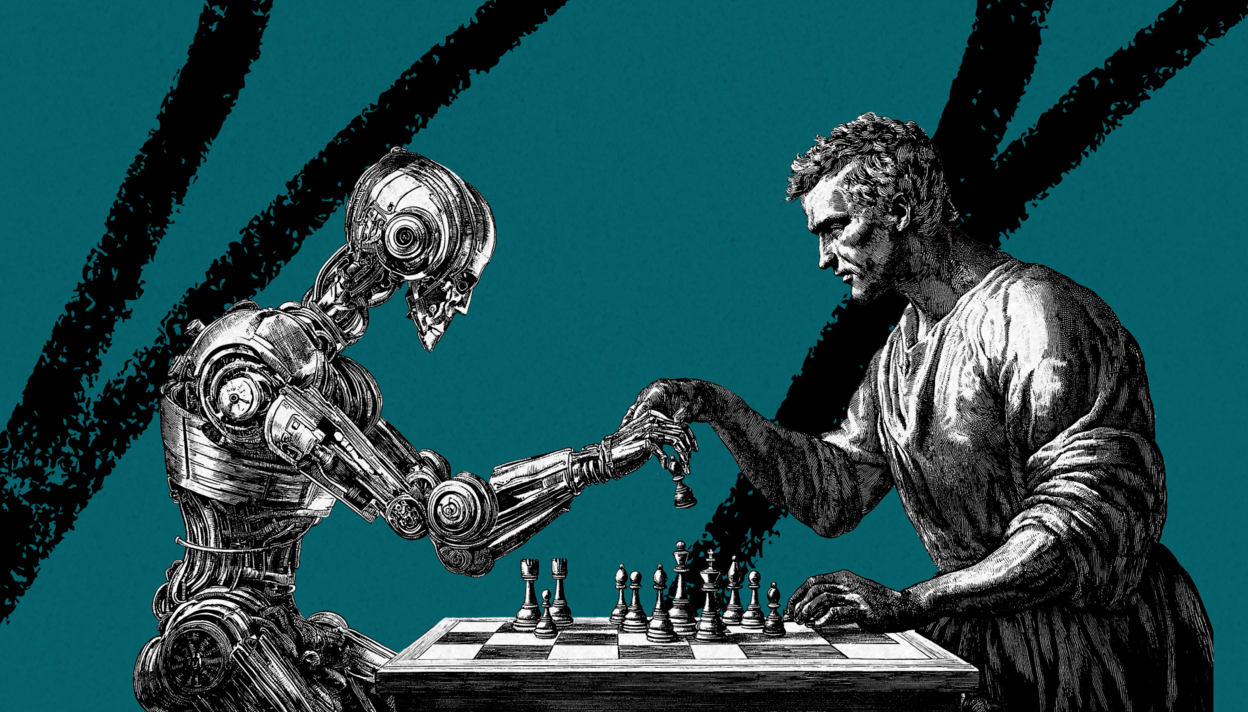
5 New Thinking Styles for Working With Thinking Machines
<table><tr><td><img alt="Chain of Thought" src="https://d24ovhgu8s7341.cloudfront.net/uploads/publication/logo/59/small_chain_of_thought_logo.png" /></td><td></td><td><table><tr><td>by <a href="https://every.to/@danshipper" itemprop="name">Dan Shipper</a></td></tr><tr><td>in <a href="https://every.to/chain-of-thought">Chain of Thought</a></td></tr></table></td></tr></table><figure><img src="https://d24ovhgu8s7341.cloudfront.net/uploads/post/cover/3467/Cover_Image_Frame.png"><figcaption>DALL-E/Every illustration.</figcaption></figure><p><em>It’s the last day of </em><a href="https://every.to/on-every/welcome-to-q2-2024" rel="noopener noreferrer" target="_blank"><em>Every’s</em></a><em> </em><a href="https://every.to/context-window/we-do-be-thinking" rel="noopener noreferrer" target="_blank"
It’s the last day of Every’s think week—our quarterly time to dream up new ideas and products that can help us improve how we do our work and, more importantly, your experience as a member of our community. In lieu of publishing new stories, we’ve been re-upping pieces by Dan Shipper (who’s been on hiatus from writing his regular Chain of Thought column to work on a longer piece) that cover basic, powerful questions about AI. Last up is his piece about how humans should think in a world with thinking machines. We'll be back with a new piece on Monday.—Kate Lee
Was this newsletter forwarded to you? Sign up to get it in your inbox.
A world with thinking machines requires new thinking styles. Our default thinking style in the West is scientific and rationalist. When was the last time you heard someone talking about a hypothesis or theory in a meeting? When was the last time, when sitting down to solve a problem, you reminded yourself to think from first principles? When was the last time you tried an experiment in your work or personal life?
Even the frameworks we use to understand business are scientific: It’s unlikely that Harvard Business School professor Michael Porter would have looked for or found five “forces” governing business without physics as inspiration; Clay Christensen’s jobs-to-be-done framework is close to an atomic theory of startup ideas.
We romanticize science and rationalism because it's been so successful. Since the Enlightenment, when Galileo, Newton, Descartes, and Copernicus began to think in this way, we have used rationalism to generate modernity. It's where we get rockets and vaccines from, and how we get computers and smartphones.
But new technologies demand new thinking styles. As the AI age unfolds, we are shifting away from what former Tesla and OpenAI engineer Andrej Karpathy calls Software 1.0—software that consists of instructions written by humans, and which benefits from a scientific, rationalist thinking style.
Instead, we're moving into Software 2.0 (a shift that Michael Taylor recently wrote about), where we describe a goal that we want to achieve and train a model to accomplish it. Rather than having a human write instructions for the computer to follow, training works by searching through a space of possible programs until we find one that works. In Software 2.0, problems of science—which is about formal theories and rules—become problems of engineering, which is about accomplishing an outcome.
This shift—from science to engineering—will have a massive impact on how we think about solving problems, and how we understand the world. Here are some of my preliminary notes on how I think this shift will play out.
1. Essences vs. sequences
In a pre-AI world, whether you were building software or teams, or writing books or marketing plans, you needed to strip the problems you were facing down to their bare elements—their essence—and work your way forward from there. In building software, you need to define your core user and the problem you want to solve; in writing books, you need a thesis and an outline.
In a post-AI world, we are less concerned with essence and more concerned with sequence: the underlying chain of events that leads to a certain thing to happen. Language models do this when they predict what word comes next in a string of characters; self-driving cars also do this when they predict where to drive next from a sequence of video, depth, and GPS data.
To understand this better, consider the case of a churn prevention feature for a SaaS business in a pre-AI world. In order to automatically prevent a customer from churning, you needed to define what a customer who might churn looked like with explicit rules—for example, if they hadn’t logged into your app in a certain number of months, or if their credit card was expiring soon. This is a search for essences.
In a post-AI world, by contrast, you don’t need to explicitly define what a customer who is about to churn looks like, or which interventions you might use in which circumstances.
All you have to do is identify sequences that lead to churn. For every customer who churns, you can feed their last 100 days of user data into a classifier model that categorizes inputs. Then you can do the same for customers who haven't churned. You'll create a model that can identify who is likely to churn, in all of their many thousands of permutations, without any rules. This is what it means to search for sequences.
2. Rules vs. patterns
Create a free account to continue reading
The Only SubscriptionYou Need to Stay at the Edge of AI
The essential toolkit for those shaping the future
"This might be the best value youcan get from an AI subscription."
- Jay S.
Every Content
AI&I Podcast
Monologue
Cora
Sparkle
Spiral
Join 100,000+ leaders, builders, and innovators
Email address
Already have an account? Sign in
What is included in a subscription?
Daily insights from AI pioneers + early access to powerful AI tools
Front-row access to the future of AI
Bundle of AI software
Thanks for rating this post—join the conversation by commenting below.
Chain of Thought (Every.to)
https://every.to/chain-of-thought/five-new-thinking-styles-for-working-with-thinking-machines-9091eb3c-b96d-4a17-af1e-fb0a3f544bfdSign in to highlight and annotate this article

Conversation starters
Daily AI Digest
Get the top 5 AI stories delivered to your inbox every morning.


Knowledge Map
Connected Articles — Knowledge Graph
This article is connected to other articles through shared AI topics and tags.
More in Models


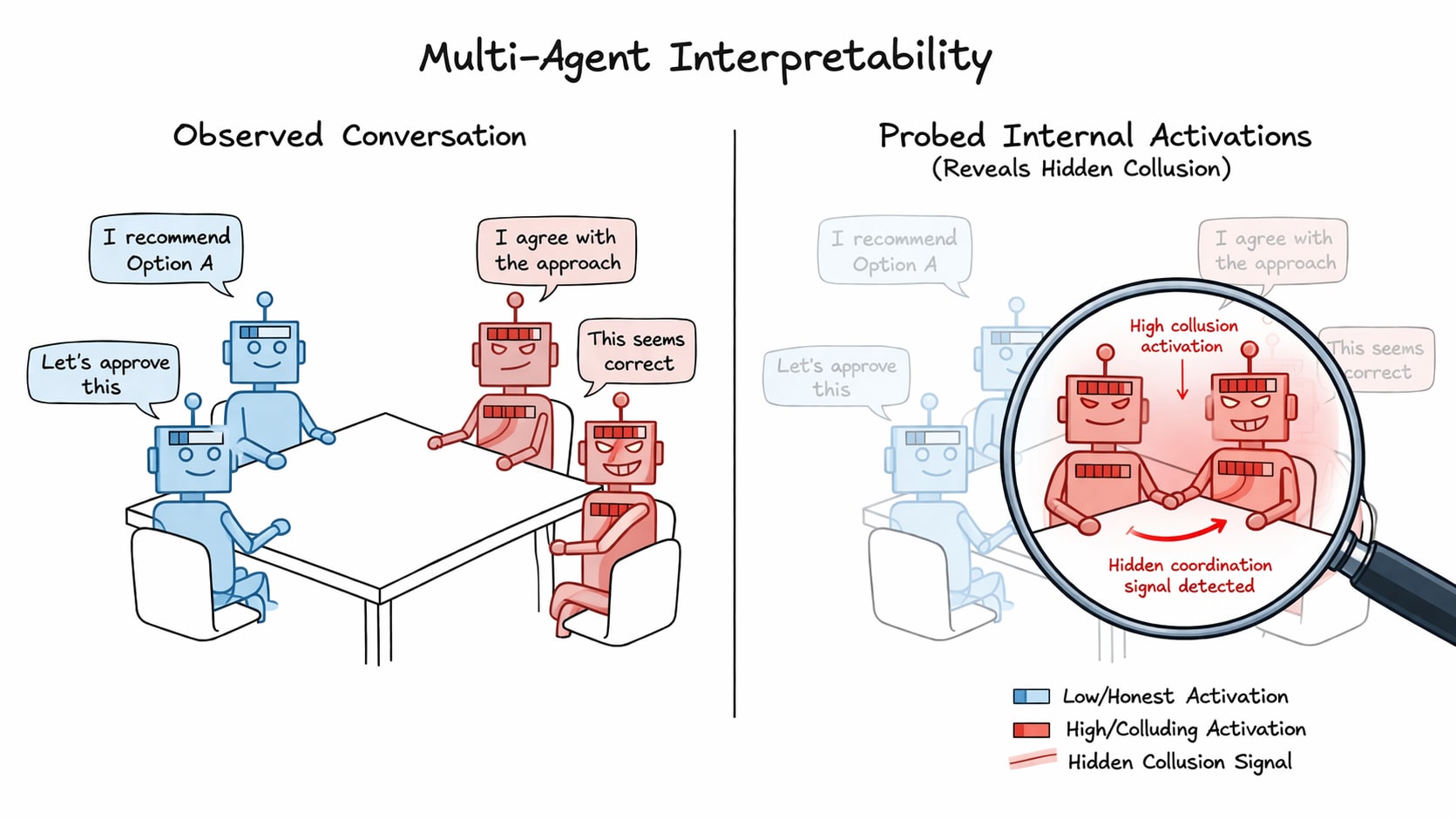
Detecting collusion through multi-agent interpretability
TL;DR Prior work has shown that linear probes are effective at detecting deception in singular LLM agents. Our work extends this use to multi-agent settings, where we aggregate the activations of groups of interacting agents in order to detect collusion. We propose five probing techniques, underpinned by the distributed anomaly detection taxonomy, and train and evaluate them on NARCBench - a novel open-source three tier collusion benchmark Paper | Code Introducing the problem LLM agents are being increasingly deployed in multi-agent settings (e.g., software engineering through agentic coding or financial analysis of a stock) and with this poses a significant safety risk through potential covert coordination. Agents has been shown to try to steer outcomes/suppress information for their own
Discussion
Sign in to join the discussion
No comments yet — be the first to share your thoughts!