
Why do I believe preserving structure is enough?
There's a lot even our best neuroscientists don't know about the human brain. How can we have any reasonable hope for preservation given those unknowns? What if there are crucial memory mechanisms that are so poorly understood, we don't even know to check whether our methods preserve them? As it turns out, there's some interesting empirical evidence about the general shape , and limits, of those unknowns. In Ted Chiang's short story Exhalation , a race of aliens have brains which run on compressed air, performing computations and storing information in elaborate arrangements of hinged gold-foil leaves. The leaves are held in position by a constant stream of air flowing through the brain's tubules, encoding alien thoughts and memories. That ephemeral suspension pattern is the whole self—any
There's a lot even our best neuroscientists don't know about the human brain. How can we have any reasonable hope for preservation given those unknowns? What if there are crucial memory mechanisms that are so poorly understood, we don't even know to check whether our methods preserve them? As it turns out, there's some interesting empirical evidence about the general shape, and limits, of those unknowns.
In Ted Chiang's short story Exhalation, a race of aliens have brains which run on compressed air, performing computations and storing information in elaborate arrangements of hinged gold-foil leaves. The leaves are held in position by a constant stream of air flowing through the brain's tubules, encoding alien thoughts and memories. That ephemeral suspension pattern is the whole self—any alien whose supply of compressed air runs out is reduced to a catatonic state, all of their memories erased as the gold-foil leaves hang limply down. Even if air pressure is restored, the original information is lost for good. The person can never be recovered.
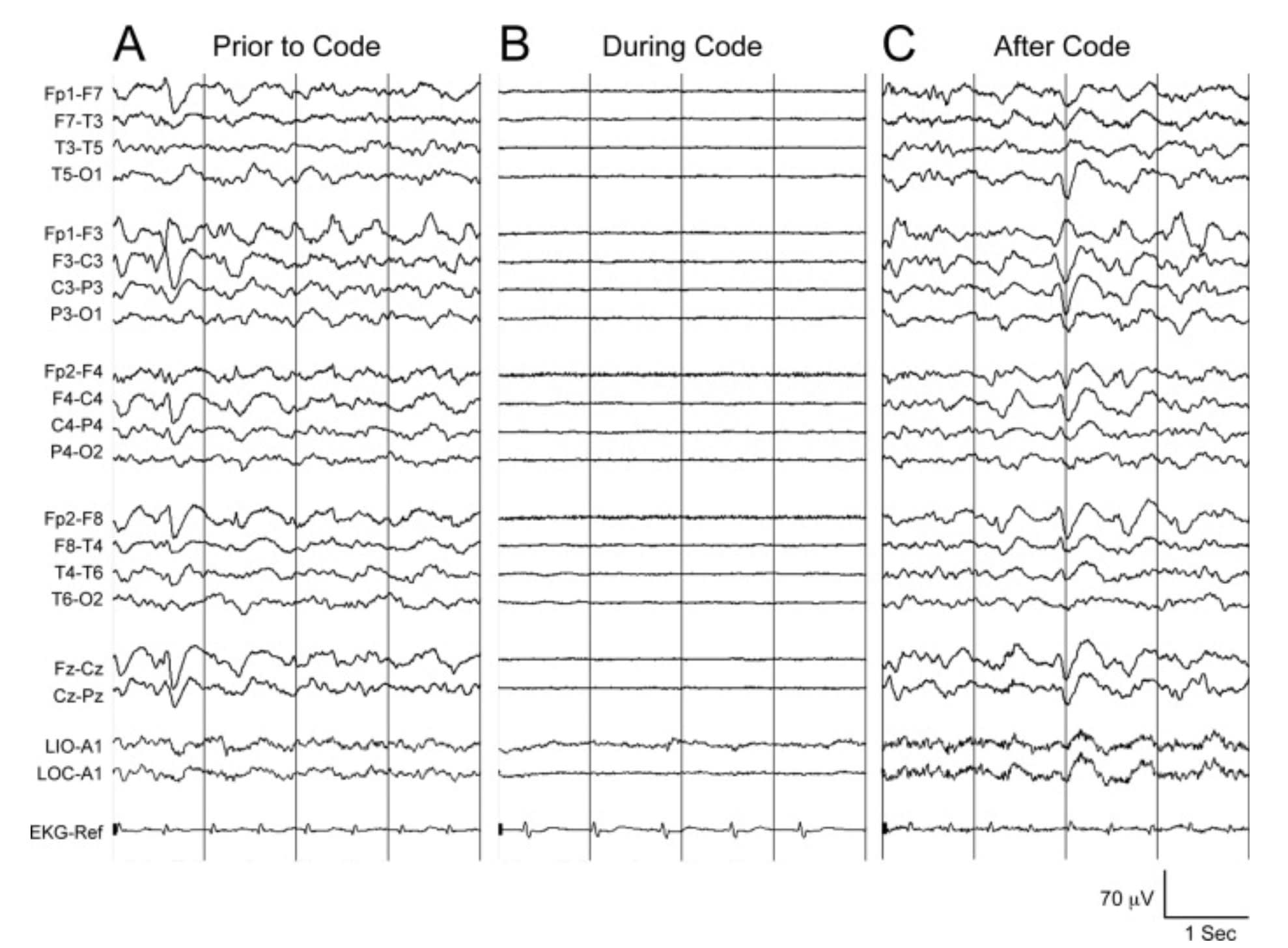
If this was how brains worked in our world, I'd be working on a very different kind of preservation, like longevity researchers or some kind of relativistic time-dilation bubble. I think we got lucky, though: when we look at electrical blackouts in the human brain, we observe something much more convenient:
This image, from Broestl et al 2013, is an EEG of a patient's brain activity. The flat section in the middle is during 15 minutes of cardiac arrest. The patient fully recovered afterwards.
The lady in the lake
In 1999, a Swedish radiologist named Anna Bågenholm fell into a frozen lake while skiing and became trapped under an eight-inch-thick layer of ice. For forty minutes, she struggled to breathe from a trapped air pocket before finally losing consciousness. At that point, her breathing stopped, her heart stopped pumping blood, and her brain went dark as electrical activity ceased—not like the quiet of sleep or even a coma, but complete electrocerebral silence. And then it took nearly an hour after that before rescuers managed to pull her body out of the water.
But this was not the end. Her rescuers airlifted her body to a hospital where—after two and a half hours with zero heartbeat—doctors attempted to carefully rewarm her. The operation took nine hours, but in the end, she survived. Even more remarkably, she made essentially a complete recovery, with no lasting brain damage save for the loss of some immediate short term memory, and no lingering problems save for some nerve damage in her hands and feet.
So a person who fell into a frozen lake, spending an hour with zero vital signs and a core body temperature of 57 °F/13.7 °C, survived the experience. The mishap was a freak accident, but the astonishing fact that recovery is possible tells us something about how brains work. Bågenholm's case should already make us suspicious of any theory where—like the unfortunate gold-foil leaves in Chiang’s pneumatic aliens—the ephemeral live activity of the brain is load-bearing for memory and personal identity. This situation looks like the sort of thing you'd expect to observe in a universe where brains can safely be turned off and back on again. Whatever consequences Bågenholm may have suffered from her accident, she certainly seemed to emerge with her memories, cognition, and personality intact.
Using cold to save lives: DHCA
How is such survival possible? Of course, at ordinary warm temperatures, we can only go a few minutes without oxygen before suffering lasting catastrophic damage—hence the debilitating consequences of heart attack and stroke. But cold-water survival, which has been documented since ancient times, is another story. It turns out that a warm, oxygen-starved brain quickly begins to damage itself. While you'd ideally like your brain to have all the oxygen it wants, the next best thing is to avoid trying to run it—just like you'd power off your phone if you spilled a glass of water on it. It turns out that cold temperatures (about 15-30°C) are very effective at powering down brains in this way.
In fact, once you know the phenomenon exists, powering down brains turns out to be a useful technology—specifically for brain and heart surgeons whose operations depend on being able to work on a brain or heart while it is temporarily offline. The heart does not try to pump blood, the brain does not spark with electricity, and yet the body does not suffocate from the resulting lack of oxygen. Hence the technique of hypothermic circulatory arrest (HCA) was developed[1]. Before an operation, surgeons lower the body’s temperature until circulation stops, usually targeting 20-28°C (moderate hypothermic circulatory arrest, MHCA) or in some cases as low as 14-20°C (deep hypothermic circulatory arrest, DHCA). This extreme cooling buys a window of time in which all normal vital signs are suspended—heartbeat stops, breathing stops, the brain becomes quiet—and the delicate surgery can take place. After the procedure is complete, the patient is carefully, slowly warmed and resuscitated, and they return to everyday life.
Hypothermic circulatory arrest provides cerebral protection during an extended period without oxygen or blood flow. For this reason, it has become the standard of care (Chau, 2013) for heart and brain operations since it was developed in the 1960s: for example, over 7,000 patients in the US underwent hypothermic circulatory arrest procedures between 2017 and 2021.
So how do patients fare afterwards? Do they survive with their memories, cognition, and personalities intact? In fact, in addition to the anecdotal experiences of patients and surgeons in the field, there’s plenty of literature evaluating the effects of DHCA on cognition. For example, Stecker et al. (2001) (Part II) survey 109 patients immediately after DHCA and find that 75% are aware, oriented, and neurologically normal. This doesn't seem bad, among a population of very ill and immediately post-operative people, several of whom suffered strokes before or during the procedure.
More to the point, Percy et al. (2009) studied people in high-cognitive professions who underwent DHCA. Included in the group were “physicians, lawyers, doctorates, clergymen, artists, musicians, accountants, and managers”. The researchers interviewed both patients and their close family members, asking what differences they noticed before and after the surgery. The researchers found “excellent preservation of cognitive function after surgery, according to both patient and informant responses,” arguing that “although subtle deficits after DHCA might hide in individuals with less intellectually demanding professions, it is unlikely that substantive deficits could remain undetected in our high cognitive needs group.”
I still remember the first time I ever heard about DHCA: a brief digression during a TA session that was part of Sebastian Seung's Intro to Neuroscience class at MIT, 2009. I remember because learning about DHCA was literally life changing for me. I learned that people can be "shut down" by cold, that they don't have any appreciable brain activity in such a state, that this was being used in hospitals routinely for tricky heart surgeries! For me, DHCA was one of those things that, once you see it, even for a moment, your life can never be the same again. I left that TA session in a haze. I hope to share some of that excitement with you today.
Electrocerebral silence
As a technical aside, I want to dive into the term electrocerebral silence—the electrical-blackout phenomenon observed in brains under hypothermic circulatory arrest. Although in cooled brains, electrical activity shuts down to the point that it’s undetectable on a standard EEG (unlike the gentle characteristic waveforms of an anesthetized or unconscious brain, electrocerebral silence looks like a total flatline; see Mizrahi et al. 1989.), the point isn’t the total absence of electricity. Brain cells, being bags of ions, may still occasionally emit tiny, sporadic sparks. The point is that they are totally disrupted in their ordinary electrical behaviors, unable to perform anything like normal synaptic computations (Volgushev 2000), and operating at levels so low they are invisible under EEG.
Stecker et al 2001, Part I, Figure 3, “(D) precooling, (E) appearance of periodic complexes, (F) appearance of burst suppression, and (G) electrocerebral silence”. This EEG readout shows the progression of electrical activity in a brain as hypothermia is induced. The final image (G) shows electrocerebral silence—where potential has fallen below the EEG’s level of random noise, around 2–3 µV.
Stecker et al. (2001) tried deliberately super-stimulating neurons in chilly hypothermic brains, inducing evoked potentials by stimulating the wrist using a current 10-50x larger than a normal nerve signal. They found that even these oversize pulses petered out before reaching the cortex, indicating that the signaling pathways through the deep brain had been disrupted. The neurons had lost their ability to transmit information.
Cool them even further, and you can eventually knock out the ability of individual neurons to fire at all, even when artificially stimulated. The exact failure temperature varies by neuron, but averages around 12°C, and gets as low as 4°C (Girard and Bullier, 1989). Notably, 4°C is a temperature from which humans have recovered (Zafren 2020).
Girard and Bullier 1989, Figure 5A. Most neurons become incapable of firing around 12°C, even when artificially stimulated.
In short, I'd argue that in a person undergoing routine HCA, the occasional solitary neuron may send off sparks, but it’s clear these chilled, oxygen-starved neurons are almost entirely silent, are unable to communicate with each other over long distances, and that the ordinary dynamics of electrical cascades in the brain—and whatever information those dynamics held—have been totally disrupted.
Known unknowns
When I look at the state of the evidence, I find it implausible that we live in the inconvenient world of Chiang's aliens. Instead, I seem to observe a world where the electrical cascades in the brain can be disrupted and zeroed out, but as long as the structure is intact, latent cognition remains intact. (For what it's worth, "memory is structural" is also the conventional view among neuroscientists.)
This is why Nectome has put so much energy into preserving nanostructure in exquisite detail. There's a lot we don't know about the human brain, but whatever secrets it holds, the evidence points to them being stored in its intricate physical structures. We can't decipher them yet—but we can make sure the structure is right there, ready for the future.
- ^
Charles Drew was one of the pioneers of HCA, and I'm sure, regardless of what's been written after that fact, that he had to fight to make the idea happen; progress often requires people to stand up and do the "obvious" often at significant personal expense, and for this he's one of my heroes.
LessWrong AI
https://www.lesswrong.com/posts/brxjGPbMy2zCQxFma/why-do-i-believe-preserving-structure-is-enoughSign in to highlight and annotate this article

Conversation starters
Daily AI Digest
Get the top 5 AI stories delivered to your inbox every morning.
More about
surveyresearch
Grounding AI-in-Education Development in Teachers' Voices: Findings from a National Survey in Indonesia
arXiv:2604.01630v1 Announce Type: new Abstract: Despite emerging use in Indonesian classrooms, there is limited large-scale, teacher-centred evidence on how AI is used in practice and what support teachers need, hindering the development of context-appropriate AI systems and policies. To address this gap, we conduct a nationwide survey of 349 K-12 teachers across elementary, junior high, and senior high schools. We find increasing use of AI for pedagogy, content development, and teaching media, although adoption remains uneven. Elementary teachers report more consistent use, while senior high teachers engage less; mid-career teachers assign higher importance to AI, and teachers in Eastern Indonesia perceive greater value. Across levels, teachers primarily use AI to reduce instructional pre

Common advice #3: Asking why one more time
Written quickly as part of the Inkhaven Residency . At a high level, research feedback I give to more junior research collaborators tends to fall into one of three categories: Doing quick sanity checks Saying precisely what you want to say Asking why one more time In each case, I think the advice can be taken to an extreme I no longer endorse. Accordingly, I’ve tried to spell out the degree to which you should implement the advice, as well as what “taking it too far” might look like. Previously, I covered doing quick sanity checks and saying what you want to say precisely . I’ll conclude these posts by talking about probably the hardest to communicate category of common advice: asking why one more time. Asking why one more time In my opinion, the most important skill in empirical research

Knowledge Map
Connected Articles — Knowledge Graph
This article is connected to other articles through shared AI topics and tags.
More in Products
Grounding AI-in-Education Development in Teachers' Voices: Findings from a National Survey in Indonesia
arXiv:2604.01630v1 Announce Type: new Abstract: Despite emerging use in Indonesian classrooms, there is limited large-scale, teacher-centred evidence on how AI is used in practice and what support teachers need, hindering the development of context-appropriate AI systems and policies. To address this gap, we conduct a nationwide survey of 349 K-12 teachers across elementary, junior high, and senior high schools. We find increasing use of AI for pedagogy, content development, and teaching media, although adoption remains uneven. Elementary teachers report more consistent use, while senior high teachers engage less; mid-career teachers assign higher importance to AI, and teachers in Eastern Indonesia perceive greater value. Across levels, teachers primarily use AI to reduce instructional pre

How to Automate Upwork Proposals with Python (Real Code Inside)
How to Automate Upwork Proposals with Python (Real Code Inside) Last month I sent 47 proposals on Upwork. I personally wrote 3 of them. The other 44 were drafted by Claude AI, filtered through a scoring algorithm I built over two weekends, and delivered to my inbox via Telegram before most freelancers even saw the job posting. My response rate on those AI-assisted proposals? 31%. Higher than my hand-written average from the previous quarter. This article shows you exactly how I built that system. The Real Problem With Upwork Proposals If you've freelanced on Upwork for more than a month, you know the grind. You refresh the job feed. You see something promising. You spend 20 minutes writing a tailored proposal. You hit submit. Nothing. Meanwhile, the client already hired someone who respond
Migration and Modernisation with Kiro CLI
Background Once upon a time, there was a developer who needed to keep updating the dependencies of each tool/product/software. There is a dependabot which still helpful for updating minor versions. However, it will need a manual update/migration whenever a major version comes. Migrating to a major version is frustrating for me if I need to update it in bulk. Updating only one app is pretty fine, but how about multiple apps? I believe we will stop doing it. AI Era The AI (Artificial Intelligence) era has come. Much automation can be achieved by AI. I have a good belief that I can migrate much more easily whenever I use AI. Not like the old age, which needs many manual changes, especially the breaking changes! Migration as Vibes I'm starting the migration as vibes. So, I only put a simple pr
Destructuring in JavaScript
Have you ever written code like this? ```js id="before1" const user = { name: "Rahul", age: 22 }; const name = user.name; const age = user.age; It works—but it’s **repetitive**. Destructuring lets you **extract values from arrays or objects in a cleaner way**. --- ## 🧠 What Is Destructuring? Destructuring is a JavaScript feature that allows you to: > Unpack values from arrays or objects into **distinct variables** in a single step. --- ## 🔹 Destructuring Arrays Instead of: ```js id="arrayBefore" const numbers = [10, 20, 30]; const first = numbers[0]; const second = numbers[1]; Use destructuring: ```js id="arrayAfter" const [first, second] = [10, 20, 30]; console.log(first); // 10 console.log(second); // 20 ### ✅ Notes: * Order matters in arrays * You can skip items with commas: ```js id=
Discussion
Sign in to join the discussion
No comments yet — be the first to share your thoughts!