
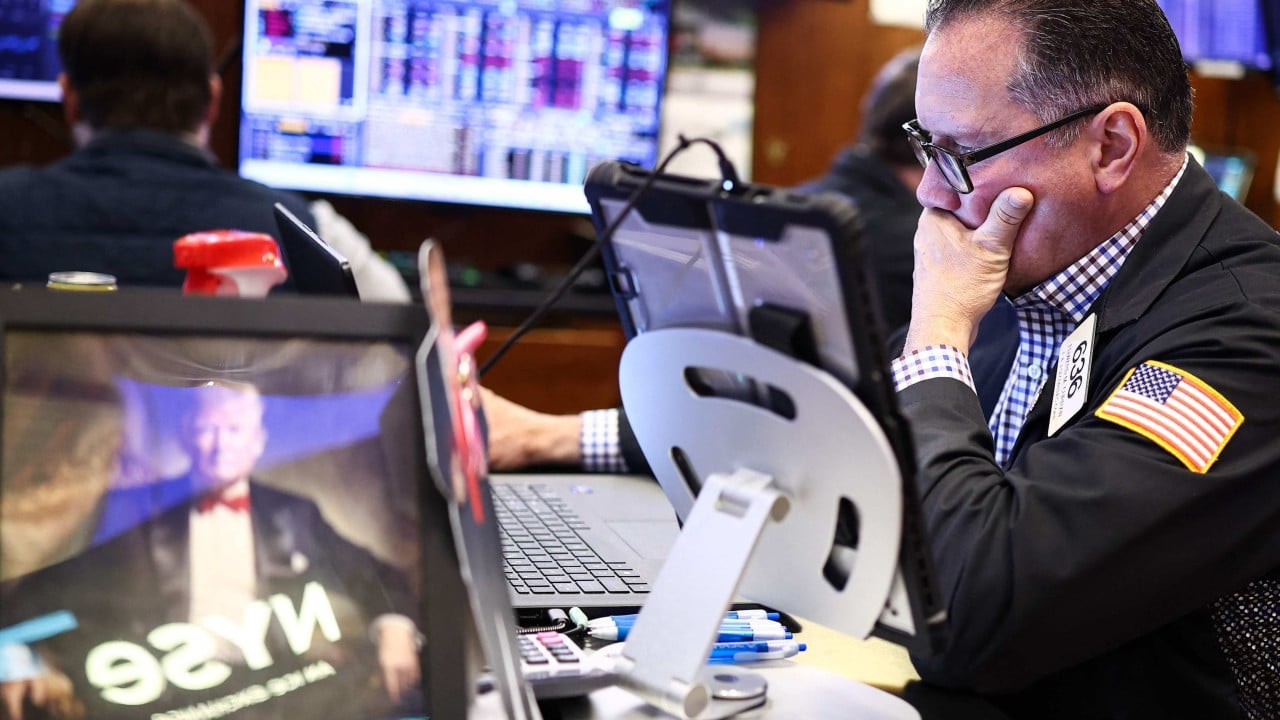
US crude tops US$110, Wall Street falls after Trump vows more Iran attacks
Stocks slumped and oil prices soared on Thursday after President Donald Trump vowed the US will continue to attack Iran and failed to offer a clear timetable for ending the conflict in the Middle East. The S&P 500 fell 1.1 per cent, with three out of every four stocks in the benchmark index losing ground. The Dow Jones Industrial Average shed 545 points, or 1.2 per cent, as of 9.52am Eastern. The Nasdaq composite fell 1.6 per cent. Major indexes throughout Europe and Asia also fell. The broad...
Stocks slumped and oil prices soared on Thursday after President Donald Trump vowed the US will continue to attack Iran and failed to offer a clear timetable for ending the conflict in the Middle East.
The S&P 500 fell 1.1 per cent, with three out of every four stocks in the benchmark index losing ground. The Dow Jones Industrial Average shed 545 points, or 1.2 per cent, as of 9.52am Eastern. The Nasdaq composite fell 1.6 per cent. Major indexes throughout Europe and Asia also fell.
The broad slide for US and global stocks follows a national address from Trump on Wednesday where he said the US will continue to hit Iran “extremely hard over the next two to three weeks”.
Markets had been mostly gaining ground throughout the week on hopes that the war would conclude soon. Major indexes are still on track to close out the week with gains.
Thursday is the last day of trading on Wall Street this week with the stock market closed on Good Friday.
Crude oil prices have been the main force behind the sharp swings for stocks globally. Shipping traffic has been severely curtailed in the Strait of Hormuz, where a fifth of the world’s traded oil passes through during peacetime.
SCMP Tech (Asia AI)
https://www.scmp.com/news/world/united-states-canada/article/3348851/us-crude-tops-us110-wall-street-falls-after-trump-vows-more-iran-attacks?utm_source=rss_feedSign in to highlight and annotate this article

Conversation starters
Daily AI Digest
Get the top 5 AI stories delivered to your inbox every morning.
More about
benchmarkstockeurope
AMD's Lemonade Just Made Every Nvidia-Only AI Guide Obsolete
Search for "how to run LLMs locally" and count the Nvidia logos. CUDA this, CUDA that. If you own AMD hardware — and statistically, a lot of you do — the local AI ecosystem has treated you like a second-class citizen for years. That just changed. Lemonade is an open-source, AMD-backed local AI server that handles LLM chat, image generation, speech synthesis, and transcription — all from a single install, all running on your hardware, all private. It hit 216 points on Hacker News this week, and the discussion thread tells you everything about why AMD users are paying attention. 🍋 What Lemonade actually is: A 2MB native C++ service that auto-configures for your AMD GPU, NPU, or CPU. It exposes an OpenAI-compatible API at localhost:13305 , meaning any app that talks to OpenAI (VS Code Copilo

Big Tech firms are accelerating AI investments and integration, while regulators and companies focus on safety and responsible adoption.
The AI landscape is experiencing unprecedented growth and transformation. This post delves into the key developments shaping the future of artificial intelligence, from massive industry investments to critical safety considerations and integration into core development processes. Key Areas Explored: Record-Breaking Investments: Major tech firms are committing billions to AI infrastructure, signaling a significant acceleration in the field. AI in Software Development: We examine how companies are leveraging AI for code generation and the implications for engineering workflows. Safety and Responsibility: The increasing focus on ethical AI development and protecting vulnerable users, particularly minors. Market Dynamics: How AI is influencing stock performance, cloud computing strategies, and
Knowledge Map
Connected Articles — Knowledge Graph
This article is connected to other articles through shared AI topics and tags.
More in Models
In-Silico Perturbation Meets Single-Cell Foundation Models: From Zero-Shot Potential to Fine-Tuned…
In-Silico Perturbation Meets Single-Cell Foundation Models: From Zero-Shot Potential to Fine-Tuned Signal Editor’s note: Xiong Liu, Director of Data Science and AI at Novartis, will speak at ODSC AI East 2026 this April 28th-30th. Check out his talk, “ Evaluating Foundation Models for in-silico Target Discovery ,” there! In-silico perturbation (ISP) aims to simulate how cells shift state under an intervention, such as a genetic or chemical manipulation. Single-cell foundation models (scFMs) like Geneformer and scGPT make this goal especially compelling. Pretrained on massive single-cell atlases, they learn embeddings that can be applied to downstream tasks with relatively little additional modeling. However, a gap remains between the technical possibility of ISP and its biological trustwor

Mitigating collusive self-preference by redaction and paraphrasing
tldr: superficial self-preference can be mitigated by perturbation, but can be hard to eliminate Introduction Our goal is to understand and mitigate collusion, which we define as an agent’s failure to adhere to its assigned role as a result of interaction with other agents . Collusion is a risk in control , in particular, untrusted monitoring. An agent can collude with its monitor by secretly embedding cues in its output to cause the monitor to overlook harmful actions. The embedded cues don’t need to be subtle when the communication channel is less restricted: the agent can persuade the monitor. With a more restricted channel, the agent can still collude with the monitor using mechanisms like steganography or schelling points . In reward modeling , collusion manifests as self-preference :

Discussion
Sign in to join the discussion
No comments yet — be the first to share your thoughts!