

Topology-Hiding Path Validation for Large-Scale Quantum Key Distribution Networks
arXiv:2604.01831v1 Announce Type: cross Abstract: Secure long-distance communication in quantum key distribution (QKD) networks depends on trusted repeater nodes along the entire transmission path. Consequently, these nodes will be subject to strict auditing and certification in future large-scale QKD deployments. However, trust must also extend to the network operator, who is responsible for fulfilling contractual obligations -- such as ensuring certified devices are used and transmission paths remain disjoint where required. In this work, we present a path validation protocol specifically designed for QKD networks. It enables the receiver to verify compliance with agreed-upon policies. At the same time, the protocol preserves the operator's confidentiality by ensuring that no sensitive i
View PDF HTML (experimental)
Abstract:Secure long-distance communication in quantum key distribution (QKD) networks depends on trusted repeater nodes along the entire transmission path. Consequently, these nodes will be subject to strict auditing and certification in future large-scale QKD deployments. However, trust must also extend to the network operator, who is responsible for fulfilling contractual obligations -- such as ensuring certified devices are used and transmission paths remain disjoint where required. In this work, we present a path validation protocol specifically designed for QKD networks. It enables the receiver to verify compliance with agreed-upon policies. At the same time, the protocol preserves the operator's confidentiality by ensuring that no sensitive information about the network topology is revealed to users. We provide a formal model and a provably secure generic construction of the protocol, along with a concrete instantiation. For long-distance communication involving 100 nodes, the protocol has a computational cost of 1-2.5s depending on the machine, and a communication overhead of less than 70kB - demonstrating the efficiency of our approach.
Subjects:
Quantum Physics (quant-ph); Cryptography and Security (cs.CR)
Cite as: arXiv:2604.01831 [quant-ph]
(or arXiv:2604.01831v1 [quant-ph] for this version)
https://doi.org/10.48550/arXiv.2604.01831
arXiv-issued DOI via DataCite (pending registration)
Submission history
From: Stephan Krenn [view email] [v1] Thu, 2 Apr 2026 09:45:43 UTC (75 KB)
Sign in to highlight and annotate this article

Conversation starters
Daily AI Digest
Get the top 5 AI stories delivered to your inbox every morning.
More about
modelannouncecompliance

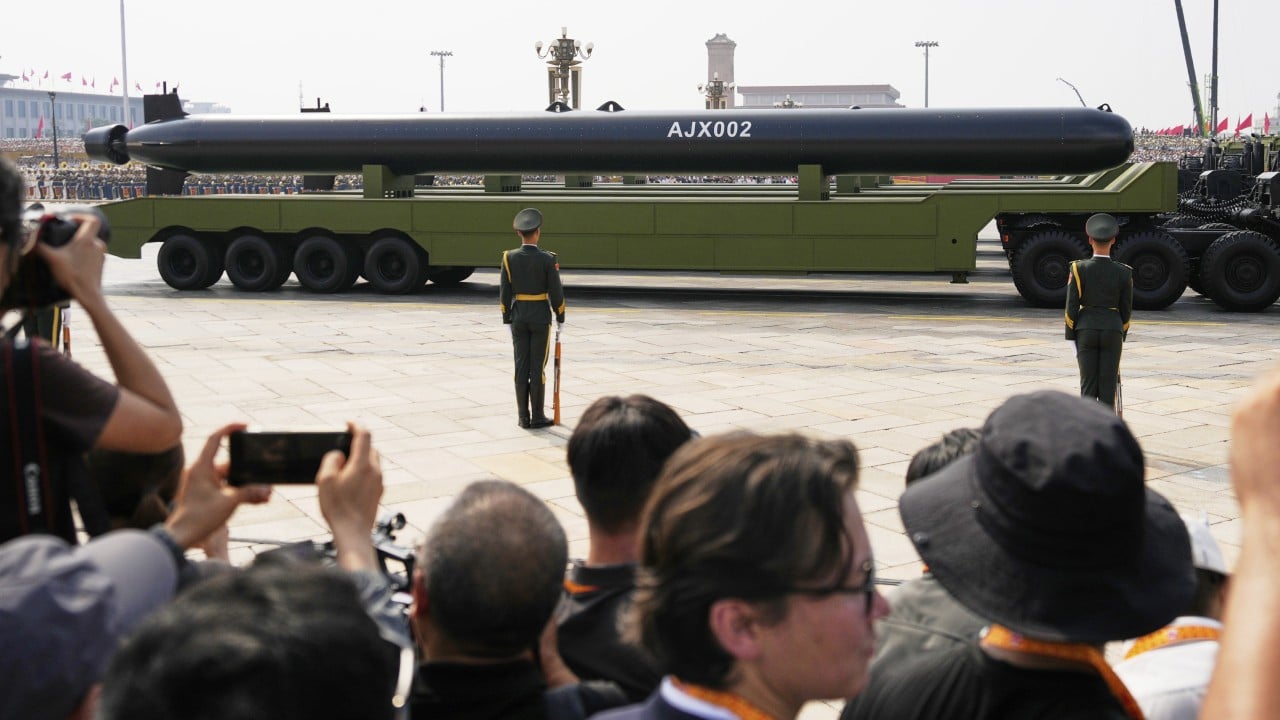
China not targeting US West Coast with ultra-large underwater drones: lead scientist
China’s unmanned submersibles now rank as the world’s largest, with last year’s military parade showcasing two models (HSU001 and AJX002) approaching 20 metres (66 feet) in length. Satellite imagery analysed by Western media also revealed a classified variant exceeding 40 metres at a naval installation, triggering international concern – particularly in the United States. These dimensions created a brand new class of drones known as extra-extra-large uncrewed underwater vehicles (XXLUUVs). They...
Knowledge Map
Connected Articles — Knowledge Graph
This article is connected to other articles through shared AI topics and tags.
More in Models

How China is transforming Hong Kong into a strategic hub
Hong Kong’s first five-year plan is expected to guide the city’s future development. Never before has the city attempted a comprehensive plan in the style of mainland China, signalling a major shift in how it approaches long‑term growth. The real question is not why a laissez‑faire economy must adopt a new model but how this transformation will unfold. This exercise is unprecedented on multiple fronts. First, it departs from Hong Kong’s long-standing reliance on market forces and incremental...
Discussion
Sign in to join the discussion
No comments yet — be the first to share your thoughts!