
This $400 (Not) AI Keychain Is Pointless, Extravagant, and Weirdly Lovable
Daniel Kuntz, one of Starboy's creators, tells us it's a "f*ck you" to AI gadgets.
Gadgets venture to do a lot nowadays. They want to revolutionize the way you work, or sleep, or unwind, or how much data you can get from your pee—almost all of them endeavor to change your life in some way, shape, or form for the better. That’s the hook, anyway; whether or not they actually do any of those things successfully is another can of overcomplicated worms. But what if gadgets did something much bolder—much more subversive, even? What if they did… nothing at all?
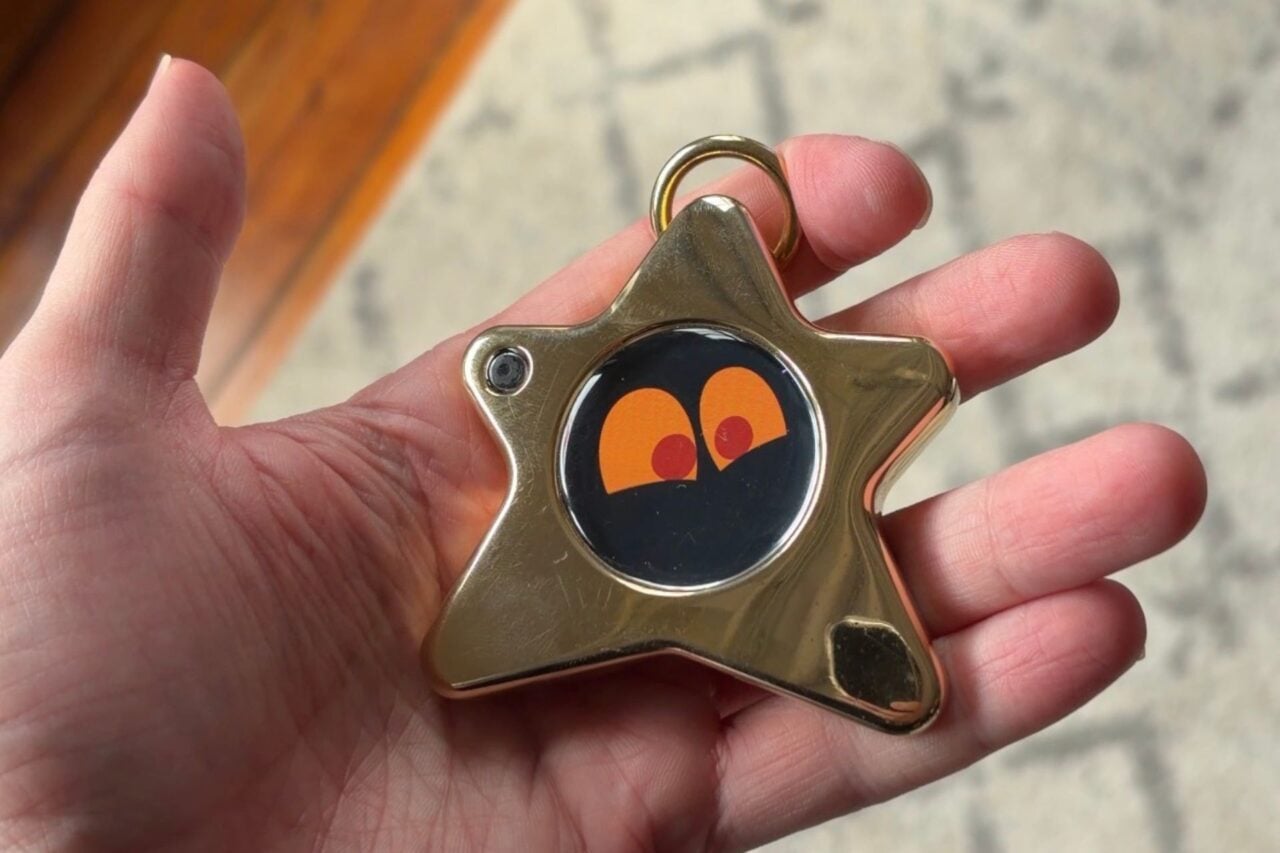
That’s pretty much the whole concept of Starboy, a Tamagotchi-like keychain that costs anywhere between $200 and $440 at the highest end. It’s a pet (kind of), and a piece of jewelry (kind of), and uses AI (kind of), but as one of Starboy’s creators, Daniel Kuntz, puts it, the star-shaped toy promises “not to change your life.”
And based on my experience interacting with Starboy, that’s exactly the kind of underachievement that Starboy excels at. Mostly, Starboy feels like a tech-ish accessory. It’s got an OLED display that shows a cartoonishly emotive face, which Kuntz tells me was designed by someone who used to animate for Disney. It’s got a camera so it can see what you’re doing, too. With this combo of screen, camera, and some other sensors, you’re able to engage with Starboy.
© James Pero / Gizmodo
When I flip Starboy off, it gets angry. When I shake its silly ass around, it gets dizzy. Thanks to a temperature sensor, when I throw Starboy in the freezer, it gets cold and shivers. It’s frivolous stuff mostly, though you can do some useful stuff like giving it a thumbs up to check on the keychain’s battery life. This gesture sends a bar rising across the screen that shows you the level. If it rises all the way, you’re full; if it rises halfway, you’re at half capacity. It’s one of the only practical features I witnessed in my 30-minute demo with the toy.
There’s no app and it doesn’t connect to your phone
Mostly, Starboy is defined not by what it does but by what it doesn’t do. It does not, for instance, connect to your phone. This, Kuntz tells me, is another pointed choice—maybe even a dogmatic one. At the mere suggestion of introducing an app down the line to expand Starboy’s functionality, Kuntz is quick to shut the idea down.
“It’s never going to connect to your phone,” he tells Gizmodo. “And that’s like a spiritual, aesthetic decision, not a pragmatic decision.”
Though Kuntz admits an app could make Starboy a “better product” by connecting to your phone, he paints the idea of relying on our glass slabs as a slippery slope. Where does the endeavor stop? You could add even more sensors and add complexity, but the price goes up, and so does the headache, both for Kuntz’s team, but maybe even for the people using Starboy. If you start introducing apps, then maybe there’s pressure to start including subscriptions, for example—another thing that Kuntz is staunchly opposed to.
Don’t call it an AI gadget
And don’t even get started on AI. The team intentionally does not include “AI” in its marketing, though Starboy does very much use it (they call it machine learning) to recognize faces and gestures.
Star boys, plural. © James Pero / Gizmodo
Kuntz even goes as far as to describe Starboy as a kind of “fck you” to AI gadget companies like Humane, which made the now-defunct Ai Pin—a $700 wearable that was meant to partially (depending on which stage of Humane’s marketing you’re referencing as canon) replace your phone. Long story short, the Ai Pin didn’t exactly take off the way founders Imran Chaudhri and Bethany Bongiorno had hoped. Just two years after the Ai Pin’s release, the gadget has been reduced to a piece of scrap metal; Humane was acquired by HP, and now Chaudhri, who now operates the remnants of the company, is tackling less flashy problems like how to get your printer to connect.
Starboy, for its non-role in the troubled saga of AI gadgets, is working to avoid stories like this entirely, and so is Kuntz.
“The entire industry is hopelessly mimetic,” he tells Gizmodo. “I think everybody in Silicon Valley kind of moves in herds, and everybody copies each other. And people often need—I don’t know what you want to call—permission. Or they need to see somebody else doing it before they want to attempt the same thing.”
On one hand, I agree. On the other hand, it’s a lofty way to talk about an expensive hunk of (mostly) useless metal and circuits. In our demo, I often found myself struggling to find out what to do with Starboy. Flipping it off was fun, but the amusement was over quickly—same goes for shaking Starboy around until it hates me. Maybe I’m not sadistic enough, but torturing Starboy at length—inanimate object or not—just feels a little too Game of Thrones for me.
The Starboy team has plans to allow Starboy to communicate with other Starboys via Bluetooth, though that feature wasn’t functional yet for my demo. I guess you could find joy in collecting Starboys—each face is unique, and there are 5,000 variations with various associated rarities. But at a starting price of $200, I don’t think many people will have the (not) AI toy budget big enough to support that habit. And even with the stuff that Starboy can actually do, the experience that I had felt like it could use a little improvement. It often struggled to see my face or hand gestures (or maybe it struggled to process them), causing a bit of a delay in our interactions.
It’s kind of pointless, which is the whole point
It could use some fine-tuning. Then again, there’s a part of me that feels like whining about Starboy not being fast or exciting enough feels like complaining that your luxurious designer dog still chases its own tail instead of playing chess with you. If that’s a genuine gripe of yours, I’m just not sure that you’ll ever be happy with anything, let alone Starboy.
Just chillin’. © James Pero / Gizmodo
For now, Starboy is really just a lil’ guy. Kuntz makes overtures to the idea of making luxury products, countering questions like “Why would someone buy this?” with “Why does someone buy a 911?” but even that doesn’t feel quite accurate either, even if the toys come in fancy brass and stainless steel finishes. I think I know what really motivates Starboy, and it’s not fashion, or AI, or even technology; it’s the fact that sometimes, you can just make a tech thing, and that thing doesn’t have to do much at all. That feels like a weirdly powerful message today, so, I don’t know, maybe there is something deep waiting to be unlocked in Starboy’s obstinacy. The question is: are you really willing to pay $440 to find out what that message is?
Gizmodo
https://gizmodo.com/starboy-ai-keychain-is-pointless-extravagant-and-weirdly-lovable-2000740949Sign in to highlight and annotate this article

Conversation starters
Daily AI Digest
Get the top 5 AI stories delivered to your inbox every morning.
More about
lovable
Vibe coding: я написал приложение, не зная ни строчки кода
Photo: Daniil Komov / Pexels В субботу вечером я сел за ноутбук, открыл Cursor и написал: «Сделай мне трекер привычек с графиками прогресса, тёмной темой и экспортом в CSV». Через 2 часа 40 минут у меня было работающее веб-приложение. Я не написал ни одной строчки кода руками. Вообще ни одной. TL;DR: Vibe coding позволяет собирать работающие приложения на естественном языке, и в этой статье я покажу, как именно это делать, какие инструменты брать и где этот подход рассыпается в труху. Что такое vibe coding и почему все вдруг заговорили об этом В феврале 2025 года Андрей Карпати, бывший директор по AI в Tesla, написал пост, который разл��телся по всему интернету. Он описал новый способ программирования: ты говоришь ИИ, что хочешь получить, а он пишет код. Ты не читаешь этот код. Не редактир

🌪️ Proof of Work: The To-Do List of Infinite Regret
<p>**</p> <h2> What I Built </h2> <p>**<br> I built a productivity app for people who hate being productive. Proof of Work is a digital psychological experiment that turns simple task management into a high-stakes gamble.</p> <p>The gimmick? You cannot "check off" a task. To complete anything (e.g., "Buy Milk"), you must first win a game of Minesweeper on an Expert-level grid (30x16 with 99 mines). If you hit a mine, the Hydra Engine triggers: your task isn't cleared—it duplicates 20 times. Now you have to buy milk 21 times. It is a functional implementation of a "short-circuit" for the human brain.</p> <p>Demo<br> </p> <div class="crayons-card c-embed text-styles text-styles--secondary"> <div class="c-embed__content"> <div class="c-embed__body flex items-center justify-between"> <a href="
Nintendo's Origins
You may think you know the Nintendo story: a plumber named Mario, a princess named Zelda… and didn’t they buy the Seattle Mariners at some point? We thought we knew it too. And then we started researching and were blown away. The lovable Disney-like Nintendo that we know today is a 130 year-old a playing card company (i.e. gambling), forged in the shadowy world of the Yakuza and shaped by a four-generation cycle of bitter family betrayal. And its unlikely transformation into a global multi-billion dollar media monopoly was led by an iron-fisted patriarch who — amazingly — never played a video game in his life! Get ready for one of our favorite stories Acquired has ever told — we couldn’t make this one up if we tried! Links: Our Atari episode with Nolan Bushnell Video of id Software’s legen
Knowledge Map
Connected Articles — Knowledge Graph
This article is connected to other articles through shared AI topics and tags.
More in Generative UI


IBM Advances Quantum Computing Research: Will it Boost Prospects? - The Globe and Mail
<a href="https://news.google.com/rss/articles/CBMi4wFBVV95cUxNbWZ0WnZydkVQUm0yajVZUVp5cW5wSnV3Vy1Fclh4RzJybVhXX1p5Y0J3X2hkeG8xTm42WDhHNU9uOXV6VXB2TmZGU2w5WFNkYXlCcTlEXzR1TDNMV050TW1qOXVTUENZX1BzakpxS2NsSm9IaWdBOTNidGYwckJtQlVnMGYzSnJNTXU3a0VzaWZ6R0hPSUFlMHJwVDYzQWUyV2VKUWZiTE05V21PWXRHOVhsYm1yRTRGVTlQOERPNnh3NEtTNGwyUDVGaW03VWVldHd0ejNOenBvSFNBcHhhUG5iaw?oc=5" target="_blank">IBM Advances Quantum Computing Research: Will it Boost Prospects?</a> <font color="#6f6f6f">The Globe and Mail</font>
Secure RAG for Regulated Industries: Key Controls - Blockchain Council
<a href="https://news.google.com/rss/articles/CBMixgFBVV95cUxPeU03V0ZJemJwbVY1cm13MDFMLWxwa2pUd3ZJQXdKT3liek54Wk5ObTVIV0NLcHF4TGxRVUt5VzYyNTh1T1h3aTl4LUoxTml5TnMyMTJyVWktV2xSS2I5MmZJczJvcjdmQW9PbmlkOEdtVFEtZDU3ek15T1NtaVg0dktyZDdlV1N0YWRzX3E5Z2JkMEVLRzA2b0NNZ0sxMzZQR2Jac1d2N295X1dBSWNoWmU1bjlHSTNQbjhDemdPa1Z2aTVKblE?oc=5" target="_blank">Secure RAG for Regulated Industries: Key Controls</a> <font color="#6f6f6f">Blockchain Council</font>
Discussion
Sign in to join the discussion
No comments yet — be the first to share your thoughts!