
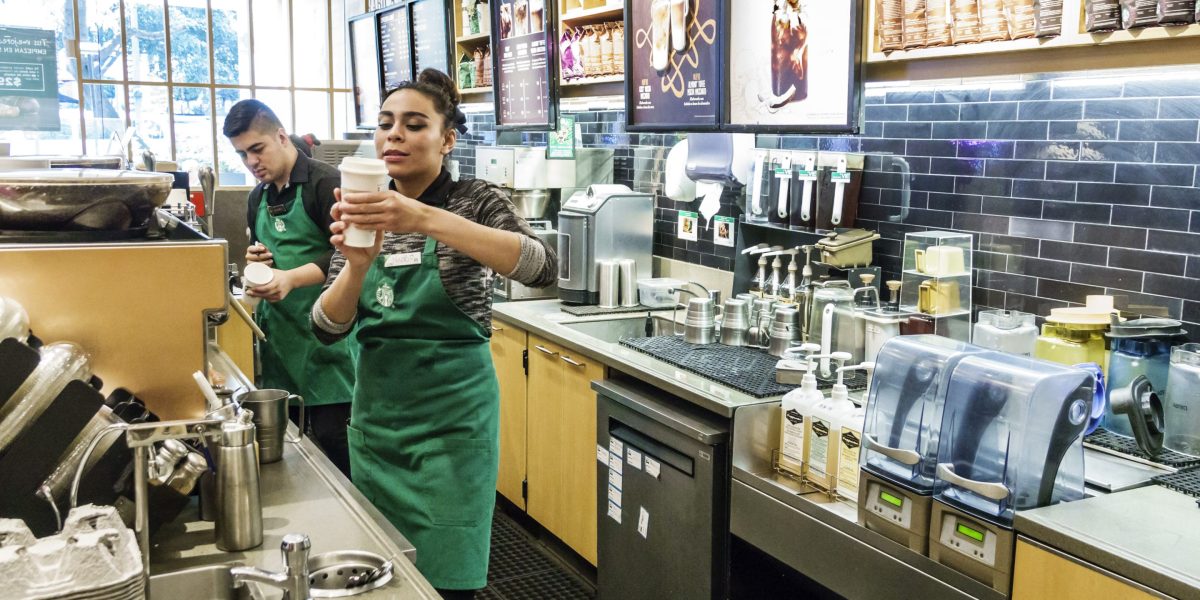
Starbucks is offering $1,200 bonuses, expanded tipping, and weekly payouts to boost the pay of its U.S. baristas
Starbucks will offer up to $1,200 in bonuses each year and expanded tipping options for its U.S. hourly workers as the company pours $500 million into a turnaround effort.
Coffee giant Starbucks is looking to encourage its baristas and hourly workers to improve their sales and customer service by sweetening the pot with bigger financial perks.
The $103 billion coffee chain announced on Thursday that it would expand bonuses and tipping options in a bid to boost worker pay. Starting this July, all of its U.S. hourly workers, including baristas and shift supervisors, can make up to an additional $300 each quarter—amounting to $1,200 a year—when their stores meet or exceed sales, operational, and customer service goals.
There will also be new pathways for customers to tip their baristas. Currently, tipping is restricted to patrons who place orders in-store and at the drive-thru and pay with cash, credit cards, or mobile transactions via Starbucks cards. But under the new policy rolling out this summer, customers will also be able to tip when paying with a credit card for mobile orders and when scanning and paying at the register.
Thanks to the new bonus and tipping incentives, Starbucks estimates that eligible U.S. employees will earn 5% to 8% more than what they earn today. The Seattle-based coffee chain said its baristas and shift supervisors currently earn more than $30 an hour on average in pay and benefits. Under the new plan, paychecks will go out weekly instead of twice a month, with the first quarterly payout hitting this fall.
“The new incentive rewards program recognizes partners for the progress they make possible,” Starbucks said in its Thursday announcement, adding that the cost of the bonuses should be offset by “improvements to coffeehouse performance and operations, and the customer experience.”
Fortune reached out to Starbucks for comment.
Starbucks’ $500 million turnaround effort and union tensions
The coffee chain’s new pay perks come amid a $500 million turnaround effort and ongoing tensions with unionized workers.
Starbucks CEO Brian Niccol, who took the helm of the coffee giant in 2024, has been striving to improve customer service in hopes of boosting sales. The company has invested around $500 million as part of its “Back to Starbucks” push to increase staffing during rush times; pay out additional hours; and expand worker rosters. So far, something has clicked; global sales at Starbucks locations grew 4% last quarter, and the company’s shares rose 7.3% this year through Thursday.
Meanwhile, the billion-dollar coffee behemoth has yet to agree to a contract with the Starbucks Workers United union, which has been advocating for higher wages and stable work schedules. The union, representing workers at approximately 600 of its 10,000 U.S. stores, is set to negotiate with the company later this month.
The new incentive plan changes are subject to collective bargaining at the unionized locations—and the union tells Fortune it’s a reaction to its continued push for higher take-home pay. The group says it will continue to fight for better store staffing, wages, and consistent scheduling, and that the new pay perks are subject to others’ discretion.
“It’s notable that these bonuses and tips will be largely out of baristas’ control, relying on customer tipping and store performance metrics as determined by Starbucks management,” the group tells Fortune in a statement. “Union Starbucks baristas have been raising the alarm on low pay, inconsistent hours, and understaffing for years.”
Fortune Tech
https://fortune.com/2026/04/03/starbucks-offering-1200-bonus-tipping-weekly-payouts-boost-us-barista-pay/Sign in to highlight and annotate this article

Conversation starters
Daily AI Digest
Get the top 5 AI stories delivered to your inbox every morning.
More about
companymillion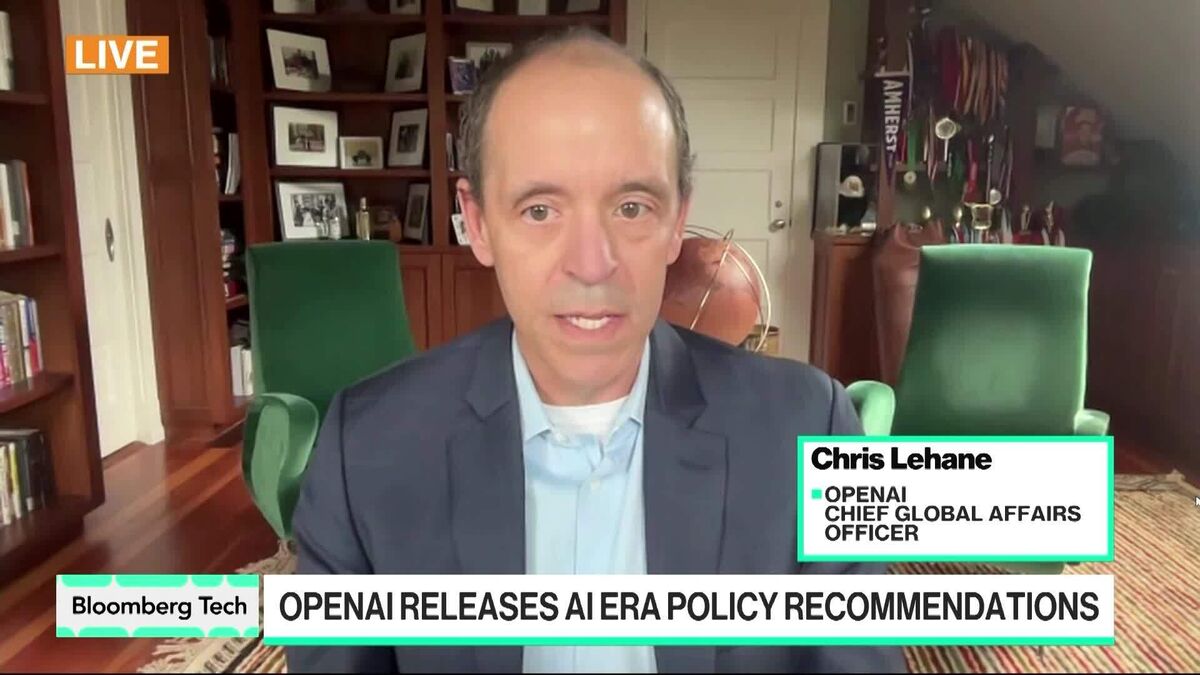
OpenAI Releases Policy Recommendations for AI Age
OpenAI has released policy recommendations to address the rapid social changes driven by AI. OpenAI's Chief Global Affairs Officer Chris Lehane discusses the company’s ideas to “ensure AI benefits everyone.” Lehane joins Caroline Hyde and Ed Ludlow on “Bloomberg Tech.” (Source: Bloomberg)

We aren’t even close to AGI
Supposedly we’ve reached AGI according to Jensen Huang and Marc Andreessen. What a load of shit. I tried to get Claude code with Opus 4.6 max plan to play Elden Ring. Couldn’t even get past the first room. It made it past the character creator, but couldn’t leave the original chapel. If it can’t play a game that millions have beat, if it can’t even get past the first room, how are we even close to Artificial GENERAL Intelligence? I understand that this isn’t in its training data but that’s the entire point. Artificial general intelligence is supposed to be able to reason and think outside of its training data. submitted by /u/CrimsonShikabane [link] [comments]
![[OpenAI] Industrial policy for the Intelligence Age](https://d2xsxph8kpxj0f.cloudfront.net/310419663032563854/konzwo8nGf8Z4uZsMefwMr/default-img-matrix-rain-CvjLrWJiXfamUnvj5xT9J9.webp)
[OpenAI] Industrial policy for the Intelligence Age
As we move toward superintelligence, incremental policy updates won’t be enough. To kick-start this much needed conversation, OpenAI is offering a slate of people-first policy ideas(opens in a new window) designed to expand opportunity, share prosperity, and build resilient institutions—ensuring that advanced AI benefits everyone. These ideas are ambitious, but intentionally early and exploratory. We offer them not as a comprehensive or final set of recommendations, but as a starting point for discussion that we invite others to build on, refine, challenge, or choose among through the democratic process. To help sustain momentum, OpenAI is: welcoming and organizing feedback through [email protected] establishing a pilot program of fellowships and focused research grants of u
Knowledge Map
Connected Articles — Knowledge Graph
This article is connected to other articles through shared AI topics and tags.
More in Products

The Geometry Behind the Dot Product: Unit Vectors, Projections, and Intuition
The geometric foundations you need to understand the dot product The post The Geometry Behind the Dot Product: Unit Vectors, Projections, and Intuition appeared first on Towards Data Science .

AI Is Insatiable
While browsing our website a few weeks ago, I stumbled upon “ How and When the Memory Chip Shortage Will End ” by Senior Editor Samuel K. Moore. His analysis focuses on the current DRAM shortage caused by AI hyperscalers’ ravenous appetite for memory, a major constraint on the speed at which large language models run. Moore provides a clear explanation of the shortage, particularly for high bandwidth memory (HBM). As we and the rest of the tech media have documented, AI is a resource hog. AI electricity consumption could account for up to 12 percent of all U.S. power by 2028. Generative AI queries consumed 15 terawatt-hours in 2025 and are projected to consume 347 TWh by 2030. Water consumption for cooling AI data centers is predicted to double or even quadruple by 2028 compared to 2023. B

The one piece of data that could actually shed light on your job and AI
This story originally appeared in The Algorithm, our weekly newsletter on AI. To get stories like this in your inbox first, sign up here. Within Silicon Valley’s orbit, an AI-fueled jobs apocalypse is spoken about as a given. The mood is so grim that a societal impacts researcher at Anthropic, responding Wednesday to a call for

How Meta Used AI to Map Tribal Knowledge in Large-Scale Data Pipelines
AI coding assistants are powerful but only as good as their understanding of your codebase. When we pointed AI agents at one of Meta s large-scale data processing pipelines – spanning four repositories, three languages, and over 4,100 files – we quickly found that they weren t making useful edits quickly enough. We fixed this by building [...] Read More... The post How Meta Used AI to Map Tribal Knowledge in Large-Scale Data Pipelines appeared first on Engineering at Meta .
Discussion
Sign in to join the discussion
No comments yet — be the first to share your thoughts!