

Speech LLMs are Contextual Reasoning Transcribers
arXiv:2604.00610v1 Announce Type: new Abstract: Despite extensions to speech inputs, effectively leveraging the rich knowledge and contextual understanding of large language models (LLMs) in automatic speech recognition (ASR) remains non-trivial, as the task primarily involves direct speech-to-text mapping. To address this, this paper proposes chain-of-thought ASR (CoT-ASR), which constructs a reasoning chain that enables LLMs to first analyze the input speech and generate contextual analysis, thereby fully exploiting their generative capabilities. With this contextual reasoning, CoT-ASR then performs more informed speech recognition and completes both reasoning and transcription in a single pass. Moreover, CoT-ASR naturally supports user-guided transcription: while designed to self-genera
View PDF HTML (experimental)
Abstract:Despite extensions to speech inputs, effectively leveraging the rich knowledge and contextual understanding of large language models (LLMs) in automatic speech recognition (ASR) remains non-trivial, as the task primarily involves direct speech-to-text mapping. To address this, this paper proposes chain-of-thought ASR (CoT-ASR), which constructs a reasoning chain that enables LLMs to first analyze the input speech and generate contextual analysis, thereby fully exploiting their generative capabilities. With this contextual reasoning, CoT-ASR then performs more informed speech recognition and completes both reasoning and transcription in a single pass. Moreover, CoT-ASR naturally supports user-guided transcription: while designed to self-generate reasoning, it can also seamlessly incorporate user-provided context to guide transcription, further extending ASR functionality. To reduce the modality gap, this paper introduces a CTC-guided Modality Adapter, which uses CTC non-blank token probabilities to weight LLM embeddings, efficiently aligning speech encoder outputs with the LLM's textual latent space. Experiments show that, compared to standard LLM-based ASR, CoT-ASR achieves a relative reduction of 8.7% in word error rate (WER) and 16.9% in entity error rate (EER).
Subjects:
Computation and Language (cs.CL)
Cite as: arXiv:2604.00610 [cs.CL]
(or arXiv:2604.00610v1 [cs.CL] for this version)
https://doi.org/10.48550/arXiv.2604.00610
arXiv-issued DOI via DataCite (pending registration)
Submission history
From: Keqi Deng [view email] [v1] Wed, 1 Apr 2026 08:13:50 UTC (248 KB)
Sign in to highlight and annotate this article

Conversation starters
Daily AI Digest
Get the top 5 AI stories delivered to your inbox every morning.
More about
modellanguage modelannounce
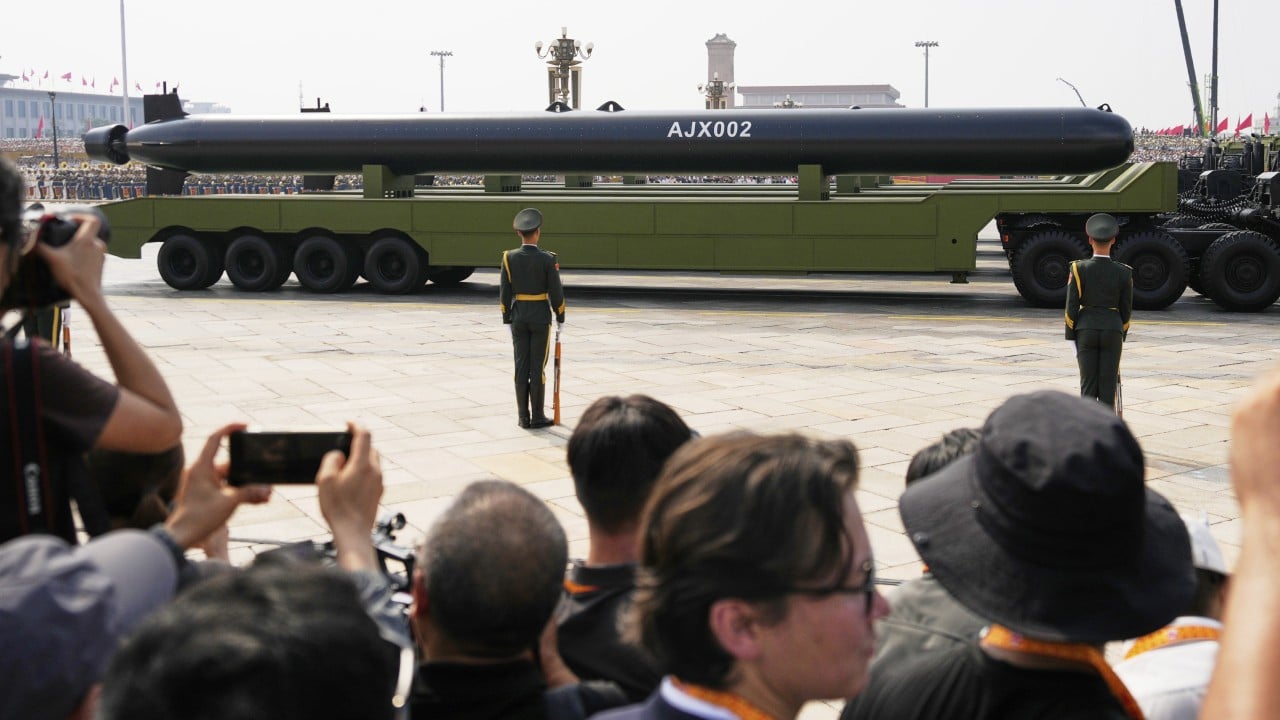
China not targeting US West Coast with ultra-large underwater drones: lead scientist
China’s unmanned submersibles now rank as the world’s largest, with last year’s military parade showcasing two models (HSU001 and AJX002) approaching 20 metres (66 feet) in length. Satellite imagery analysed by Western media also revealed a classified variant exceeding 40 metres at a naval installation, triggering international concern – particularly in the United States. These dimensions created a brand new class of drones known as extra-extra-large uncrewed underwater vehicles (XXLUUVs). They...

How China is transforming Hong Kong into a strategic hub
Hong Kong’s first five-year plan is expected to guide the city’s future development. Never before has the city attempted a comprehensive plan in the style of mainland China, signalling a major shift in how it approaches long‑term growth. The real question is not why a laissez‑faire economy must adopt a new model but how this transformation will unfold. This exercise is unprecedented on multiple fronts. First, it departs from Hong Kong’s long-standing reliance on market forces and incremental...
Knowledge Map
Connected Articles — Knowledge Graph
This article is connected to other articles through shared AI topics and tags.
More in Models
How China is transforming Hong Kong into a strategic hub
Hong Kong’s first five-year plan is expected to guide the city’s future development. Never before has the city attempted a comprehensive plan in the style of mainland China, signalling a major shift in how it approaches long‑term growth. The real question is not why a laissez‑faire economy must adopt a new model but how this transformation will unfold. This exercise is unprecedented on multiple fronts. First, it departs from Hong Kong’s long-standing reliance on market forces and incremental...

Discussion
Sign in to join the discussion
No comments yet — be the first to share your thoughts!