
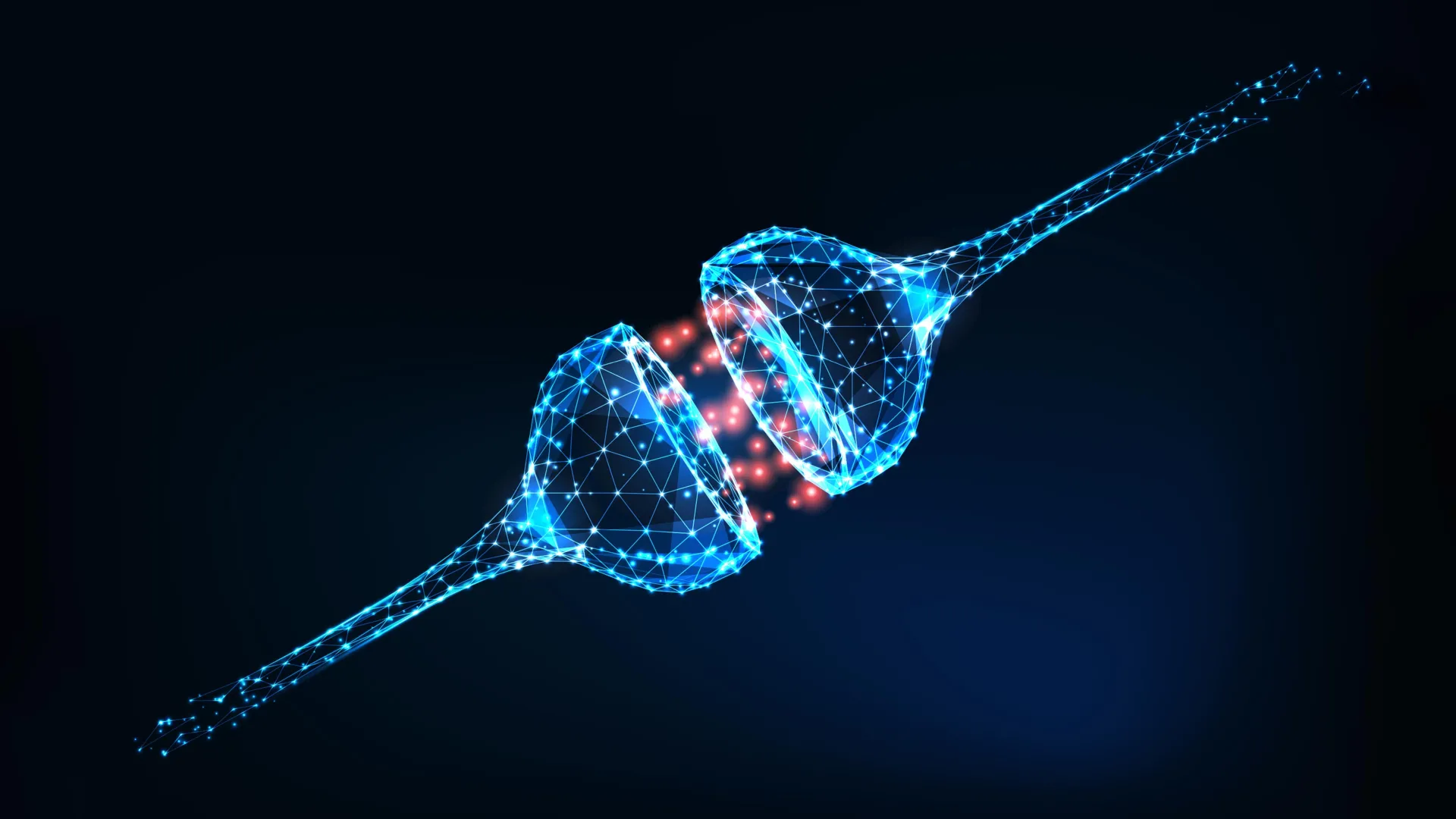
Scientists build artificial neurons that work like real ones
UMass Amherst engineers have built an artificial neuron powered by bacterial protein nanowires that functions like a real one, but at extremely low voltage. This allows for seamless communication with biological cells and drastically improved energy efficiency. The discovery could lead to bio-inspired computers and wearable electronics that no longer need power-hungry amplifiers. Future applications may include sensors powered by sweat or devices that harvest electricity from thin air.
Engineers at the University of Massachusetts Amherst have developed an artificial neuron whose electrical activity closely matches that of natural brain cells. The innovation builds on the team's earlier research using protein nanowires made from electricity-producing bacteria. This new approach could pave the way for computers that run with the efficiency of living systems and may even connect directly with biological tissue.
"Our brain processes an enormous amount of data," says Shuai Fu, a graduate student in electrical and computer engineering at UMass Amherst and lead author of the study published in Nature Communications. "But its power usage is very, very low, especially compared to the amount of electricity it takes to run a Large Language Model, like ChatGPT."
The human body operates with remarkable electrical efficiency -- more than 100 times greater than that of a typical computer circuit. The brain alone contains billions of neurons, specialized cells that send and receive electrical signals throughout the body. Performing a task such as writing a story uses only about 20 watts of power in the human brain, whereas a large language model can require more than a megawatt to accomplish the same thing.
Engineers have long sought to design artificial neurons for more energy-efficient computing, but reducing their voltage to match biological levels has been a major obstacle. "Previous versions of artificial neurons used 10 times more voltage -- and 100 times more power -- than the one we have created," says Jun Yao, associate professor of electrical and computer engineering at UMass Amherst and the paper's senior author. Because of this, earlier designs were far less efficient and couldn't connect directly with living neurons, which are sensitive to stronger electrical signals.
"Ours register only 0.1 volts, which about the same as the neurons in our bodies," says Yao.
There are a wide range of applications for Fu and Yao's new neuron, from redesigning computers along bio-inspired, and far more efficient principles, to electronic devices that could speak to our bodies directly.
"We currently have all kinds of wearable electronic sensing systems," says Yao, "but they are comparatively clunky and inefficient. Every time they sense a signal from our body, they have to electrically amplify it so that a computer can analyze it. That intermediate step of amplification increases both power consumption and the circuit's complexity, but sensors built with our low-voltage neurons could do without any amplification at all."
The secret ingredient in the team's new low-powered neuron is a protein nanowire synthesized from the remarkable bacteria Geobacter sulfurreducens, which also has the superpower of producing electricity. Yao, along with various colleagues, have used the bacteria's protein nanowires to design a whole host of extraordinary efficient devices: a biofilm, powered by sweat, that can power personal electronics; an "electronic nose" that can sniff out disease; and a device, which can be built of nearly anything, that can harvest electricity from thin air itself.
This research was supported by the Army Research Office, the U.S. National Science Foundation, the National Institutes of Health and the Alfred P. Sloan Foundation.
Sign in to highlight and annotate this article

Conversation starters
Daily AI Digest
Get the top 5 AI stories delivered to your inbox every morning.
More about
application
Prologue: After We No Longer Write Code by Hand, What Remains for Engineers?
1. A Question We Can No Longer Avoid See Figures 0-1 and 0-2 in this chapter. Over the past decade, software engineers have had a broadly stable understanding of themselves. We proved our value by writing implementations, reading systems, fixing bugs, refactoring, and aligning team collaboration. Even as job specialization became more detailed, that central image did not change: an engineer was, first of all, someone who personally built complex things. But once agents began to enter real development workflows, that image was quietly unsettled. Code implementation, test scaffolding, documentation patches, simple regressions, fault reproduction, and localized fixes—more and more steps that once depended on human hands began to be handed over to models. The change is uneven and far from comp

IA-TIGRIS: An Incremental and Adaptive Sampling-Based Planner for Online Informative Path Planning
arXiv:2502.15961v3 Announce Type: replace Abstract: Planning paths that maximize information gain for robotic platforms has wide-ranging applications and significant potential impact. To effectively adapt to real-time data collection, informative path planning must be computed online and be responsive to new observations. In this work, we present IA-TIGRIS (Incremental and Adaptive Tree-based Information Gathering Using Informed Sampling), which is an incremental and adaptive sampling-based informative path planner designed for real-time onboard execution. Our approach leverages past planning efforts through incremental refinement while continuously adapting to updated belief maps. We additionally present detailed implementation and optimization insights to facilitate real-world deployment

Washington launches export initiative to ensure ‘future of AI is led by the United States’
The US government has unveiled an AI export initiative designed to cement American technological leadership while countering China’s growing influence in the sector. Washington is inviting US companies to form “preset” consortiums to offer full-stack artificial intelligence solutions around the world. Applications will be accepted until the end of June, the International Trade Administration (ITA), an agency under the US Department of Commerce, said in a news release issued on Wednesday. The...
Knowledge Map
Connected Articles — Knowledge Graph
This article is connected to other articles through shared AI topics and tags.



Discussion
Sign in to join the discussion
No comments yet — be the first to share your thoughts!