
Rubin Observatory Spots Over 11,000 Asteroids in Record Haul
Astronomers just can’t catch a break from Rubin.
The Vera C. Rubin Observatory isn’t even a year old, but it’s already giving astronomers (arguably pleasant) insomnia with its constant spam of cosmic discoveries. And its latest batch of alerts brings a literal ocean of asteroids.
In a statement yesterday, Rubin scientists announced the observatory’s “largest asteroid haul yet” that delivered over 11,000 new asteroids. Rubin also captured more than 80,000 known asteroids, “including some that had previously been observed but were later ‘lost’ because their orbits were too uncertain to predict their future locations,” according to the release. This batch is just the start; astronomers aren’t even close to fully analyzing Rubin’s data. Oh, did I mention that it’s not even been a year since the observatory officially opened?
All of Rubin’s asteroid discoveries are available in the Rubin Orbitviewer. More information on the discoveries has been posted on the Rubin Asteroid Discoveries Dashboard.
Young but powerful
The Vera Rubin Observatory, named for the eponymous astronomer, is a 27.5-foot (8.4-meter) wide telescope at Cerro Pachon, Chile. As the largest digital camera on Earth, its unprecedented observational capabilities have been eye-opening—literally—for astronomers, who received more than 800,000 alerts from Rubin on various datasets from the dark cosmos during an inaugural wave of notifications.
“What used to take years or decades to discover, Rubin will unearth in months,” Mario Juric, lead scientist for Rubin’s Solar System research, said in the statement. “We are beginning to deliver on Rubin’s promise to fundamentally reshape our inventory of the Solar System and open the door to discoveries we haven’t yet imagined.”
Needles in haystacks
Rubin’s combination of the digital camera, large mirror, and state-of-the-art software enables it to “survey the southern sky at roughly six times the sensitivity of most current asteroid searches,” according to the statement. The latest batch included 33 previously unknown near-Earth objects (NEOs), which represents what astronomers have identified so far and accounts for only around 40% of all the data.
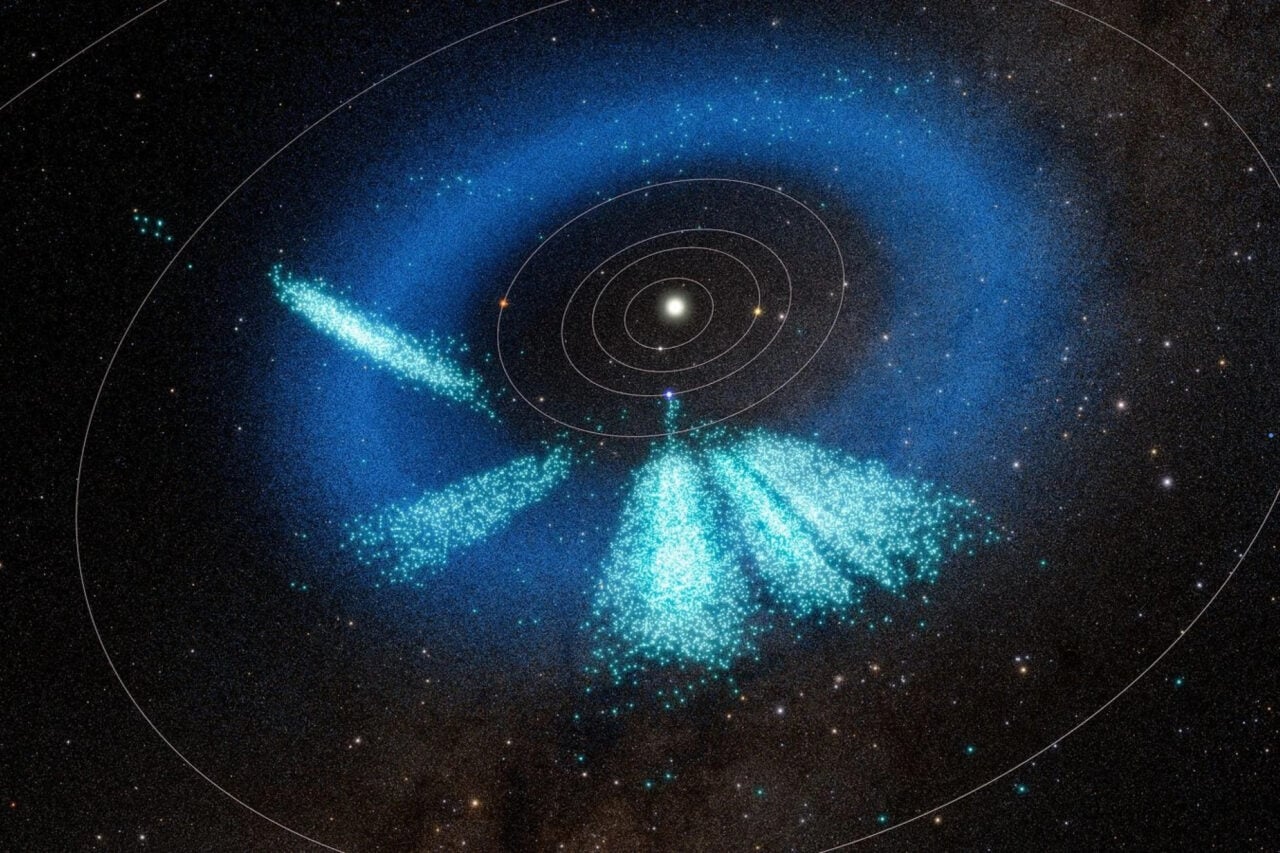
A model of the solar system showing the roughly 380 trans-Neptunian objects (TNOs) discovered using observations taken during Rubin’s early optimization surveys in summer 2025. Credit: NSF–DOE Vera C. Rubin Observatory/NOIRLab/SLAC/AURA/R. Proctor
But the dataset also contained roughly 380 trans-Neptunian objects (TNOs), including some of the most distant small, planet-like objects ever discovered. Finding TNOs “is like searching for a needle in a field of haystacks—out of millions of flickering sources in the sky,” Matthew Holman, an astrophysicist at the Center for Astrophysics | Harvard & Smithsonian, explained in the statement.
Babe, wake up
For perspective, Rubin found 380 TNO candidates in less than two months. In the last three decades, all of humanity’s detectors combined found 5,000 TNOs. The observatory is so good at its job that, I admit, it’s almost frightening.
Apparently, Rubin isn’t operating at full survey mode at the moment; once it does, astronomers expect it’ll capture an additional 90,000 new NEOs, some of which might brush past Earth. Indeed, Juric said that the latest asteroid haul represents “just the tip of the iceberg” of Rubin’s capabilities. So it really seems that we’re very close to building the most detailed census of our galactic neighborhood.
Sign in to highlight and annotate this article

Conversation starters
Daily AI Digest
Get the top 5 AI stories delivered to your inbox every morning.
Knowledge Map
Connected Articles — Knowledge Graph
This article is connected to other articles through shared AI topics and tags.




Discussion
Sign in to join the discussion
No comments yet — be the first to share your thoughts!