
Random numbers, Persian code: A mysterious signal transfixes radio sleuths
https://www.wired.com/story/a-mysterious-numbers-station-is-... Comments URL: https://news.ycombinator.com/item?id=47599510 Points: 42 # Comments: 55
The radio signal first started broadcasting on February 28, about 12 hours after the United States and Israel began bombing Iran.
On a scratchy shortwave signal almost twice a day -- in the early morning and early evening on Coordinated Universal Time -- a man's voice can be heard speaking Persian, counting out a series of apparently random numbers. The numbers are read out for varying stretches of time, followed by a pause in which the word tavajjoh -- which translates as "attention" -- is spoken three times.
The mystery of the transmission transfixed many in the global community of amateur radio sleuths, who have traded notes and tips on the signal, who's behind it, and what its purpose might be.
Five days later, it got more interesting.
Beginning on March 4, the signal started to be jammed, with a cacophonous screech of electronic noise that made it all but impossible to hear the numbers. The original transmission paused for a period of time, then moved to another shortwave frequency.
"It's interesting because it started to be jammed on the initial frequency," said Akin Fernandez, who is widely considered an authority on the decades-old encoded radio technology known as a numbers station. "Someone doesn't want the recipient [of the signal] to hear the numbers."
"It's an adversarial situation, two groups acting against one another. The question [is] who has the technical means to jam a station," Fernandez said. "The United States has the means, which means this is being transmitted by Iran. Or then it could be Iran, which means the United States is the transmission source."
"More likely this is an operation against Iran," he said.
'Absolutely Unbreakable'
Regardless of whose transmission it is and who is doing the jamming -- there are plenty of competing theories -- the mysterious broadcast is a throwback to another era, before the advent of digital encryption used widely in apps like WhatsApp and Signal and other places.
The transmission is called a numbers station, a Cold War-era tool that employs radio transmissions and old-school cryptology to transmit secret messages, usually to spies around the world.
The concept: Using a random series of a numbers, generated by some mechanical or electronic device or something more powerful, a person can send a coded message to another person in possession of a decoder, often called a "one-time pad."
An Iranian radar system system is seen during the first day of an Iranian military air defense exercise in October 2020
Anyone can listen to the transmission; shortwave transmissions travel long distances, signals bouncing off the atmosphere. But only a person with the decoder key can decipher it. The concept got a cameo in the US spy drama The Americans, set in the 1980s.
Numbers station code is "absolutely unbreakable," said Fernandez, who more than two decades ago published a four-CD audio compendium of hundreds of recordings from around the world called the Conet Project. It's considered the Bible for numbers-station enthusiasts.
"The number keys that are used are perfectly random. There are no mathematical operations you can use on them to brute force them," he said. "And even if the answer gets out, say in proper English, it's not necessarily understandable."
"You can't tell anything about a random set of letters or numbers by their length other than their length. The length of message is not the content of the information being transmitted," he said. "But it is possible to infer the purpose of stations by the length that they're online and the noise they transmit if there is no text message."
A spy and intelligence radio set (R-394KM) used by the Soviet-era KGB
The Persian language broadcast is the first new numbers station in years, according to Priyom, a blog run by radio enthusiasts who identified, cataloged, and analyzed the signal. The transmission was first dubbed V32 by a British-based group called Enigma2000. US-based reporter Seth Hettena also highlighted the signal in a blog post on March 4.
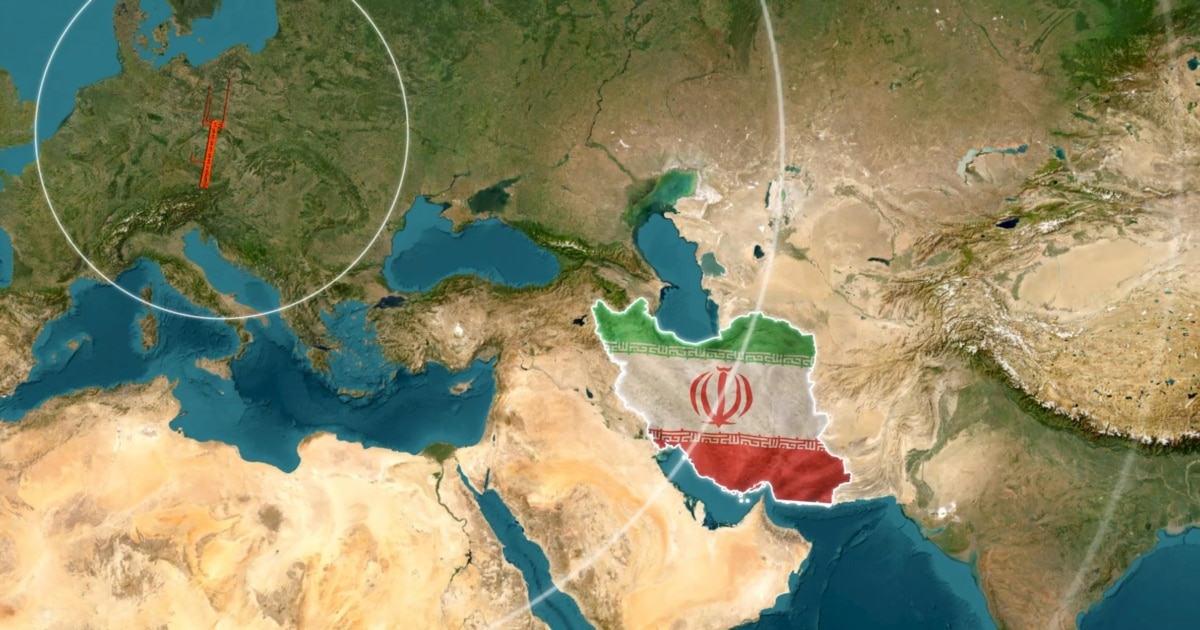
The group says its far-flung members have been able to triangulate the origin of the signal's transmitter: "somewhere in an area encompassing northern Italy, Switzerland, western Germany, eastern France, Belgium, and the Netherlands."
That narrowed the possibilities for the owner of the V32 transmission.
And then the jamming started.
Bubble Jammer
During the Cold War, broadcasts such as those from the BBC, Deutsche Welle, and Radio Free Europe/Radio Liberty, among others, were routinely jammed by Soviet bloc authorities who wanted to discourage citizens from getting uncensored information: news about their own countries, or, say, jazz and rock music from the West.
You drown out the incoming broadcast with dissonant noise, something known as a bubble jammer.
On March 4, according to Priyom, a bubble jammer started broadcasting noise on the same shortwave frequency as the original V32 broadcast, rendering it difficult to understand.
The V32 transmissions were interrupted briefly and then switched to another nearby frequency, Priyom said.
"At first the station was thought to be a spy station for the Iran Islamic regime, but when the bubble jammer appeared to jam it, it was an eye-opener," said Mauno Ritola, a database administrator at the Radio Data Center, a German-based radio company.
"It is exactly the same kind of bubble jammer that is used against Radio Farda, VOA Farsi, Iran International TV shortwave relay, and BBC Farsi," he said. "Even Radio Free Iran suffered from it one night."
Radio Farda is the Persian-language service for Radio Free Europe/Radio Liberty, also known as RFE/RL.
As for the source of the transmission, the global radio community has competing theories; many appear to home in on the United States as the originator, potentially sending coded messages to agents within Iran.
Other theories focus on Israel or even Turkey, which is not a participant in the US-Israeli campaign but is a long-established regional rival to Tehran.
Or, the Priyom bloggers posited, it could be a psychological operation: "a pretty visible, single-frequency station, starting up out of nowhere for a prime-time show on the first day of the war, with relatively few reliability features to ensure recipients actually could copy messages in their entirety and without errors."
The CIA did not immediately respond to an e-mailed query from RFE/RL.
Further muddying the waters: ABC News on March 9 reported that the US government had sent an alert to law enforcement agencies regarding "intercepted encrypted communications."
The report did not specify what exactly the transmission was, or whether it was a numbers station signal.
"While the exact contents of these transmissions cannot currently be determined, the sudden appearance of a new station with international rebroadcast characteristics warrants heightened situational awareness," ABC quoted the alert as saying.
RFE/RL correspondent Kian Sharifi contributed to this report.
Hacker News Top
https://www.rferl.org/a/mystery-numbers-station-persian-signal-iran-war/33700659.htmlSign in to highlight and annotate this article

Conversation starters
Daily AI Digest
Get the top 5 AI stories delivered to your inbox every morning.
Knowledge Map
Connected Articles — Knowledge Graph
This article is connected to other articles through shared AI topics and tags.

Discussion
Sign in to join the discussion
No comments yet — be the first to share your thoughts!