
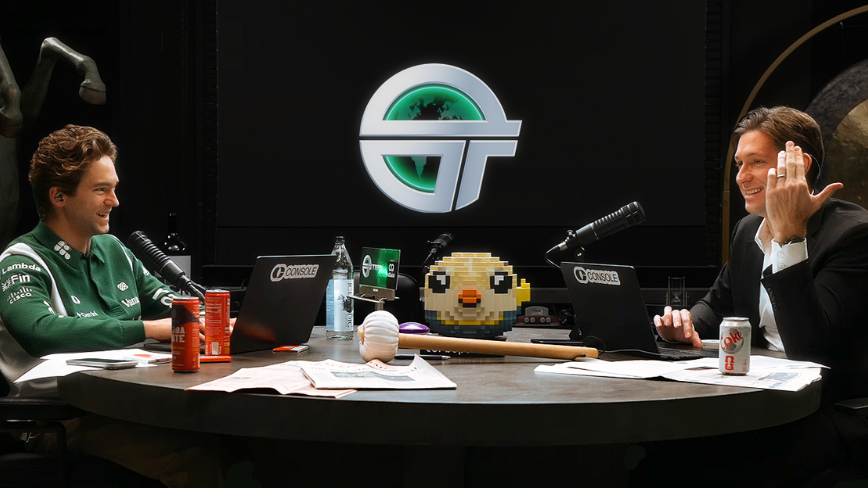
OpenAI buys TBPN, Silicon Valley’s favourite tech talk show, in its first media acquisition
The daily live show, hosted by former founders John Coogan and Jordi Hays, will sit inside OpenAI’s strategy organisation and report to chief global affairs officer Chris Lehane. Terms were not disclosed. OpenAI says TBPN will keep its editorial independence. OpenAI has acquired TBPN, the Technology Business Programming Network, the Silicon Valley talk show that [ ] This story continues at The Next Web
The daily live show, hosted by former founders John Coogan and Jordi Hays, will sit inside OpenAI’s strategy organisation and report to chief global affairs officer Chris Lehane. Terms were not disclosed. OpenAI says TBPN will keep its editorial independence.
OpenAI has acquired TBPN, the Technology Business Programming Network, the Silicon Valley talk show that has built a cult following among founders, investors, and executives since launching in March 2025.
The deal, terms of which were not disclosed, marks OpenAI’s first acquisition of a media company. TBPN will sit inside OpenAI’s strategy organisation and report to Chris Lehane, the company’s chief global affairs officer.
The show is hosted by John Coogan and Jordi Hays, both former tech founders, and airs daily on YouTube and X for roughly three hours, covering tech, business, AI, and defence. It has attracted an influential Silicon Valley audience, averaging around 70,000 viewers per episode across platforms, and has featured guests including Meta CEO Mark Zuckerberg, Microsoft CEO Satya Nadella, and Sam Altman himself.
The 💜 of EU tech
The latest rumblings from the EU tech scene, a story from our wise ol' founder Boris, and some questionable AI art. It's free, every week, in your inbox. Sign up now!
The show generated approximately $5 million in advertising revenue in 2025 and is on track to exceed $30 million this year, according to the Wall Street Journal. Sponsors include fintech firms Ramp and Plaid, Google’s Gemini division, and the New York Stock Exchange. TBPN has 11 employees and says it is profitable.
Fidji Simo, OpenAI’s CEO of Applications, announced the acquisition internally in a memo to staff, describing TBPN as “one of the places where the conversation about AI and builders is actually happening day to day.”
Simo pledged that OpenAI would maintain TBPN’s editorial independence, with the team continuing to choose its own guests and make its own editorial decisions. Altman, who has appeared on the show multiple times, posted on X that TBPN is “my favourite tech show” and added: “I don’t expect them to go any easier on us.”
The acquisition is an unusual move for an AI laboratory, and raises immediate questions about editorial independence that OpenAI is pre-emptively trying to answer.
TBPN will report to Lehane, a figure who served as a senior strategist in the Clinton administration and who has been described as a political operative skilled at managing press narratives. The show has previously covered OpenAI and its competitors as a subject, a dynamic that will now exist within an ownership structure. Coogan, for his part, noted on X that he has known Altman for over a decade, with Altman having backed his first company in 2013. Whether the promised editorial firewall holds will become apparent over time.
Sign in to highlight and annotate this article

Conversation starters
Daily AI Digest
Get the top 5 AI stories delivered to your inbox every morning.
More about
acquisitionreportglobal
Cloud Observability vs Monitoring: What's the Difference and Why It Matters
Cloud Observability vs Monitoring: What's the Difference and Why It Matters Your alerting fires at 2 AM. CPU is at 94%, error rate is at 6.2%, and latency is climbing. You page the on-call engineer. They open the dashboard. They see the numbers going up. What they cannot see is why — because the service throwing errors depends on three upstream services, one of which depends on a database that is waiting on a connection pool that was quietly exhausted by a batch job that ran 11 minutes ago. Monitoring told you something was wrong. Observability would have told you what. This is not a semantic argument. Teams with mature observability resolve incidents 2.8x faster than teams that rely on monitoring alone, according to DORA research. The gap matters in production. Understanding why the gap e

Real-time emotion detection from webcam — no wearables needed
We’ve been running controlled trials with real-time facial affect analysis using nothing but a standard 720p webcam — no IR sensors, no EEG caps, no chest straps. The goal? Detect emotional valence and arousal with enough accuracy to be useful in high-stakes environments: remote proctoring, telehealth triage, UX research. Most open-source pipelines fail here because they treat emotion as a static classification problem. We treat it as a dynamic signal. Our stack uses a lightweight RetinaFace for detection, followed by a pruned EfficientNet-B0 fine-tuned on dynamic expressions from the AFEW and SEED datasets — not just static FER2013 junk. Temporal smoothing via a 1D causal CNN on top of softmax outputs reduces jitter and improves response latency under variable lighting. The real breakthro
Takedown is not a ticket, but a campaign-suppression system
Most security teams still talk about takedown as if it were one workflow: detect a phishing page, file an abuse report, wait for the host or registrar, close the ticket, move on. That model was always too simple, and it is getting weaker. The better way to think about takedown is this: takedown is the process of reducing attacker operating time across the assets, channels, and trust surfaces a campaign depends on . If your process only removes one URL but leaves the spoofed number, the cloned social profile, the fake app listing, the paid ad, or the next domain in the chain untouched, you did not really suppress the campaign. You trimmed one branch. That distinction matters because modern phishing and scam operations are not domain-only problems. APWG recorded 892,494 phishing attacks in Q
Knowledge Map
Connected Articles — Knowledge Graph
This article is connected to other articles through shared AI topics and tags.
More in Market News
Behind the Curtain: Sam's superintelligence New Deal
OpenAI CEO Sam Altman is doing something no tech titan has ever done: He's publishing a detailed blueprint for how government should tax, regulate and redistribute the wealth from the very technology he's racing to build and spread. Why it matters: Altman told us in a half-hour interview that AI superintelligence is so close, so mind-bending, so disruptive that America needs a new social contract — on the scale of the Progressive Era in the early 1900s, and the New Deal during the Great Depression . The big picture: The threats of inaction or slow action are grave, Altman warns — widespread job loss, cyberattacks, social upheaval, machines man can't control. The two most immediate threats, he said, are cyberattacks and biological attacks: We've told you that top tech, business and governme


Discussion
Sign in to join the discussion
No comments yet — be the first to share your thoughts!