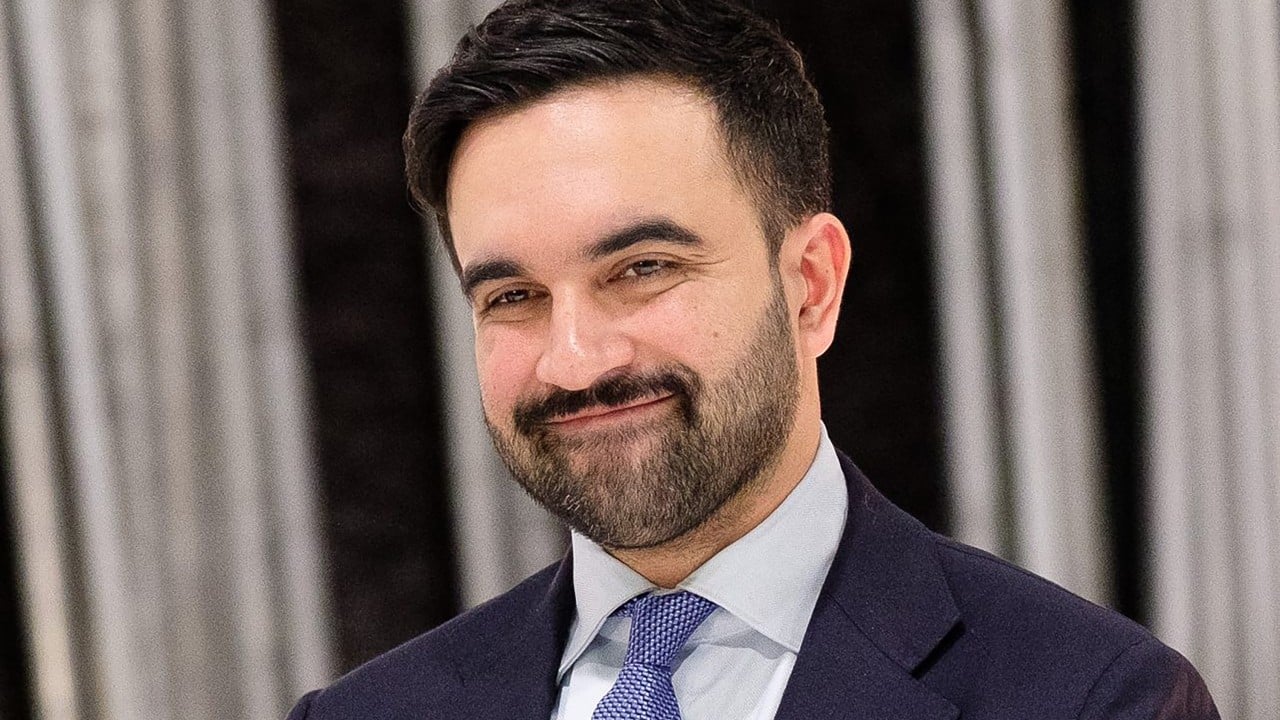
New York Mayor Mamdani puts city’s government back on TikTok
Almost three years ago, New York City joined governments across the country in banning TikTok from its phones over security concerns about the Chinese social media site. On Tuesday, Mayor Zohran Mamdani, a bona fide social media star, took to the app to announce a reversal: “TikTok, we’re back.” The city will now allow agencies to start posting again on the short-form social media site as long as departments follow a set of security precautions, according to a memo from city cybersecurity...
Almost three years ago, New York City joined governments across the country in banning TikTok from its phones over security concerns about the Chinese social media site.
On Tuesday, Mayor Zohran Mamdani, a bona fide social media star, took to the app to announce a reversal: “TikTok, we’re back.”
The city will now allow agencies to start posting again on the short-form social media site as long as departments follow a set of security precautions, according to a memo from city cybersecurity officials provided by the mayor’s office.
The prohibition was established by Eric Adams, Mamdani’s predecessor, in 2023, as the federal government and many US states restricted the app from government-owned devices over concerns that its parent company, ByteDance, could share data with the Chinese government.
TikTok had waved off the governments’ worries as unfounded. Since then it has reached an agreement to spin off its US operation in a move to alleviate those concerns and avoid a wider ban in the country.
Democratic Socialist Mamdani elected New York City mayor
Democratic Socialist Mamdani elected New York City mayor
In a memo on Tuesday, NYC Cyber Command, which is in charge of safeguarding city systems against cyber threats, wrote that the change was about broadening the city’s communications reach.
SCMP Tech (Asia AI)
https://www.scmp.com/news/world/united-states-canada/article/3348591/new-york-mayor-mamdani-puts-citys-government-back-tiktok?utm_source=rss_feedSign in to highlight and annotate this article

Conversation starters
Daily AI Digest
Get the top 5 AI stories delivered to your inbox every morning.
More about
announcegovernmentcountry
GazeCLIP: Gaze-Guided CLIP with Adaptive-Enhanced Fine-Grained Language Prompt for Deepfake Attribution and Detection
arXiv:2603.29295v1 Announce Type: new Abstract: Current deepfake attribution or deepfake detection works tend to exhibit poor generalization to novel generative methods due to the limited exploration in visual modalities alone. They tend to assess the attribution or detection performance of models on unseen advanced generators, coarsely, and fail to consider the synergy of the two tasks. To this end, we propose a novel gaze-guided CLIP with adaptive-enhanced fine-grained language prompts for fine-grained deepfake attribution and detection (DFAD). Specifically, we conduct a novel and fine-grained benchmark to evaluate the DFAD performance of networks on novel generators like diffusion and flow models. Additionally, we introduce a gaze-aware model based on CLIP, which is devised to enhance t
ENEIDE: A High Quality Silver Standard Dataset for Named Entity Recognition and Linking in Historical Italian
arXiv:2603.29801v1 Announce Type: new Abstract: This paper introduces ENEIDE (Extracting Named Entities from Italian Digital Editions), a silver standard dataset for Named Entity Recognition and Linking (NERL) in historical Italian texts. The corpus comprises 2,111 documents with over 8,000 entity annotations semi-automatically extracted from two scholarly digital editions: Digital Zibaldone, the philosophical diary of the Italian poet Giacomo Leopardi (1798--1837), and Aldo Moro Digitale, the complete works of the Italian politician Aldo Moro (1916--1978). Annotations cover multiple entity types (person, location, organization, literary work) linked to Wikidata identifiers, including NIL entities that cannot be mapped to the knowledge graph. To the best of our knowledge, ENEIDE represents
MELT: Improve Composed Image Retrieval via the Modification Frequentation-Rarity Balance Network
arXiv:2603.29291v1 Announce Type: new Abstract: Composed Image Retrieval (CIR) uses a reference image and a modification text as a query to retrieve a target image satisfying the requirement of ``modifying the reference image according to the text instructions''. However, existing CIR methods face two limitations: (1) frequency bias leading to ``Rare Sample Neglect'', and (2) susceptibility of similarity scores to interference from hard negative samples and noise. To address these limitations, we confront two key challenges: asymmetric rare semantic localization and robust similarity estimation under hard negative samples. To solve these challenges, we propose the Modification frEquentation-rarity baLance neTwork MELT. MELT assigns increased attention to rare modification semantics in mult
Knowledge Map
Connected Articles — Knowledge Graph
This article is connected to other articles through shared AI topics and tags.
More in Laws & Regulation

Anthropic Dials Back AI Safety Commitments - WSJ
<a href="https://news.google.com/rss/articles/CBMiiwNBVV95cUxOdlVzdkFnMTJBcWU4MGJmVjZWdHdSS05scHczVXZRVDlJNXZ5eVY0eDU2d09YNEw5bXhlYjdIWGdnN0lpTGZTNnFhLTY5dUJ1QlF6TjAzRWxEMmEteGQyRGNHRDlQR2lVVEQ3dk5Tb0dSY3lfZER1WkNUQzM1VTQyaHQzM2k5LVh0UDJpN3FjWV9GbFJ5UHk5YkZXLWRSX2RzOTJVZHZfbVVXdHRkQXFfQjZUNUxhXzJlTFYzUnZJTkNuTXpDYldHQXZMYWhKZ3YyMmRDM0I5bHFnRjF0VFBhSHB1YUs2OVFBLUZIQ21vdURUY0ZXQ3h3allhOUVVUGU3TEY5OWdtZWdUMHl0Nm5INEhuUkZ0V2Z5bjM3eTN4cDRNQlEydUlkWllCVVJHOS1FcXo0U21xNF9sN3laWW1kRUlCb1R5UGFHdHMzOE1kd0F6cU9yMVF2REhLUFJpeW5xX2Z3NlJLYWZpTmlmVnJpWDhEeDlrUTJ3VGFpTXN4Q20zMU1NTTRjMzg1SQ?oc=5" target="_blank">Anthropic Dials Back AI Safety Commitments</a> <font color="#6f6f6f">WSJ</font>
Top 10 AI Prompts and Use Cases and in the Government Industry in Tanzania - nucamp.co
<a href="https://news.google.com/rss/articles/CBMi2AFBVV95cUxQd3hVcEt5aHRCQmh5cXh5RmxuM2VkUVREeEQwQVpSTXo5RlpNNjhMdnQ3d0txNUNaMzJEMndpN0l1T1pMV3dFb3VBLWJPaTI3ckNNY3BiaXZMc2R3QTUtczdQalZsQ0RZRWpmUDFuTGNVaEdrd0MzV0V5RVlwdHUzTTEtYnFaeGRqSlkwaVhESXdhMnpLNkk5eENMNTV0V0hoeWRRUElHQmVZTVlmVkwtY3F5UXVaMWpfaDY1ZHh0SkZLR0Zsd3JHbk5CN2ZwOEd0dUNPdm5YcWU?oc=5" target="_blank">Top 10 AI Prompts and Use Cases and in the Government Industry in Tanzania</a> <font color="#6f6f6f">nucamp.co</font>
Stochastic Dimension Implicit Functional Projections for Exact Integral Conservation in High-Dimensional PINNs
arXiv:2603.29237v1 Announce Type: new Abstract: Enforcing exact macroscopic conservation laws, such as mass and energy, in neural partial differential equation (PDE) solvers is computationally challenging in high dimensions. Traditional discrete projections rely on deterministic quadrature that scales poorly and restricts mesh-free formulations like PINNs. Furthermore, high-order operators incur heavy memory overhead, and generic optimization often lacks convergence guarantees for non-convex conservation manifolds. To address this, we propose the Stochastic Dimension Implicit Functional Projection (SDIFP) framework. Instead of projecting discrete vectors, SDIFP applies a global affine transformation to the continuous network output. This yields closed-form solutions for integral constraint
Discussion
Sign in to join the discussion
No comments yet — be the first to share your thoughts!