
More, and More Extensive, Supply Chain Attacks
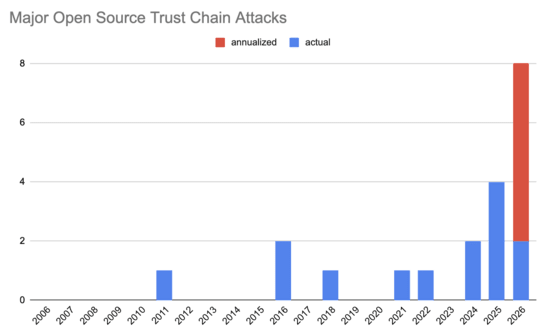
Open source components are getting compromised a lot more often. I did some counting, with a combination of searching, memory, and AI assistance, and we had two in 2026-Q1 ( trivy , axios ), after four in 2025 ( shai-hulud , glassworm , nx , tj-actions ), and very few historically [1]: Earlier attacks were generally compromises of single projects, but some time around Shai-Hulud in 2025-11 there started to be a lot more ecosystem propagation. Things like the Trivy compromise leading to the LiteLLM compromise and (likely, since it was three days later and by the same attackers) Telnyx . I only counted the first compromise in chain in the chart, but if we counted each one the increase would be much more dramatic. Similarly, I only counted glassworm for 2025, when it came out, but it's still
Open source components are getting compromised a lot more often. I did some counting, with a combination of searching, memory, and AI assistance, and we had two in 2026-Q1 (
trivy,
axios), after four in 2025 (
shai-hulud,
glassworm,
nx,
tj-actions), and very few historically [1]:
Earlier attacks were generally compromises of single projects, but some time around Shai-Hulud in 2025-11 there started to be a lot more ecosystem propagation. Things like the Trivy compromise leading to the LiteLLM compromise and (likely, since it was three days later and by the same attackers) Telnyx. I only counted the first compromise in chain in the chart, but if we counted each one the increase would be much more dramatic. Similarly, I only counted glassworm for 2025, when it came out, but it's still going.
In January I told a friend something like: "I'm surprised we're not seeing more AI-enabled cyberattacks. It seems like AIs have gotten to the point that they'd really be helping bad actors here, but it all still feels pretty normal and I don't understand why." While it's always hard to call the departure of an exponential from a noisy baseline, if this is AI helping with attacks we should expect this rate of increase to continue.
Other data points that have me expecting security to get worse before it gets better:
- Linux is seeing a large increase in real security reports:
We were between 2 and 3 per week maybe two years ago, then reached probably 10 a week over the last year with the only difference being only AI slop, and now since the beginning of the year we're around 5-10 per day depending on the days (fridays and tuesdays seem the worst). Now most of these reports are correct, to the point that we had to bring in more maintainers to help us.
We're seeing the defender side, but attackers can use the same tooling.
- Claude Opus 4.6 seems to be actually good at finding and exploiting holes:
When we pointed Opus 4.6 at some of the most well-tested codebases (projects that have had fuzzers running against them for years, accumulating millions of hours of CPU time), Opus 4.6 found high-severity vulnerabilities, some that had gone undetected for decades.
- AI agents eagerly pull in unvetted dependencies if they seem like they'd solve the problem at hand, and while humans do this too the agents massively speed up this process.
But I do think it will get better: while I'm not an expert here, I see many factors that favor defenders:
-
I think it's pretty likely that security bugs in major software are for the first time being identified faster than they're being written.
-
Checking package updates for vulnerabilities was never something most people did, but automated systems could plausibly do it well.
-
Most programmers are pretty terrible reviewing code in enough detail to notice something underhanded, but LLMs excel at this kind of attention to detail.
-
Developer education is hard, model education is much less so. I remember how long it took for SQL injections to go from a known attack to something most programmers knew not to do; it's way easier to keep LLMs from doing this.
-
Dependency cooldowns are very simple, but would help a lot.
-
Migration to more robust systems is more automatable. Automated conversion from C to Rust, switching to TrustedTypes, etc.
I wish defenders in biology had the same structural advantages!
[1] Here's my attempt at earlier years, all with a bar of "compromise of a widely used open-source trust path that forced action well beyond the directly compromised maintainer or project":
-
2024: polyfill.io, xz
-
2022: pytorch
-
2021: ua-parser-js
-
2018: event-stream
-
2016: ke-ranger, linux mint
-
2011: vsftpd
lesswrong.com
https://www.lesswrong.com/posts/XPYS5RcFqwCMfaoWo/more-and-more-extensive-supply-chain-attacksSign in to highlight and annotate this article

Conversation starters
Daily AI Digest
Get the top 5 AI stories delivered to your inbox every morning.



Knowledge Map
Connected Articles — Knowledge Graph
This article is connected to other articles through shared AI topics and tags.
More in Releases

The Spaceballs sequel will be released in April next year
There's finally a release date for the Spaceballs sequel — but before you get too excited, it's a whole year away. As first reported by Deadline , Amazon MGM Studios announced on Friday night that the upcoming Spaceballs movie will hit theaters on April 23, 2027, right around the 40th anniversary of the first film. Several members of the original cast will be reprising their roles, according to Deadline , including Mel Brooks, Rick Moranis, Bill Pullman, George Wynder and Daphne Zuniga. Spaceballs: The Release Date. April 23, 2027. pic.twitter.com/5Xv0BKmf7C — Amazon MGM Studios (@AmazonMGMStudio) April 4, 2026 Whispers of a potential Spaceballs 2 go back a couple of years, but Brooks officially confirmed in an extremely on-brand announcement video last summer that the movie is actually ha

Template Literals in JavaScript
when you first start javascript building string often involves using the + operator.While this works quickly but it become messy and hard to read as code grows. Before ES6, developers created strings like this: let name = " Alice " ; let age = 25 ; let message = " Hello, my name is " + name + " and I am " + age + " years old. " This approach has several drawbacks: Hard to read: The sentence is broken into multiple parts. Error-prone: Easy to forget spaces or quotes. Messy with complex strings: Adding more variables makes it worse. Difficult for multi-line strings: Requires \n or awkward formatting. Template Literal Syntax Template literals were introduced in ES6 and use backticks (`) instead of quotes. javascript let message = Hello, my name is Alice. ; Embedding Variables in Strings Inste

The Documentation Attack Surface: How npm Libraries Teach Insecure Patterns
Most security audits focus on code. But across five reviews of high-profile npm libraries — totaling 195 million weekly downloads — I found the same pattern: the code is secure, but the README teaches developers to be insecure. One finding resulted in a GitHub Security Advisory (GHSA-8wrj-g34g-4865) filed at the axios maintainer's request. This isn't a bug in any single library. It's a systemic issue in how the npm ecosystem documents security-sensitive operations. The Pattern A library implements a secure default. Then its README shows a simplified example that strips away the security. Developers copy the example. The library's download count becomes a multiplier for the insecure pattern. Case 1: axios — Credential Re-injection After Security Stripping (65M weekly downloads) The code: fo

Discussion
Sign in to join the discussion
No comments yet — be the first to share your thoughts!