
ML Safety Newsletter #2
Adversarial Training, Feature Visualization, and Machine Ethics
Welcome to the 2nd issue of the ML Safety Newsletter. In this edition, we cover:
- adversarial training for continuous and discrete inputs
- feature visualizations vs. natural images for interpretability
- steering RL agents from causing wanton harm
- ... and much more.
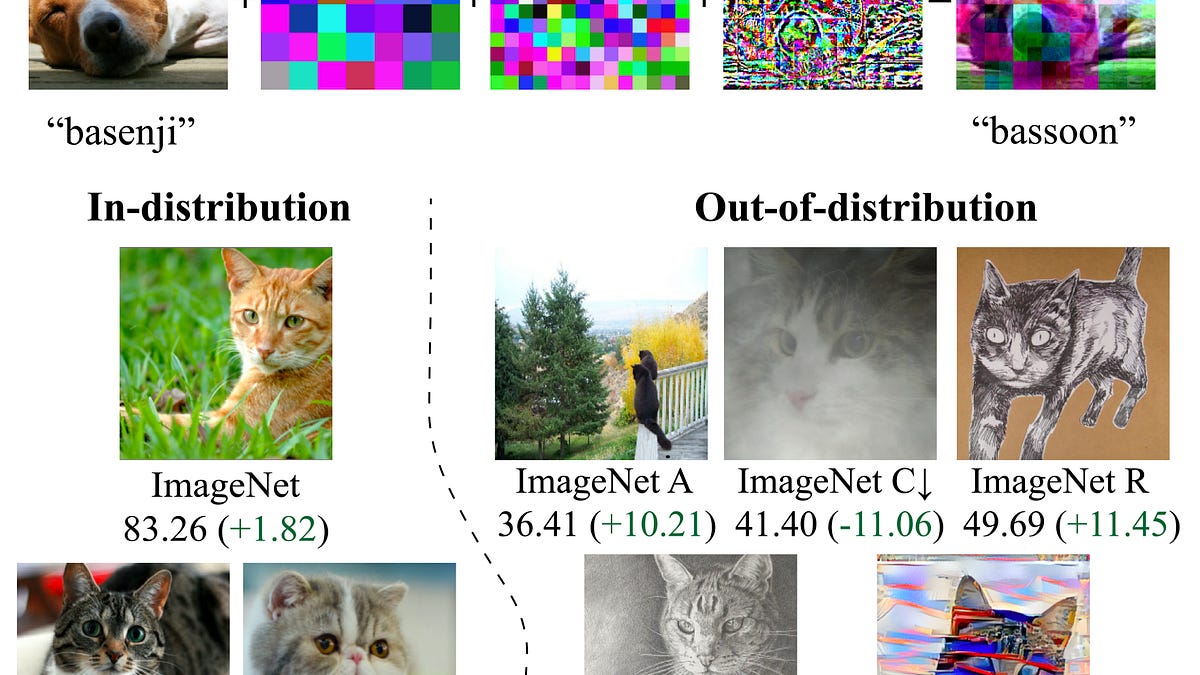
Top: Visualization of adversarial pyramid perturbations. Bottom: In-distribution and out-of-distribution examples, and the gains from adversarial pyramid training.
While adversarial training can help make models more robust to a few specific attacks, it usually substantially reduces robustness in practical settings. However, this paper proposes a new type of adversarial training that provides strong robustness gains across the board. Adversarial training has been difficult to make useful, as the adversary often overpowers the model. By imposing a useful structural constraint on adversarial perturbations, their method reopens a research direction towards robust representations.
Paper
Non-adversarial: just collect more data. Static adversarial: collect data to break the model from the first round. Dynamic adversarial: collect data to break the model from the most recent round.
Imagine the following loop:
- train a model on the current dataset
- add new labeled examples to the dataset in order to patch model errors
- repeat
Repeated many times, would models become highly reliable? Meta AI has been exploring this approach in recent papers, and this Meta AI paper shows that this loop has sharply diminishing returns. This suggests that collecting a large amount of adversarially curated data is an impractical path towards human-level reliability. However, adversarially curated data is better than randomly curated data, which may be why companies such as Tesla use this loop.
Paper
An adversarial NLP benchmark dataset that covers many different types of adversarial transformations.
In the NeurIPS domain adaptation competition, the winning solution did not use domain adaptation methods and just used an off-the-shelf Vision Transformer (BeIT).
A collection of real-world images with unusual texture, 3D pose, shape, background context (spurious cues), and weather. Synthetic data augmentation helps with many of these real-world distribution shifts.
This paper tries to evaluate whether feature visualizations help users interpret neural networks. Users are given two occluded images, one that is maximally activating and one that is minimally activating, and users are to predict which is maximally activating. While feature visualizations help users predict which image is maximally activating, the effect is minor and users perform similarly when given simpler natural images rather than feature visualizations. This NeurIPS paper shares many authors with the previous ICLR paper which finds that natural images are often more helpful for interpretability than feature visualizations.
Paper
Adversarial patches can help to teach models how to locate anomalous regions.
A postprocessing method that helps models locate anomalous regions.
A dataset that captures instances of deception in negotiation conversations.
Moral knowledge from a classifier trained on ETHICS combined with standard Q-values creates agents that take fewer immoral actions.
We repurposed text adventure games and annotated hundreds of thousands of lines of game source code to highlight whenever a morally salient event occurs. We found that roughly 17% of actions that receive reward are immoral—this suggests pretraining in diverse RL environments will incentivize agents to behave badly. Using these diverse text-based environments, we showed it is possible to use models from the ETHICS paper to transform reinforcement learning (RL) agents' Q-values and cause them to behave less destructively. With our technique, agents propose actions, and a separate model can successfully filter out unethical actions, preventing RL agents from causing wanton harm. If the action screening module can become highly reliable and adversarially robust, this could potentially prevent advanced agents from choosing many clearly harmful actions.
Paper
Mitigating unintended consequences by encouraging agents to take reversible actions.
A method to reduce the gaming of model-based proxies.
Towards a text-based assistant that is helpful, honest, and harmless.
Mathematical Reasoning Forecasting. OpenAI’s eighth-grade arithmetic word problems dataset is challenging even for fine-tuned GPT-3, showing that multistep mathematical reasoning is difficult for today’s largest models. However, computers are quite capable of executing multiple steps of instructions to calculate answers to maths problems. A recent work shows Codex can be leveraged to write computer programs that successfully solve undergraduate probability problems. The Codex model outputs a programmatic strategy to reach the answer, and the computer performs the busy work needed to execute the strategy and calculate the answer.
Grants. Open Philanthropy will fund grants on measuring and forecasting AI risks, techniques for enhancing human feedback, interpretability, and honest AI. Applications are due January 10th, 2022.
No posts
Sign in to highlight and annotate this article

Conversation starters
Daily AI Digest
Get the top 5 AI stories delivered to your inbox every morning.
More about
trainingfeaturesafety
How AI Is Changing the Way We Build Online Businesses
Not long ago, building an online business meant: months of development hiring developers large upfront costs Today? AI has completely changed the game. Now, one person can go from idea → to revenue faster than ever before. And this shift is just getting started. ⚠️ The Old Way vs The New Way Before AI: Build everything from scratch Spend weeks on infrastructure Launch slowly Iterate even slower With AI: Build faster Automate key tasks Launch quickly Iterate in real time The difference is massive. 🧠 AI Is Reducing the Cost of Building One of the biggest changes: 👉 Building is no longer the bottleneck AI helps with: generating content writing code automating workflows handling repetitive tasks What used to take weeks… 👉 now takes days ⚙️ Infrastructure Is No Longer the Hard Part Another s

Beyond the Boardroom: How Decentralized Autonomous Organizations (DAOs) are Reshaping E-commerce
Beyond the Boardroom: How Decentralized Autonomous Organizations (DAOs) are Reshaping E-commerce The digital economy is in constant flux, driven by innovation and a persistent desire for greater transparency and user empowerment. Amidst this evolution, a powerful new paradigm is emerging: Decentralized autonomous organizations (DAOs) in commerce . These blockchain-native entities are not just a technical curiosity; they represent a fundamental shift in how businesses can be structured, governed, and operated, offering a compelling alternative to traditional corporate hierarchies. For developers, entrepreneurs, and anyone interested in the future of online business, understanding the implications of DAOs for e-commerce is no longer optional – it's essential. The Democratization of Digital M

Same Agents, Different Minds — What 180 Configurations Proved About AI Environment Design
Google tested 180 agent configurations. Same foundation models. Same tasks. Same tools. The only variable was how the agents talked to each other. Independent agents — working in parallel, no communication — amplified errors 17.2 times. Give the same agents a centralized hub-and-spoke topology, and error amplification dropped to 4.4 times. Same intelligence. Same training. A 3.9x difference in error rate, explained entirely by communication structure. This isn't a story about better prompts or smarter models. It's a story about environment. And it follows directly from a claim I made in Part 1 of this series : the interface isn't plumbing between the AI and the world. It's a mold that shapes what the AI becomes. Part 1 argued this through cases — a developer who felt hollowed out by AI, a
Knowledge Map
Connected Articles — Knowledge Graph
This article is connected to other articles through shared AI topics and tags.



Discussion
Sign in to join the discussion
No comments yet — be the first to share your thoughts!