

Long-Reach Robotic Cleaning for Lunar Solar Arrays
arXiv:2603.29240v1 Announce Type: new Abstract: Commercial lunar activity is accelerating the need for reliable surface infrastructure and routine operations to keep it functioning. Maintenance tasks such as inspection, cleaning, dust mitigation, and minor repair are essential to preserve performance and extend system life. A specific application is the cleaning of lunar solar arrays. Solar arrays are expected to provide substantial fraction of lunar surface power and operate for months to years, supplying continuous energy to landers, habitats, and surface assets, making sustained output mission-critical. However, over time lunar dust accumulates on these large solar arrays, which can rapidly degrade panel output and reduce mission lifetime. We propose a small mobile robot equipped with a
View PDF HTML (experimental)
Abstract:Commercial lunar activity is accelerating the need for reliable surface infrastructure and routine operations to keep it functioning. Maintenance tasks such as inspection, cleaning, dust mitigation, and minor repair are essential to preserve performance and extend system life. A specific application is the cleaning of lunar solar arrays. Solar arrays are expected to provide substantial fraction of lunar surface power and operate for months to years, supplying continuous energy to landers, habitats, and surface assets, making sustained output mission-critical. However, over time lunar dust accumulates on these large solar arrays, which can rapidly degrade panel output and reduce mission lifetime. We propose a small mobile robot equipped with a long-reach, lightweight deployable boom and interchangeable cleaning tool to perform gentle cleaning over meter-scale workspaces with minimal human involvement. Building on prior vision-guided long-reach manipulation, we add a compliant wrist with distal force sensing and a velocity-based admittance controller to regulate stable contact during surface cleaning. In preliminary benchtop experiments on a planar surface, the system maintained approximately 2 N normal force while executing a simple cleaning motion over boom lengths from 0.3 m to 1.0 m, with RMS force error of approximately 0.2 N after initial contact. These early results suggest that deployable long-reach manipulators are a promising architecture for robotic maintenance of lunar infrastructure such as solar arrays, radiators, and optical surfaces.
Comments: Extended abstract, 4 pages, 3 figures, accepted to and presented at the Sustainable Space Robotics Workshop at iSpaRo 2025
Subjects:
Robotics (cs.RO)
ACM classes: I.2.9
Cite as: arXiv:2603.29240 [cs.RO]
(or arXiv:2603.29240v1 [cs.RO] for this version)
https://doi.org/10.48550/arXiv.2603.29240
arXiv-issued DOI via DataCite (pending registration)
Submission history
From: Long Yin Chung [view email] [v1] Tue, 31 Mar 2026 04:09:11 UTC (4,514 KB)
Sign in to highlight and annotate this article

Conversation starters
Daily AI Digest
Get the top 5 AI stories delivered to your inbox every morning.
More about
announceapplicationarxiv
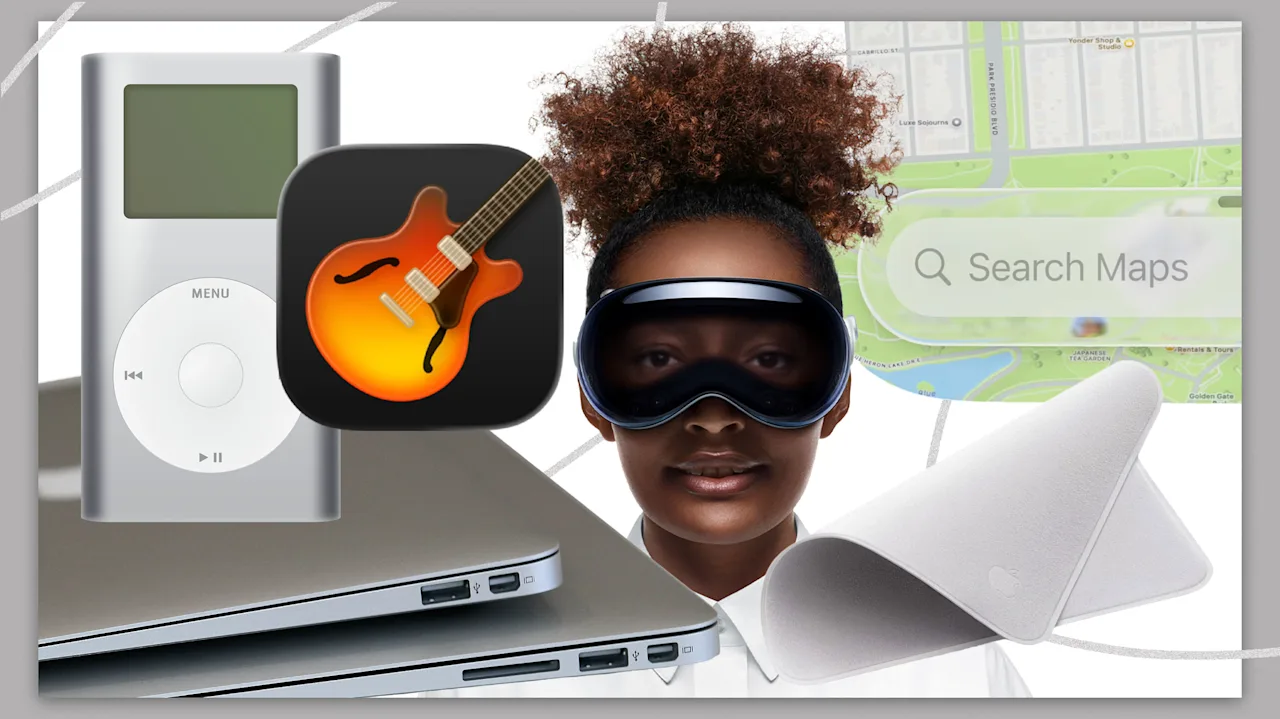
Apple at 50: The tech giant’s best, worst, and weirdest ideas
Founded by Steve Jobs and Steve Wozniak, Apple officially incorporated on April 1, 1976. The company helped usher in the era of personal computing, pairing meticulous design with tight hardware–software integration and a simple promise: It just works . Its history has been anything but linear. There were early breakthroughs, a near-collapse in the 1990s , and a dramatic revival after Jobs returned, followed by a run of mass-market hits beginning with the iPod and accelerating with the iPhone. All told, Apple has over five decades launched category-defining products, shelved its share of misfires, and pushed some genuinely odd ideas. These are the clearest examples of each. Apple s best iPod Mini: While the original iPod transformed music consumption and kicked off Apple s ascent as a consu
4 AI chatbots tried to fact-check Rubio on Iran. They couldn’t agree
On Monday, March 30, Secretary of State Marco Rubio told Good Morning America ’s George Stephanopoulos that the U.S. objectives in the Iran war are exactly the same as those laid out by President Donald Trump on February 28, when the U.S. and Israel launched airstrikes across the country. The consistency of the objectives over the past month of fighting is a sensitive issue; the White House doesn’t want to appear to have whittled down its strategic goals so that it can depart the conflict sooner. “This operation is about a set of very specific objectives; the president laid them out on the very first night of operations,” Rubio told Stephanopoulos. “I ll repeat them to you now because I hear a lot of talk about we don t know what the clear objectives are. Rubio then listed four objectives:
Knowledge Map
Connected Articles — Knowledge Graph
This article is connected to other articles through shared AI topics and tags.

Discussion
Sign in to join the discussion
No comments yet — be the first to share your thoughts!