
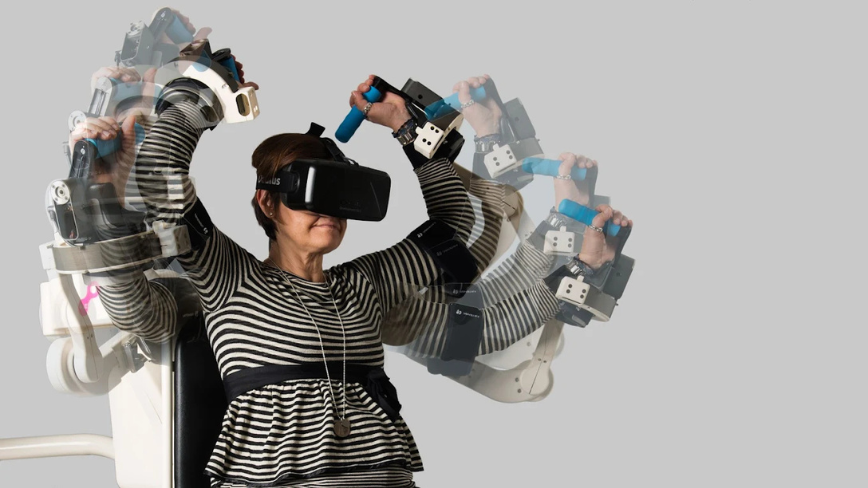
Italian rehabilitation robotics startup Wearable Robotics raises €5M to expand its arm exoskeleton
Hey there, superstar! ✨ Imagine you have a favorite toy robot, but this robot is super special!
There's a company called "Wearable Robotics" that makes a robot arm that you can wear, like a superhero glove! It helps people who have trouble moving their arms, maybe after they've been sick. It's like a friendly helper that gently guides their arm to move again.
Guess what? Lots of grown-ups gave this company some money, like giving them extra coins for the candy store! 💰 This means they can make even more robot arms and send them to kids and grown-ups all over the world who need help. Yay for helpful robots! 🎉
The Pisa-based Sant’Anna spin-off has deployed its ALEX RS bilateral upper-limb exoskeleton across 20 countries since founding in 2014. CDP Venture Capital led the Series A, with SIMEST providing international expansion funding through Italy’s Ministry of Foreign Affairs. Wearable Robotics, an Italian rehabilitation technology company spun out of the Sant’Anna School of Advanced Studies in [ ] This story continues at The Next Web
The Pisa-based Sant’Anna spin-off has deployed its ALEX RS bilateral upper-limb exoskeleton across 20 countries since founding in 2014. CDP Venture Capital led the Series A, with SIMEST providing international expansion funding through Italy’s Ministry of Foreign Affairs.
Wearable Robotics, an Italian rehabilitation technology company spun out of the Sant’Anna School of Advanced Studies in Pisa, has raised €5 million in a Series A funding round to accelerate international expansion and complete its product portfolio.
The round was led by CDP Venture Capital through its Accelerators Fund, with participation from MITO Technology, LIFTT, SIMEST, RoboIT, and Toscana Next, a co-investment fund managed by CDP Venture Capital and backed by the main Tuscan banking foundations. Lucia Lencioni serves as CEO.
The company, founded in 2014, develops wearable robotic rehabilitation devices integrated with augmented and virtual reality systems for neuromotor recovery. Its flagship product, ALEX RS, is a bilateral upper-limb exoskeleton designed for post-stroke rehabilitation that covers 92% of the human arm’s natural range of motion.
The device is CE certified as a Class IIa medical device. More than 50 units have been deployed in clinical hospitals and rehabilitation centres across 20 countries.
Wearable Robotics holds a family of eight proprietary patents covering kinematics, sensors, actuation systems, and exoskeleton design. The biomedical division operates under the Nexum Robotics brand.
SIMEST’s participation is notable: the Italian state-backed institution provides financing to Italian companies for international expansion under a mandate from the Ministry of Foreign Affairs and International Cooperation, which makes its involvement a direct signal of North America as the primary geographic target.
The broader investor consortium, which combines CDP Venture Capital’s startup infrastructure, LIFTT’s deep tech focus (a LIFTT portfolio note confirms it has backed Wearable Robotics since 2023), and RoboIT’s national technology transfer mandate for robotics, reflects a co-ordinated Italian public-private push behind one of the more clinically validated rehabilitation robotics companies in Europe.
The €5 million will fund product portfolio completion, regulatory approvals in new markets, commercial and distribution network expansion, and production capacity optimisation. The rehabilitation robotics market has commercial depth: an estimated 200 million patients globally require neuromotor rehabilitation following stroke, traumatic brain injury, and spinal cord injury, according to Wearable Robotics.
Traditional physical therapy achieves full mobility recovery in only around 10% of patients, the company says, the gap that robotic rehabilitation systems are designed to close through more intensive, measurable, and personalised treatment.
Sign in to highlight and annotate this article

Conversation starters
Daily AI Digest
Get the top 5 AI stories delivered to your inbox every morning.
More about
startupcompanyfunding


The rapid adoption of AI coding tools has let workers generate massive volumes of code, leaving companies scrambling to review and secure the AI-generated code (New York Times)
New York Times : The rapid adoption of AI coding tools has let workers generate massive volumes of code, leaving companies scrambling to review and secure the AI-generated code When a financial services company recently began using Cursor, an artificial intelligence technology that writes computer code, the difference that it made was immediate.
Knowledge Map
Connected Articles — Knowledge Graph
This article is connected to other articles through shared AI topics and tags.


Discussion
Sign in to join the discussion
No comments yet — be the first to share your thoughts!