
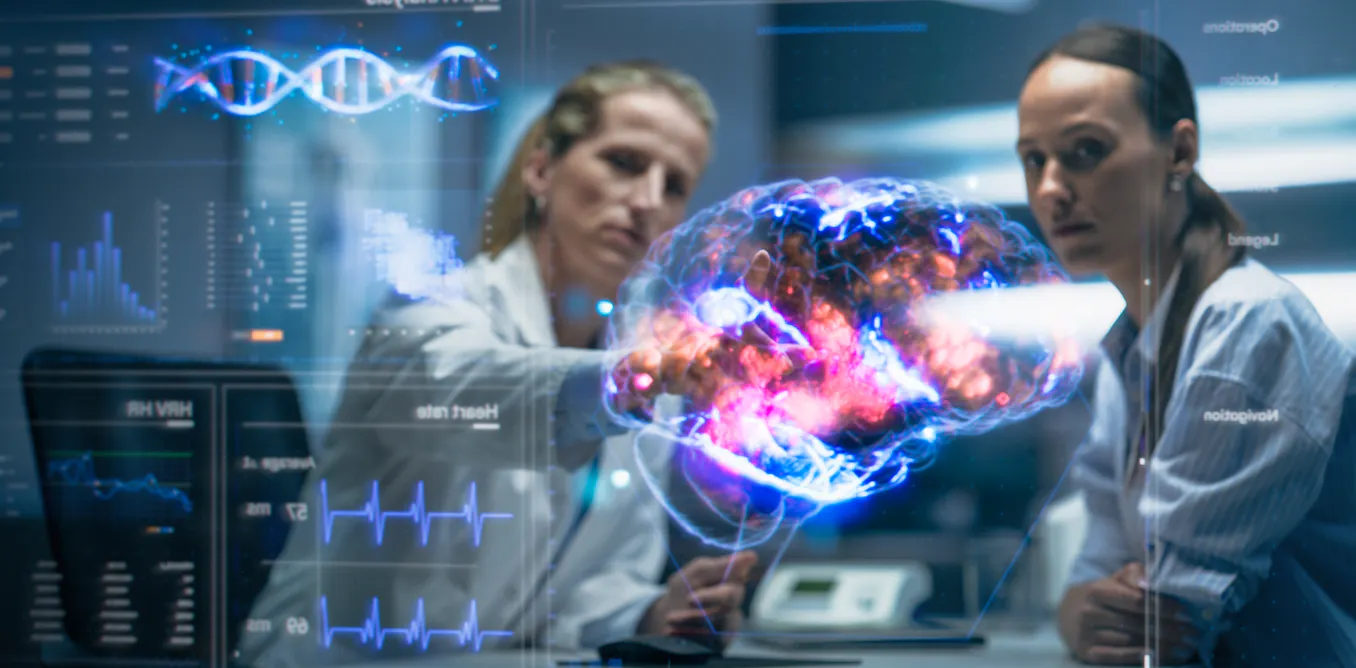
How to build a digital ‘twin’ of the human brain – what existing models overlook
Existing digital models of the human brain risk missing out on what makes you ‘you’.
The potential to create personalised digital “twins” of your brain and body is a hot topic in neuroscience and medicine today. These computer models are designed to simulate how parts of your brain interact, and how the brain may respond to stimulation, disease or medication.
The extraordinary complexity of the brain’s billions of neurons makes this a very difficult task, of course, even in the era of AI and big data. Until now, whole-brain models have struggled to capture what makes each brain unique.
People’s brains are all wired slightly differently, so everyone has a unique network of neural connections that represents a kind of “brain fingerprint”.
However, most so-called brain twins are currently more like distant cousins. Their performance is barely any closer to the real thing than if the model were using the wiring diagram of a random stranger.
This matters because digital twins are increasingly proposed as tools for testing treatments by computer simulation, before applying them to real people. If these models fail to capture fundamental principles of each patient’s unique brain organisation, their predictions won’t be personalised – and in worst cases could be misleading.
In our latest study, published in Nature Neuroscience, we show that realistic digital brain twins require something that many existing models overlook: competition between the brain’s different systems.
Our findings suggest that without competition, digital twins risk being overly generic, missing out on what makes you “you”.
Excess of cooperation
The human brain is never static. The ebb and flow of its activity can be mapped non-invasively using neuroimaging methods such as functional MRI. A computer model can be built from this, specific to that person and simulating how the regions of their brain interact. This is the idea of the digital twin.
The brain is often described as a highly cooperative system. Yet everyday experiences such as focusing attention or switching between tasks tells us intuitively that brain systems compete for limited resources. Our brains cannot do everything at once, and not all regions can be active together all the time.
During attention-demanding cognitive tasks, some regions of the brain such as the intraparietal sulcus (IPS) routinely increase activity, while others such as the posterior cingulate cortex (PCC) and medial prefrontal cortex (MPF) decrease activity. At rest, the opposite happens. Fox et al/PNAS, Author provided (no reuse)
Despite this, the vast majority of brain simulations over the past 20 years have not taken these competitive interactions between regions into account. Rather, they have “forced” neighbouring regions to cooperate. This can push the simulated brain into overly synchronised states that are rarely seen in real brains.
In a large comparative study of humans, macaque monkeys and mice, our international team of researchers used non-invasive brain activity recordings to show that the most realistic whole-brain models not only require cooperative interactions within specialised brain circuits, but long-range competitive interactions between different circuits.
To achieve this, we compared two types of brain model: one in which all interactions between brain regions were cooperative, and another in which regions could either excite or suppress each other’s activity. In humans, monkeys and mice, the models that included competitive interactions consistently outperformed cooperative-only models.
Using a large-scale analysis of over 14,000 neuroimaging studies, we found that spontaneous activity in the competitive models more faithfully reflected known cognitive circuits, such as those involved in attention or memory. This suggests competition is crucial for enabling the brain to flexibly activate appropriate combinations of regions – a hallmark of intelligent behaviour.
Visual summary of our study:
When whole-brain models of humans, macaques and mice are allowed to treat interactions between some brain regions as competitive, they consistently do so – generating activity patterns that closely resemble those associated with real cognitive processes. Luppi et al/Nature Neuroscience, CC BY
We concluded that competitive interactions act as a stabilising force, allowing different brain systems to take turns in shaping the direction of the brain’s ebbs and flows without interference or distraction. This ability to avoid runaway activity may also contribute to the remarkable energy-efficiency of the mammalian brain, which is many orders of magnitude more efficient than modern AI systems.
Crucially, models with competitive interactions were not only more accurate but also more individual-specific. This means they were better at capturing the unique brain fingerprint that distinguishes one person’s brain from another’s.
No longer lost in translation?
The fact that our findings hold across humans and other mammals suggests they reflect fundamental principles of how intelligent systems work. In each case, we found models with competitive interactions generated brain activity patterns that closely resembled those associated with real cognitive processes.
This could have major implications for translational neuroscience. Animal models are routinely used to test treatments before human trials, yet differences between species often limit how well these results translate. Around 90% of treatments for neuropsychiatric disorders are “lost in translation”, failing in human clinical trials after showing promise in animal trials.
Combining brain imaging data from human patients with whole-brain modelling could radically change this. A framework that works across species would provide a powerful bridge between basic research and clinical application.
If someone needs intervention in the brain, for example due to epilepsy or a tumour, their digital twin could be used to explore how the patient’s brain activity would change when stimulated with different levels of drugs or electrical impulses. This might significantly improve on existing trial-and-error approaches with real patients, and thus provide better treatments.
The general principles of brain organisation across species also offer a path for understanding how to shape the next generation of artificial intelligence. In the not-too-distant future, we may be able to construct digital twins that are more faithful in reproducing the salient features of the human brain – and potentially, AI models that are more faithful to the human mind.
The Conversation AI
https://theconversation.com/how-to-build-a-digital-twin-of-the-human-brain-what-existing-models-overlook-279681Sign in to highlight and annotate this article

Conversation starters
Daily AI Digest
Get the top 5 AI stories delivered to your inbox every morning.
More about
model
How AI Is Transforming Cybersecurity and Compliance — A Deep Dive into PCI DSS
The intersection of artificial intelligence and cybersecurity is no longer a future concept — it is the present reality shaping how organizations defend their data, detect threats, and demonstrate regulatory compliance. As cyber threats grow in sophistication and volume, traditional rule-based security tools are struggling to keep pace. AI is filling that gap with speed, precision, and adaptability that human analysts alone cannot match. Nowhere is this transformation more consequential than in the world of payment security and compliance. The Payment Card Industry Data Security Standard (PCI DSS) — the global framework governing how organizations handle cardholder data — has long been a compliance burden for businesses of all sizes. AI is now fundamentally changing how companies achieve,

Resume Skills Section: Best Layout + Examples (2026)
Your skills section is the most-scanned part of your resume after your name and current title. ATS systems use it for keyword matching. Recruiters use it as a 2-second compatibility check. If it's poorly organized, buried at the bottom, or filled with the wrong skills, both audiences move on. Where to Place Your Skills Section Situation Best Placement Why Technical role (SWE, DevOps, data) Below name, above experience Recruiters check your stack before reading bullets Non-technical role (PM, marketing, ops) Below experience Experience and results matter more Career changer Below name, above experience Establishes relevant skills before unrelated job titles New grad / intern Below education, above projects Education sets context, skills show what you can do The rule: place skills where they
Discussion: AI and Privacy-First Development
Title: Why LLM Context Windows Aren't the Answer to Personal AI Memory As developers, we often try to solve the 'memory' problem by simply stuffing more tokens into the context window. But as the window grows, so does the latency and the risk of the model 'hallucinating' or losing focus on key details. More importantly, there's the privacy wall: how do we give an agent access to a user's long-term digital history without compromising their data? I’ve been diving deep into the architecture of self-hosted memory hubs. The idea is to maintain a local, user-controlled vector store that serves as a 'long-term memory' for AI agents. By using a system like Nexus Memory, you can programmatically provide only the necessary context to an agent for a specific task, keeping the rest of the data safely
Knowledge Map
Connected Articles — Knowledge Graph
This article is connected to other articles through shared AI topics and tags.
More in Models
Discussion: AI and Privacy-First Development
Title: Why LLM Context Windows Aren't the Answer to Personal AI Memory As developers, we often try to solve the 'memory' problem by simply stuffing more tokens into the context window. But as the window grows, so does the latency and the risk of the model 'hallucinating' or losing focus on key details. More importantly, there's the privacy wall: how do we give an agent access to a user's long-term digital history without compromising their data? I’ve been diving deep into the architecture of self-hosted memory hubs. The idea is to maintain a local, user-controlled vector store that serves as a 'long-term memory' for AI agents. By using a system like Nexus Memory, you can programmatically provide only the necessary context to an agent for a specific task, keeping the rest of the data safely

v4.4 - MCP server support!
Changes MCP server support : Use remote MCP servers from the UI. Just add one server URL per line in the new "MCP servers" field in the Chat tab and send a message. Tools will be discovered automatically and used alongside local tools. [Tutorial] Several UI improvements , further modernizing the theme: Improve hover menu appearance in the Chat tab. Improve scrollbar styling (thinner, more rounded). Improve message text contrast and heading colors. Improve message action icon visibility in light mode. Make blockquote, table, and hr borders more subtle and consistent. Improve accordion outline styling. Reduce empty space between chat input and message contents. Hide spin buttons on all sliders (these looked ugly on Windows). Show filename tooltip on file attachments in the chat input. Add Wi
An Implementation Guide to Running NVIDIA Transformer Engine with Mixed Precision, FP8 Checks, Benchmarking, and Fallback Execution - MarkTechPost
An Implementation Guide to Running NVIDIA Transformer Engine with Mixed Precision, FP8 Checks, Benchmarking, and Fallback Execution MarkTechPost
![trunk/23618880643dd5dadb28c68e0fc154beaa8c67f4: [caffe2] Remove unused batch_box_cox perfkernel files (#179515)](https://avatars.githubusercontent.com/u/2453524?s=60&v=4)
trunk/23618880643dd5dadb28c68e0fc154beaa8c67f4: [caffe2] Remove unused batch_box_cox perfkernel files (#179515)
These files are unused from the codebase and are being de-synced by D99686350. They were originally added by: #86569 (Unify batch_box_cox implementations into perfkernels folder) #143556 (Move vectorized templates into a separate file for box_cox operator) #143627 (Add AVX512 support for box_cox operator) #159778 (Add float batch box cox SVE128 implementation) Authored with Claude. Pull Request resolved: #179515 Approved by: https://github.com/atalman
Discussion
Sign in to join the discussion
No comments yet — be the first to share your thoughts!