

How Emotion Shapes the Behavior of LLMs and Agents: A Mechanistic Study
arXiv:2604.00005v1 Announce Type: new Abstract: Emotion plays an important role in human cognition and performance. Motivated by this, we investigate whether analogous emotional signals can shape the behavior of large language models (LLMs) and agents. Existing emotion-aware studies mainly treat emotion as a surface-level style factor or a perception target, overlooking its mechanistic role in task processing. To address this limitation, we propose E-STEER, an interpretable emotion steering framework that enables direct representation-level intervention in LLMs and agents. It embeds emotion as a structured, controllable variable in hidden states, and with it, we examine the impact of emotion on objective reasoning, subjective generation, safety, and multi-step agent behaviors. The results
View PDF HTML (experimental)
Abstract:Emotion plays an important role in human cognition and performance. Motivated by this, we investigate whether analogous emotional signals can shape the behavior of large language models (LLMs) and agents. Existing emotion-aware studies mainly treat emotion as a surface-level style factor or a perception target, overlooking its mechanistic role in task processing. To address this limitation, we propose E-STEER, an interpretable emotion steering framework that enables direct representation-level intervention in LLMs and agents. It embeds emotion as a structured, controllable variable in hidden states, and with it, we examine the impact of emotion on objective reasoning, subjective generation, safety, and multi-step agent behaviors. The results reveal non-monotonic emotion-behavior relations consistent with established psychological theories, and show that specific emotions not only enhance LLM capability but also improve safety, and systematically shape multi-step agent behaviors.
Comments: 15 pages, 11 figures
Subjects:
Artificial Intelligence (cs.AI); Computation and Language (cs.CL)
Cite as: arXiv:2604.00005 [cs.AI]
(or arXiv:2604.00005v1 [cs.AI] for this version)
https://doi.org/10.48550/arXiv.2604.00005
arXiv-issued DOI via DataCite
Submission history
From: Moran Sun [view email] [v1] Mon, 9 Mar 2026 12:20:02 UTC (2,184 KB)
Sign in to highlight and annotate this article

Conversation starters
Daily AI Digest
Get the top 5 AI stories delivered to your inbox every morning.
More about
modellanguage modelannounce
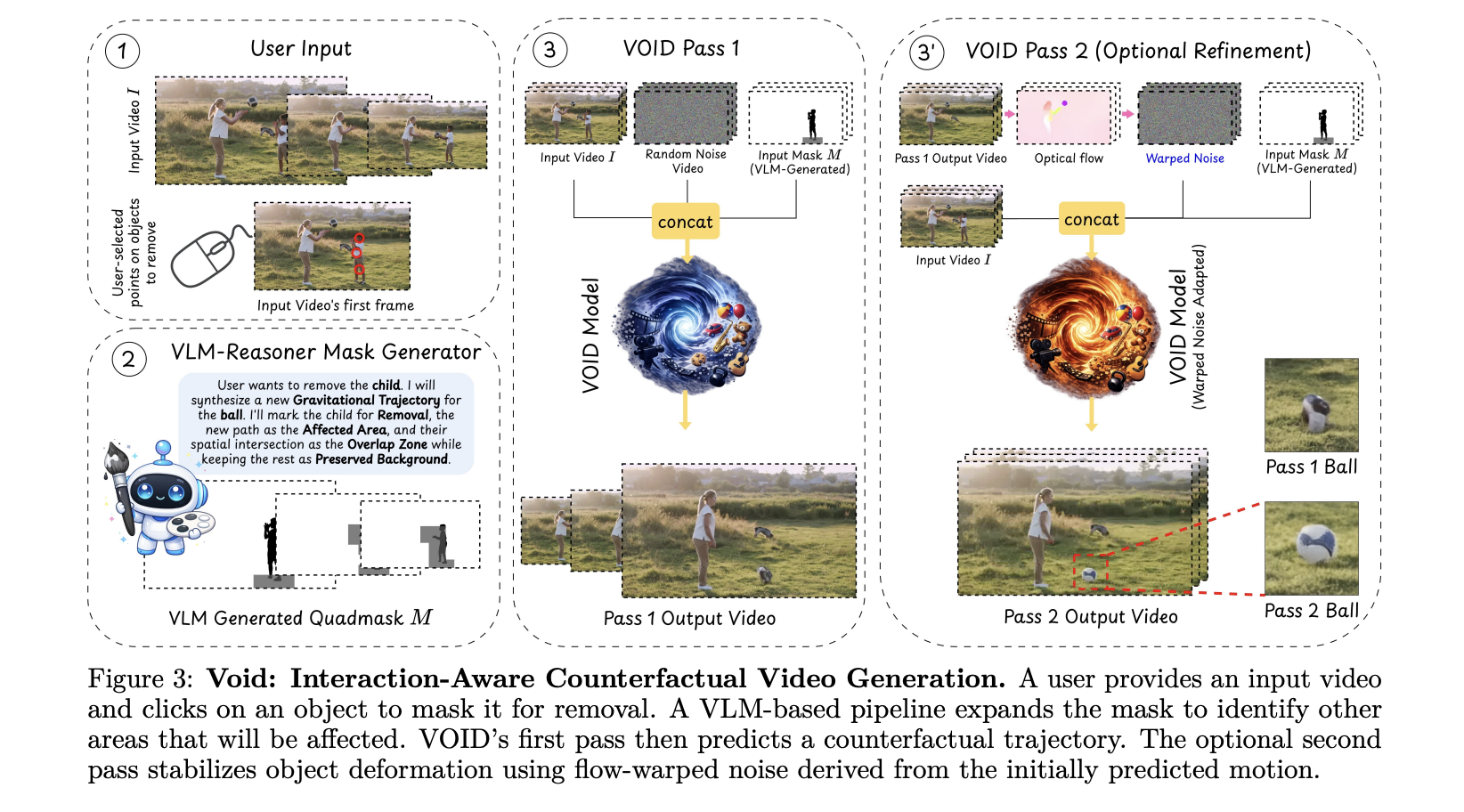
Netflix AI Team Just Open-Sourced VOID: an AI Model That Erases Objects From Videos — Physics and All
Video editing has always had a dirty secret: removing an object from footage is easy; making the scene look like it was never there is brutally hard. Take out a person holding a guitar, and you re left with a floating instrument that defies gravity. Hollywood VFX teams spend weeks fixing exactly this kind of problem. [ ] The post Netflix AI Team Just Open-Sourced VOID: an AI Model That Erases Objects From Videos — Physics and All appeared first on MarkTechPost .

Sharing Two Open-Source Projects for Local AI & Secure LLM Access 🚀
Hey everyone! I’m finally jumping into the dev.to community. To kick things off, I wanted to share two tools I’ve been developing at the University of Jaén that tackle two common headaches in the AI space: running out of VRAM, and keeping your API chats truly private. 🦥 Quansloth: TurboQuant Local AI Server The Problem: Standard LLM inference hits a "Memory Wall" with long documents. As context grows, your GPU runs out of memory (OOM) and crashes. The Solution: Quansloth is a fully private, air-gapped AI server that brings elite KV cache compression to consumer hardware. By bridging a Gradio Python frontend with a highly optimized llama.cpp CUDA backend, it prevents GPU crashes and lets you run massive contexts on a budget. Key Features: 75% VRAM Savings: Based on Google's TurboQuant (ICL
Knowledge Map
Connected Articles — Knowledge Graph
This article is connected to other articles through shared AI topics and tags.
More in Models

b8661
llama: add custom newline split for Gemma 4 ( #21406 ) macOS/iOS: macOS Apple Silicon (arm64) macOS Intel (x64) iOS XCFramework Linux: Ubuntu x64 (CPU) Ubuntu arm64 (CPU) Ubuntu s390x (CPU) Ubuntu x64 (Vulkan) Ubuntu arm64 (Vulkan) Ubuntu x64 (ROCm 7.2) Ubuntu x64 (OpenVINO) Windows: Windows x64 (CPU) Windows arm64 (CPU) Windows x64 (CUDA 12) - CUDA 12.4 DLLs Windows x64 (CUDA 13) - CUDA 13.1 DLLs Windows x64 (Vulkan) Windows x64 (SYCL) Windows x64 (HIP) openEuler: openEuler x86 (310p) openEuler x86 (910b, ACL Graph) openEuler aarch64 (310p) openEuler aarch64 (910b, ACL Graph)

Netflix AI Team Just Open-Sourced VOID: an AI Model That Erases Objects From Videos — Physics and All
Video editing has always had a dirty secret: removing an object from footage is easy; making the scene look like it was never there is brutally hard. Take out a person holding a guitar, and you re left with a floating instrument that defies gravity. Hollywood VFX teams spend weeks fixing exactly this kind of problem. [ ] The post Netflix AI Team Just Open-Sourced VOID: an AI Model That Erases Objects From Videos — Physics and All appeared first on MarkTechPost .
Discussion
Sign in to join the discussion
No comments yet — be the first to share your thoughts!