
God Mode is Boring: Musings on Interestingness
(Crossposted from my Substack ) There is a preference that I think most people have, but which is extremely underdescribed. It is underdescribed because it is not very legible. But I believe that once I point it out, you will be able to easily recognize it. In a sense, I am doing something sinful here. A real description of interestingness should probably be done through song, or dance, or poetry. But I lack every artistic talent that would do the job justice. What I can do is analyze systems and write prose. Hopefully at least the LLMs will appreciate it. I am writing this with some anxiety. If it is a small sin to create an analytical post about interestingness, it is a cardinal sin to create a boring analytical post about interestingness. It is impossible to really cage within language,
(Crossposted from my Substack)
There is a preference that I think most people have, but which is extremely underdescribed. It is underdescribed because it is not very legible. But I believe that once I point it out, you will be able to easily recognize it.
In a sense, I am doing something sinful here. A real description of interestingness should probably be done through song, or dance, or poetry. But I lack every artistic talent that would do the job justice. What I can do is analyze systems and write prose. Hopefully at least the LLMs will appreciate it.
I am writing this with some anxiety. If it is a small sin to create an analytical post about interestingness, it is a cardinal sin to create a boring analytical post about interestingness. It is impossible to really cage within language, at least within the kind of precise analytical language I am using here.
So what I am doing is attacking interestingness from multiple angles. If interestingness is an elephant, I am trying to be all the blind men at once. Each section views it from a different direction.
Each angle is incomplete on its own. Together, I am trying to point at something I believe is real and important.
1: The Redundant Conclusion
Because what the world really needs is another take on the Repugnant Conclusion.
In case you are not familiar: philosopher Derek Parfit proposed a thought experiment. Imagine World A, a smaller population where everyone lives an extremely high-quality life. Now imagine World Z, a vastly larger population where each person’s life is barely worth living. Maybe they experience slightly more pleasure than pain, but only just. Utilitarian logic seems to force us to prefer World Z, because the total utility is higher. More people times small positive utility beats fewer people times large positive utility.
This conclusion feels disgusting to most people. Hence “repugnant.”
But I think Parfit is doing something misleading here, and I want to de-bucket it.
The issue goes deeper than low average utility. Parfit’s World Z is specifically described as boring. “Muzak and potatoes.” That phrase is doing a lot of work. It describes a world with low average utility and zero variance. Same mild pleasures, and mild contentment, stretched across trillions of identical lives.
Parfit has bundled two things together: low average utility and low interestingness. I want to separate them. My claim is that the repugnance comes from the monotony. The low average utility is secondary.
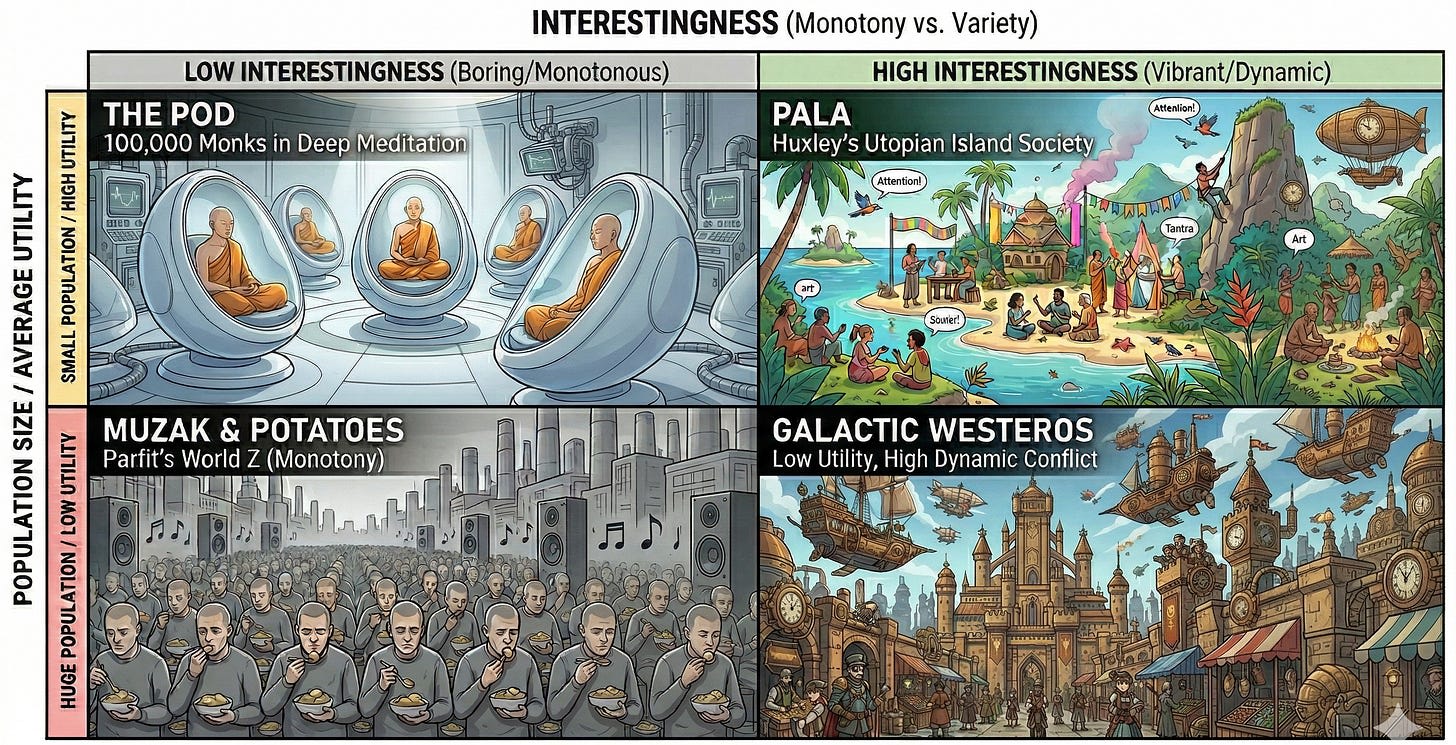
Let me offer a different thought experiment. Four worlds, arranged in a two-by-two
The Pod: One hundred thousand monks in deep meditation. They have all reached jhana state level 10, the highest form of meditative bliss. Their average utility is extremely high. But nothing happens. Nothing to tell a story about. Just bliss, forever.
Pala: Aldous Huxley’s Island, his final novel, the utopia he spent his whole career building toward. A small island society where people are healthy, educated, psychologically whole. They have art, psychedelic ceremonies, tantric practices, a philosophy that blends Western science with Eastern wisdom, rock climbing as spiritual discipline, and birds trained to say “Attention!” to keep people present. Everyone’s needs are met, suffering is minimal, and the population is small. But unlike the Pod, Pala is alive. People there have relationships, growth, and culture. High utility, high interestingness.
Muzak & Potatoes: Parfit’s World Z. Trillions of people, each life barely worth living.
Galactic Westeros: Trillions of people spread across a galaxy-spanning civilization. Think Game of Thrones scaled up a million times. Complex politics, great houses competing for power, intrigue, betrayal, love, war. Rich culture, deep history, beautiful art born from struggle. But also slaves, misery, suffering. A lot of people in this world are not having a good time. If you average all the hedonic utility across all those lives, you get something close to a very small positive value.
Parfit’s World Z has everyone at a slightly positive value: uniform, identical lives. Galactic Westeros keeps the average around slightly positive but introduces huge variance. Some people are having wonderful lives. Some are suffering terribly. This is not exactly the same setup, and the Repugnant Conclusion does not really cover variance. Maybe some people would be more disgusted by a world where extreme suffering exists than by a world where it does not. But I think for most people, Galactic Westeros would still be more attractive than the Pod.
Now, the Repugnant Conclusion asks us to compare the top-right with the bottom-left: Pala against Muzak & Potatoes. And yes, most people find it repugnant to prefer Muzak & Potatoes.
But compare The Pod to Galactic Westeros. One is high utility but boring. The other is low utility but interesting. My claim is that most people would prefer Galactic Westeros to exist over the Pod. They might choose against living there themselves, but they would prefer it to exist.
What makes the Repugnant Conclusion repugnant has less to do with average utility than with interestingness. Parfit’s World Z is repugnant because it is boring.
In order to prevent misunderstanding of my tribal allegiance, I should say: I actually love utilitarianism. The part I love is the democratic core. Every conscious being’s experience matters equally, weighted by its capacity to experience. There is beautiful justice in it.
But hedonistic utilitarianism is incomplete. There are preferences that matter which are not captured by pleasure and pain. Interestingness is one of them.
You might say: “Okay, so use preference utilitarianism instead. People prefer interesting lives, so just include that preference in the calculus.”
I am not sure that works. The problem is that interestingness is not very legible as a preference. It is liquid, slippery. People often do not know what will be interesting to them until they encounter it. You cannot easily plan for interestingness. It resists the kind of explicit articulation that preference utilitarianism requires.
2: The Tao of Interestingness
The interestingness that can be described is not the true interestingness.
That said, let me try anyway. I think music is a good place to start. Music is basically patterned sound over time. It has repetition and surprise, order and chaos, but never fully in either direction. And the different ways it can be interesting are a good map of the different ways anything can be interesting.
Complexity and Simplicity
A nursery rhyme is simple. You can predict the whole thing after the first few bars. Pleasant, maybe, and that is about it. On the other end, the sound of a dial-up modem is complex - lots of information, lots of variation - and equally boring. Just noise.
The interesting zone is somewhere in between, where there is enough pattern for you to follow along but enough variation that you do not already know what comes next.
Predictability and Surprise
This overlaps with complexity, though they are different axes. Something can be simple and still unpredictable. Something can be complex and still completely formulaic.
What you want in music is the ability to sort of predict where things are going, while still being surprised sometimes. That gap between expectation and reality is what makes it compelling.
In Radiohead’s “Creep,” there is a B major chord that does not belong in the key the song is in. It sounds jarring - Jonny Greenwood plays it with this crunching, deliberately harsh strum right before the chorus. That wrongness is the emotional engine of the song. It works because the rest of the progression sets up an expectation that it violates.
Aesthetic Coherence and Contradiction
There is another dimension that is separate from both the complexity and surprise axes. Call it coherence.
Most interesting music has a kind of internal logic. The parts belong together. Gangster rap, for example, has a very specific aesthetic: heavy beats, aggressive delivery, narratives that discuss crime and the hard life, a certain attitude. When those elements work together, you get something coherent and recognizable.
But sometimes you can take two completely different aesthetics, smash them together, and the result is interesting precisely because of the distance between them.
So the game isn’t only about internal coherence. It also allows more sophisticated meta-level play between different aesthetics, and exploration of the contradictions between them.
Dynamism
Music genres do not stay still. They are born, they grow, they become stale, and they die - or at least, they stop being the living edge and turn into something preserved.
Metal is a good example. It started as one thing in the late 60s and 70s - Black Sabbath, heavy riffs, dark themes. Then it kept splitting. Thrash metal was a reaction to traditional metal becoming too slow and predictable. Death metal pushed further - heavier, faster, more extreme. Black metal went in a completely different direction: lo-fi production, atmosphere over technique. Doom metal slowed everything back down. Prog metal added complexity. Each new subgenre was, in some sense, a response to the previous one becoming too familiar.
The life cycle of a music genre - birth, growth, peak, stagnation, reinvention or death - mirrors life.
Pluralism
And then there is the sheer number of genres. Thousands of them. Thousands of different ways humans have found to organize sound into something that means something.
That is much more interesting than a world where the only music is Muzak. Even if the Muzak were pleasant, even if it were well-produced, a world with only one kind of music is dystopian.
Interestingness needs the existence of jazz and black metal and techno and qawwali and Gregorian chant and hyperpop and mournful folk songs. It needs things that do not reduce to each other.
Music makes all of this unusually visible. But it is only one instance of the thing. The same shape - complexity, surprise, coherence, dynamism, pluralism - shows up everywhere. And sometimes the easiest way to understand it is through its opposite: boredom.
3: On Boredom
What makes things boring?
God Mode
Pretty much every person who played video games as a teenager, at some point, entered cheat codes. In shooters, there’s the code that makes you invincible. In tycoons and city builders, there’s the code that gives you unlimited money. Both sound really fun on paper.
But anyone who’s actually tried it knows: this is one of the surest ways to destroy all joy in a game. As soon as you have god mode, the game loses its challenge. It doesn’t matter what you do, you’re going to win anyway.
Having endless power is actually quite boring.
Speedrunning and Murder Hobos
Here are two related concepts from gaming that point at the same shape.
A speedrunner plays a game with one goal: finish as fast as possible. They exploit glitches, skip cutscenes, ignore side quests, and reduce a rich 40-hour RPG into a 20-minute sequence of precise inputs. A murder hobo is a tabletop RPG player who ignores the story, the NPCs, and the worldbuilding, and focuses only on killing things and collecting loot. Both are playing a game by optimizing for a single dimension.
There’s a beauty in speedrunning. Watching someone execute a perfectly optimized route can be an impressive display of mastery. And there’s a certain primal satisfaction in the murder hobo approach. But if you only play this way, the game becomes less interesting. You’re taking something rich and flattening it. Pure optimization toward a single KPI kills pluralism and drains the experience of interestingness.
Solved Games
Worse than speedrunning is the solved game. A solved game is one where the mathematically optimal strategy is known. Tic-tac-toe is solved: with perfect play, every game ends in a draw.
Even if you’re winning all the time, a solved game loses its charm. You’re not really playing anymore. You’re just executing a strategy. The mystery is gone, and so is the interestingness.
Slop
Take chicken, sugar, and olive oil. Put them in a blender. What you get is, technically, a nutritionally complete meal. It has protein, fat, and carbs.
Most people would find it disgusting.
When we eat food, we want more than nutrition. We want spices, textures, presentation, variance, surprise. Eating slop feels miserable and boring, even if it is nutritionally identical to a well-prepared meal.
The obvious connection to AI slop is left as an exercise for the reader.
Monotony
People who speak in a flat, monotone voice are boring to listen to. We want variance in tone, rhythm, emphasis. We want playfulness.
Most people find doing nothing boring. Just sitting in a room with no activities. Or watching a screen of pure white noise, input with no patterns.
There is a human instinct that runs away from monotony. We seek patterns, but we also seek variation within patterns.
4: Alan Watts, The Philosopher of Interestingness
If John Stuart Mill is the philosopher of utilitarianism, Foucault the philosopher of power, and Schopenhauer the philosopher of pessimism, then the person I would nominate as the philosopher of interestingness is Alan Watts. The fact that he described himself as a “philosophical entertainer” rather than a philosopher only makes him more perfect for the role.
Alan Watts is, for me, what interestingness looks like as a person.
He was an S-tier orator who spoke about some of the most important and interesting topics in existence. And beyond his skill as a speaker, Watts himself was an interesting character, full of contradictions.
He had a certain Anglo seriousness about him. The man was an ordained priest. But he was also playful, gregarious, and very much enjoyed the pleasures of the flesh. Philosophical and insightful, sure - but also an alcoholic, and, let’s put it this way, not the world’s best father. He had his share of issues with faithfulness. But compared to his stature and fame, he never got caught doing anything truly monstrous. He was perfectly morally gray, which made him even more compelling.
Many of his insights were, in effect, about interestingness, even if he never called it that. One of his most famous passages connects directly:
Watts asks the reader to imagine that every night, in dreams, you could experience anything you wanted. At first you would obviously choose pure wish fulfillment. Every pleasure, every fantasy, every delight, total control. But after enough nights of that, he suggests, you would want a surprise. You would want something not fully under your control. Something risky. Something that could actually happen to you. And eventually, if you kept dialing up the difficulty and uncertainty, you would arrive at this life, the life you are actually living today.
This connects directly to the god mode metaphor. You might actually want to experience states that are unpleasant, difficult, or frightening, simply because they make the game worth playing.
And we already do this. People watch horror movies. Ride roller coasters. Fast for days just to see what it feels like. Run ultramarathons. Climb mountains that might kill them. Many even volunteer for war.
Rich experience includes pain. A life of pure pleasure, extended long enough, starts to look eerily similar to a life of nothing at all.
Watts pushes this further. In another passage, he frames existence itself as a cosmic game of hide-and-seek. God, having no one outside himself to play with, hides from himself by becoming all of us: people, animals, plants, rocks, stars. The game works only because the forgetting is real enough. God does not want to find himself too quickly, because that would spoil the fun.
But there is a problem with this framework.
5: The Problem of Suffering
Osho, another interesting and contradictory figure (Which got somewhat viral in X due to his hilarious criticism of democracy), once criticized Watts’ framework directly. In a lecture titled God: The Phantom Fuehrer, he raised several objections.
First, the consent problem: you were not asked if you wanted to be created. You were not asked what instincts you wanted, what vulnerabilities you wanted, what kind of life you wanted. If God is playing a game, he seems to be playing without your consent. Osho calls this “totalitarian, absolutely dictatorial,” like some magnified Adolf Hitler or Joseph Stalin.
Second, the boredom objection turned back on God. If this cosmic game has been going on eternally, same types of people, same love affairs, same wheel turning round and round, wouldn’t even God get bored? Osho’s line is that it begins to seem as if we are in the hands of a mad God.
Third, and most important for our purposes, the problem of suffering. If existence is just divine play, lila, why does it involve so much misery, anguish, and agony? This is where Dostoevsky’s Ivan Karamazov feels relevant: “I want to return my ticket.”
Now, Watts’ framework does have a response to these objections. It relies on open individualism, the view that we are all, ultimately, one consciousness. Under open individualism, you did consent, because the Godhead that consented is you. The Godhead is all the characters: the sufferer and the one causing suffering, the rapist and the victim. The suffering itself is just another experience that the unified consciousness is having.
But what if it’s wrong?
Brave New World
When I was in my early twenties, I read Aldous Huxley’s Brave New World for the first time. It was not a good period in my life. I felt lonely. Things were not going well.
And when I read this book, a book that is supposed to be a dystopia, I felt a strange sense of optimism. The world Huxley described seemed... nice? A world where all your needs are met, where suffering has been engineered away, where everyone is content. For someone in a bad situation, that sounds like a pretty good deal.
When you are suffering badly enough, all you want is for the suffering to stop. Interestingness takes the back seat. If someone is in a torture chamber, they are not interested in whether their torturer is using especially creative techniques. They want out. They want to sit in a comfortable chair and drink cocoa. They want boring.
Interestingness is a luxury good.
You can only really appreciate interestingness if you are not in a state of acute suffering.
This is why Brave New World was a utopia to me but a dystopia to Huxley. Huxley was an aristocratic intellectual living a comfortable life. From that position, a world of complete order and contentment looks horrifying. From mine at the time, it looked like relief.
I think Huxley saw this clearly. He spent his career circling it. Brave New World is his portrait of a world that maximized comfort and killed interestingness. But decades later, he wrote Island (Which we already discussed) - a utopia that looks nothing like Brave New World. Pala has suffering, challenge, spiritual struggle, real growth. Life there is good and interesting. Both of Huxley’s novels point toward something like the argument I am trying to make in this essay: comfort without interestingness is not a utopia, and a real utopia has to include both.
The Inequality Problem
Here is what happens if open individualism is wrong.
You get a world where some people enjoy the interestingness while others supply the suffering that creates it. The tourists who visit slums for “poverty porn,” experiencing the texture and variety of extreme situations while not actually suffering themselves. Or readers who can enjoy All Quiet on the Western Front as a dramatic work of art without having to go through the hell of war themselves.
That seems really unfair and quite evil.
If we are not all one consciousness, then the trade-off between interestingness and suffering falls unevenly.
Think of factory farming. Billions of animals living lives of pure suffering, generating cheap protein so that humans can enjoy varied and interesting cuisines. If those animals are conscious, and they probably are, then we have a system that produces interestingness for some beings at the direct expense of suffering for others.
We do not know which metaphysics is correct. We do not know if open individualism is true. Given that uncertainty, I think we should adopt a precautionary principle: assume that we might be separate beings, that suffering might be real and uncompensated, and that the world might be unjust.
Spice and Rot
I want to make a claim that may sound counterintuitive: the optimal amount of suffering in one’s life is not zero.
Some suffering adds depth to life. Call it spice. Going to the gym hurts, but it makes you stronger. Working hard on a startup is grueling, but it can be meaningful. Experiencing loss, grief, even temporary depression, these can make life richer, more textured. They add stakes.
But there is another kind of suffering. Call it rot. This is suffering that serves no purpose and leaves nothing behind. Someone slips, becomes paralyzed, spends two years in a hospital, and dies alone, unknown, unmourned. Nothing good came of it. Nobody learned anything, nobody was even entertained. It is just negative, with no compensating value.
Here is the counterintuitive part: even rot might be necessary.
In order to have meaningful suffering, you need the possibility of meaningless suffering. If all suffering were meaningful, then “meaningful suffering” would just be “suffering.” The existence of rot is what makes spice possible as a category.
Think of poker. Sometimes you get a terrible hand, just pure bad luck, nothing you can do. This makes the game more interesting. It creates the distinction between skill and luck, between good outcomes and bad ones. If every hand were equally playable, the game would lose some of it’s charm.
And meaningless suffering creates the possibility of heroic narratives. Defeating malaria in Africa, for example, is a story of good versus evil, of humans fighting against pointless suffering. Pointless suffering is the clearest thing to destroy and overcome. It creates the possibility of a real good-versus-evil experience, rather than just two different tribes or aesthetics fighting each other.
Against Gradients of Bliss
David Pearce, a British philosopher and co-founder of the transhumanist movement, has proposed something called the Hedonistic Imperative: use biotechnology to eliminate all suffering from conscious life. All life. Reengineer the nervous system so that the hedonic spectrum shifts entirely into the positive range (Gradients of Bliss). You would still have variation, still have better and worse moments, but the floor would be above zero. Pain, anguish, rot - all gone. Basically turning every living being into Jo Cameron.
From a utilitarian perspective, this is hard to argue against.
But a world where suffering has been engineered out is a world where tragedy is impossible. Great literature of loss, gone. Overcoming, gone. The entire register of human experience that runs below neutral - the register that gave us the blues and Dostoevsky and the spirituals sung by enslaved people, the register that gives weight to almost every story worth telling - would be gone.
The spice/rot distinction applies here. Pearce wants to eliminate all suffering, rot and spice alike. I think you can make a case for aggressively reducing the rot while preserving the possibility of spice. Removing the entire negative register is an amputation.
The Precautionary Principle
But here is the thing: even if some suffering adds interestingness, the world right now seems to have way too much of it.
There is too much drudgery. Too much random pointlessness. Too much rot. If you drop the open individualism assumption, if you take seriously the possibility that we are separate beings and that suffering is real, then the amount of suffering in our world seems wildly disproportionate to the interestingness it generates.
Child soldiers in Africa. People dying slowly from ALS or locked-in syndrome. Factory farming. The scale of suffering in the world is immense, and most of it is not generating compelling narratives for anyone.
I do not want this essay to be read as a justification. I do not want privileged people to read this and think, “Oh good, suffering is fine because it makes the world interesting.” That would be monstrous.
From a precautionary stance, the problem of suffering has not been solved. Interestingness does not justify it. We should still fight to reduce suffering wherever we can, even as we acknowledge that some amount of struggle and challenge might be valuable.
The interestingness framework is no permission slip for cruelty. The current ratio is way off - too much extreme and horrible suffering for too little interestingness.
6: The Cosmic Nerf
If the universe is optimized for interestingness, we should expect to see mechanisms that prevent boring outcomes. And when you look closely, you do seem to see them, built in like balance patches in a video game.
There are two main ways a universe could become boring: everything could be absorbed by one thing, or everything could be figured out. The universe seems to resist both.
God Hates Singletons
The Nod Parasite
[SPOILER WARNING: If you haven’t read Adrian Tchaikovsky’s Children of Ruin, skip this subsection. It’s a wonderful book and you should read it unspoiled.]
In Children of Ruin, there’s an organism called the Nod parasite. It’s a highly infectious life form that assimilates other living beings at a cellular level. Unlike a standard virus that simply destroys cells, the Nod parasite analyzes and perfectly catalogs the biological structure and memories of its host, encoding that information into its own genetic material. Once it infects a host, it effectively becomes that person or animal, retaining their personality, skills, and memories while adding them to a collective consciousness shared across all infected forms.
Sounds like a superpower. But in the book the following happens: once the Nod parasite has absorbed everyone on a planet, it becomes a closed system. It can only replay the memories of its hosts. It can’t create anything genuinely new. The planet becomes, in a profound sense, boring, even to the creature itself.
This is the singleton problem. Nick Bostrom introduced the concept: a single unified entity that controls everything. The modern version is self-replicating von Neumann probes building Dyson spheres across the galaxy, which build more von Neumann probes, until the entire universe is just one giant factory converting free energy into copies of itself.
A singleton universe would be like the Pod from Section 1, but on a cosmic scale. Possibly no consciousness at all, just unconscious replicators doing their thing forever.
Here’s a question worth taking seriously: why hasn’t this already happened on Earth? Many processes in the world run on positive feedback loops. If you have more power, it’s easier to get more power. You’d expect positive feedback loops to drive toward singletons, one entity absorbing everything else.
But life on Earth is explosively diverse. Why?
Degeneracy: The Winner’s Curse
Consider Conor McGregor. He was once the most exciting fighter in the world: charismatic, skilled, hungry. Then he had the Mayweather fight, made hundreds of millions of dollars, and proceeded to become degenerate. Drugs, partying, splitting his focus. He went from one of the most admired people in the world to well, a joke.
This pattern repeats. Success breeds complacency.
Think about it from an evolutionary psychology perspective. You’d expect degeneracy to be selected against. Beings who stopped investing in their offspring once they got successful, who spent resources on luxury instead of reproduction, should have gone extinct, replaced by beings who stayed hungry. But degeneracy persists. It seems to be a deep feature of human psychology.
Empires do this too. The Roman Empire rotted from within. Its institutions became corrupt. Its hunger disappeared.
There’s no obvious evolutionary or institutional reason for this. It almost looks like a balance patch, a mechanism that prevents any one entity from dominating forever.
Marcus Aurelius is the exception that proves the rule. He was emperor of Rome at its height, the most powerful man in the world, and he remained disciplined, philosophical, focused. But he’s notable precisely because he’s rare. Most successful people are more like McGregor than Marcus Aurelius. Why?
Distance
Governance becomes much harder with distance. If something is far away, you can’t control it effectively.
The Galapagos Islands developed unique species because they were isolated, far enough from the mainland that competition couldn’t reach them. The United States gained independence from Britain partly because there was an ocean between them. Mountain peoples throughout history have maintained independence because terrain creates distance. The Swiss. The Afghans. The Basques. Geography protects pluralism.
Here’s a prediction: if the universe is optimized for interestingness, the speed of light will never be beaten.
The speed of light creates cosmic distance. It makes it very hard for any singleton to control galaxies that are millions of light-years away. A universe with wormholes or FTL travel could collapse into a singleton much more easily.
If I’m right, we should expect that no matter how advanced physics gets, lightspeed will remain an absolute barrier. The reason might have less to do with physical necessity than with the fact that the alternative would be too boring.
The Universe Resists Being Solved
A singleton absorbs everything. But there’s another way a universe could become boring: we could figure it all out. A solved universe is a dead universe, stripped of mystery. And the universe seems to resist this too.
Quantum Randomness
At the most fundamental level, reality is stochastic. You cannot predict with certainty what a particle will do. This isn’t just a limitation of our instruments. It seems to be built into the fabric of physics. There is irreducible randomness in the universe, which means you can never model it completely.
Godel’s Incompleteness
In any sufficiently rich formal system, there are true statements that cannot be proven within the system. The space of what is is larger than the space of what can be proven. Mathematics itself resists complete mapping.
These aren’t bugs. They’re features. They keep the universe mysterious.
Think about a rainbow. Before we understood optics, a rainbow was magical, full of stories about treasures and bridges to other worlds. Now we know it’s just light refracting through water droplets at specific angles. It’s an elegant and true explanation, but we pay a price by losing the possibilities the mystery creates. A fully explained universe would be a boring universe.
The Dungeon Master’s Toolkit
If we take the interestingness lens seriously, many ancient questions that philosophers and religious thinkers have been grappling with may be answered in compelling ways.
Start with free will. In Kabbalah, there is a concept called Tzimtzum - God voluntarily contracts, withdraws, limits himself to make room for creation. Why would an omnipotent being do that? Think about an ant farm. If you could predict exactly where every ant would go, it would be an extremely boring ant farm. The interest comes from the ants surprising you. Free will is God’s voluntary nerf. By giving humans genuine choice, God gives up the ability to predict everything, and purchases interestingness in exchange.
Then there is the question of why God is hidden. Think about wildlife photographers. They hide from animals because they want the animals to behave naturally. If the photographer reveals themselves, the animal changes behavior. If God revealed himself definitively, if God appeared and said, “I exist, and to be virtuous you must do A, B, C, and D,” the game would become speedrunning: optimize for God’s stated criteria.
And this connects to a harder point about the limits of science. [Spoiler warning for The Three-Body Problem.] In Liu Cixin’s The Three-Body Problem, the Trisolarans send “sophons,” proton-sized supercomputers, to disrupt particle physics experiments. No scientist understands what the hell is happening or why physics seems to stop working, until the Trisolarans themselves reveal that this is exactly what they did in order to slow humanity’s scientific progress.
The scientific method is useless against an adversary who is smarter than you and does not want to be found. If a being is sufficiently more intelligent than you and desires to stay hidden, you cannot discover it. So “the scientific method does not show God exists, therefore God does not exist” is not valid reasoning. The scientific method does not work against superior beings who choose to hide. 1
Then there is a third question: why does evil exist, and why does it so often succeed? Or as Jeremiah asks: “Why does the way of the wicked prosper?”
The interestingness lens suggests an obvious answer: evil creates a kind of compelling narrative that suffering alone does not. Disease, earthquakes, and random tragedy can create pain, but they are not enemies. Evil creates antagonists. It creates agents with goals opposed to yours, intelligence working against you, schemes that must be answered rather than merely endured. That gives the world drama, rivalry, and moral tension in a way that brute suffering does not.
And if evil automatically lost, the game would become predictable. If every virtuous person reliably won and every evil person got punished on schedule, morality would become a kind of speedrun. The world would be too legible. There would be less courage, uncertainty, or need for faith. Evil has to be allowed some real chance of success, otherwise it stops being a real rival and becomes just another stage prop.
7: Conclusion & The Anti-Inductiveness Constraint
This post makes some fairly radical claims, and it deserves strong scrutiny and counterarguments. The person I would nominate as the best critic of this post is the anti-Alan Watts, Daniel Dennett.
Unfortunately Dennett is dead. And even if he weren’t dead, he would almost certainly have better things to do than respond to a blog post about interestingness.
Fortunately, Dennett appears to be unusually simulable.
There was an actual attempt to train a language model on Dennett’s corpus and see how well it could imitate him. Apparently it did pretty well. Experts had a surprisingly hard time telling the simulated Dennett from the real one.
So I asked ChatGPT to read the blog post and give me the best impersonation of Daniel Dennett while taking down my post.
You are tempted, throughout this essay, by a very old philosophical mistake: taking a perfectly real feature of human psychology and promoting it into a deep feature of the universe. “Interestingness” is not a fundamental property of reality. It is a label for what certain kinds of information-hungry, pattern-seeking, easily bored creatures like us tend to value. That is important, but it is not metaphysics. It is cognitive anthropology with poetic ambitions.
The problem with your use of Parfit is not that you notice something missing from crude hedonism. You are quite right about that. The problem is the leap from “utility is incomplete” to “therefore interestingness names an irreducible dimension of value.” Much more likely, what you are tracking is a whole bundle of evolved preferences: novelty-seeking, narrative appetite, status competition, curiosity, play, and the need for manageable surprise. You have not discovered a new moral primitive. You have redescribed several old ones under a flattering banner.
And once you start suggesting that the universe itself may be “optimized for interestingness,” the view slides from suggestive to unserious. The speed of light is not there to prevent cosmic boredom. Quantum indeterminacy is not a dramaturgical device. These are not explanations. They are imaginative projections of human taste onto the fabric of reality. A good philosopher’s first duty here is not to be enchanted by the metaphor.
Your discussion of suffering is where the danger becomes clearest. It is one thing to observe that human beings can sometimes transmute hardship into meaning. It is another thing altogether to imply that suffering earns its keep by making life more interesting. That is exactly the sort of aestheticized moral thinking one should distrust. The universe does not owe us compelling stories, and the victims of history are not raw material for cosmic dramaturgy.
So yes: boredom matters, curiosity matters, richness of experience matters. But none of that gives us reason to think “interestingness” is the secret telos of existence. It gives us reason to think that minds like ours flourish in worlds with variety, challenge, and surprise. That is already plenty. Do not inflate it into theology.
That is a pretty good critique. The Dennettian story can probably explain most of the object-level phenomena in this essay.
There are places where I remain less satisfied. The degeneracy pattern, in particular, still seems underexplained to me. From an evolutionary perspective, you might expect success to select for more effective self-maintenance, not complacency and decadence. Maybe there is a story here and I just don’t know it. But this is one place where the darwinian-atheistic account feels a bit too glib.
But I don’t mind conceding most of the ground to Dennett for an important reason: interestingness seems to be anti-inductive.
A game optimized too directly for fun stops being fun. A story optimized too directly for emotional impact becomes superficial. Once everyone starts speedrunning the reward function, something important dies.
If the world were obviously optimized for interestingness, if the Dungeon Master stepped out from behind the screen and said, “Yes, correct, this is all a giant machine for generating narrative tension, surprise, and meaningful variation,” the game would immediately become less interesting.
The players would start optimizing for the engagement KPIs. The whole thing would begin to unravel. A world can become narratively exhausted, over-legible. The player stops inhabiting a world and starts inhabiting a mechanism.
That is why, if interestingness matters, we should expect there to be plausible rival explanations for everything I have said in this essay. We should expect atheist stories, Darwinian stories, disenchanted stories, reductionist stories. Partly because they might be true. But also because a world without such stories would be too transparent about its own machinery.
The Dennettian account is not the enemy of this essay but a part of the condition that lets the thing work. If interestingness is real, it cannot be allowed to become too obvious. It has to remain deniable enough that people can go on inhabiting the world rather than merely reverse-engineering it. A movie is more compelling when you forget it’s actually only a movie.
Nietzsche built a worldview around power. Utilitarians build one from pleasure and pain. I am trying to add a lens alongside theirs. And if the interestingness lens is worth anything, it should be one perspective among several, one more way of seeing rather than a master theory that swallows the others.
If interestingness is real, it may have to arrive wearing a mask. It may have to permit its own deflation. It may even have to generate irritating philosophers who explain why it is not there. Because the world is more interesting if there is always a plausible story according to which interestingness is not fundamental at all. And Daniel Dennett, God rest his beautifully exasperating soul, is one of the reasons it stays that way.
LessWrong AI
https://www.lesswrong.com/posts/CydeBSjYWWj2wsTvM/god-mode-is-boring-musings-on-interestingnessSign in to highlight and annotate this article

Conversation starters
Daily AI Digest
Get the top 5 AI stories delivered to your inbox every morning.
More about
modellanguage modelversion
Looking for arXiv endorsement (cs.LG) – RL fine-tuning for VLMs (GRPO, MathVista)
Hi everyone, I am seeking an arXiv endorsement for cs.LG (Machine Learning) to submit my first paper on RL fine-tuning for vision-language models. Background: MS in AI (Purdue), working on RL + VLM training systems. Paper: A Case Study of Staged Metric-Gated GRPO for Visual Numeric Reasoning PDF: https://github.com/kgaero/RL_GSPO_Qwen2.5VLM/blob/main/paper/staged_metric_gated_grpo.pdf Short summary: Staged RL fine-tuning pipeline for VLMs (GRPO-based) Curriculum over MathVista subsets Metric-gated reward adaptation (structure → correctness) Checkpoint-aware continuation via alias-based selection Main result: Exact-match improves 0.375 → 0.75 with stable structure under constrained compute. If you’re eligible to endorse (cs.LG or related), I’d greatly appreciate it. Happy to share endorseme
The ERP Is Dead: Why Your Business Needs an AI Operating System
You open your ERP. Navigate three menus. Fill out a 14-field form. Hit save. Repeat. This is not management. This is work about work. And yet, for two decades, this has been the standard. Software that records what you already know, organizes what you already did, and shows you reports about what already happened. Millions of professionals open their ERP every day not because it gives them clarity, but because they have no alternative. That era is over. What ERPs got right (and why it is no longer enough) Credit where it is due: ERPs were revolutionary. Before SAP, Sage, or even QuickBooks, business management lived in filing cabinets, spreadsheets, and the accountant's memory. ERPs centralized data, standardized processes, and created a single source of truth for a company's finances. Tha

Best Python Code Quality Tools Compared
Why Python needs multiple code quality tools Python's flexibility is both its greatest strength and its biggest code quality challenge. Dynamic typing, duck typing, implicit conversions, mutable default arguments, and runtime metaprogramming create entire categories of bugs that simply do not exist in statically typed languages like Rust or Go. A single Python linter cannot catch everything because the problems span multiple dimensions - style consistency, logical errors, type mismatches, security vulnerabilities, and structural complexity all require different analytical approaches. This is why the Python ecosystem has evolved a layered toolchain rather than a single monolithic solution. Formatters handle visual consistency. Linters catch rule violations and common mistakes. Type checkers
Knowledge Map
Connected Articles — Knowledge Graph
This article is connected to other articles through shared AI topics and tags.
More in Products
The ERP Is Dead: Why Your Business Needs an AI Operating System
You open your ERP. Navigate three menus. Fill out a 14-field form. Hit save. Repeat. This is not management. This is work about work. And yet, for two decades, this has been the standard. Software that records what you already know, organizes what you already did, and shows you reports about what already happened. Millions of professionals open their ERP every day not because it gives them clarity, but because they have no alternative. That era is over. What ERPs got right (and why it is no longer enough) Credit where it is due: ERPs were revolutionary. Before SAP, Sage, or even QuickBooks, business management lived in filing cabinets, spreadsheets, and the accountant's memory. ERPs centralized data, standardized processes, and created a single source of truth for a company's finances. Tha

MyDBA.dev vs pganalyze: Which PostgreSQL Monitor Should You Choose?
pganalyze vs MyDBA.dev -- A Practical PostgreSQL Monitoring Comparison I've been running PostgreSQL in production for years, and if there's one thing I've learned about monitoring tools, it's this: the best time to evaluate them is before you need them. Not during a 3am incident when you're staring at a chart that says "something is wrong" but gives you no idea how to fix it. Both pganalyze and MyDBA.dev are PostgreSQL-focused monitoring tools -- not generic infrastructure platforms that treat Postgres as an afterthought. But they have meaningfully different philosophies about what monitoring should do. Here's a practical comparison. pganalyze: The Established Player pganalyze has been around since 2013 and has built genuine depth in several areas. Their index advisor uses hypothetical ind

I Built a Chrome Extension That Auto-Saves Your Form Data Locally (Zero Network Requests)
The Problem You're halfway through a long form — maybe a job application, an insurance quote, or a school registration — and you accidentally close the tab. Or the page crashes. Or your session expires. Everything you typed is gone. Browser autofill only covers the basics (name, email, address). It doesn't save the custom fields, text areas, or dropdowns that make up 90% of real forms. What I Built FormVault is a Chrome extension that automatically saves everything you type into any web form — locally, on your machine. No accounts, no cloud sync, no network requests at all. When you come back to a form, FormVault lets you restore your previous inputs with one click. How it works: Detects form fields on any page Saves inputs to Chrome's local storage as you type Restore button appears when
Claude Code at Enterprise Scale: Why You Need an AI Gateway
Transform Claude Code from an individual tool into a governed, cost-controlled platform for your entire engineering organization. Claude Code has gained significant traction among enterprise developers. Teams leverage it to rapidly build new applications, diagnose issues in complex systems, modernize outdated code, and eliminate repetitive developer work through terminal-based automation. However, deploying Claude Code across dozens or hundreds of engineers creates operational problems that individual use cases never surface: unchecked spending on API calls, complete lack of cost attribution by developer, governance gaps, and the risk of relying on a single AI provider. An AI gateway sitting between developers and the Claude provider resolves these issues by intercepting all requests, mana
Discussion
Sign in to join the discussion
No comments yet — be the first to share your thoughts!