
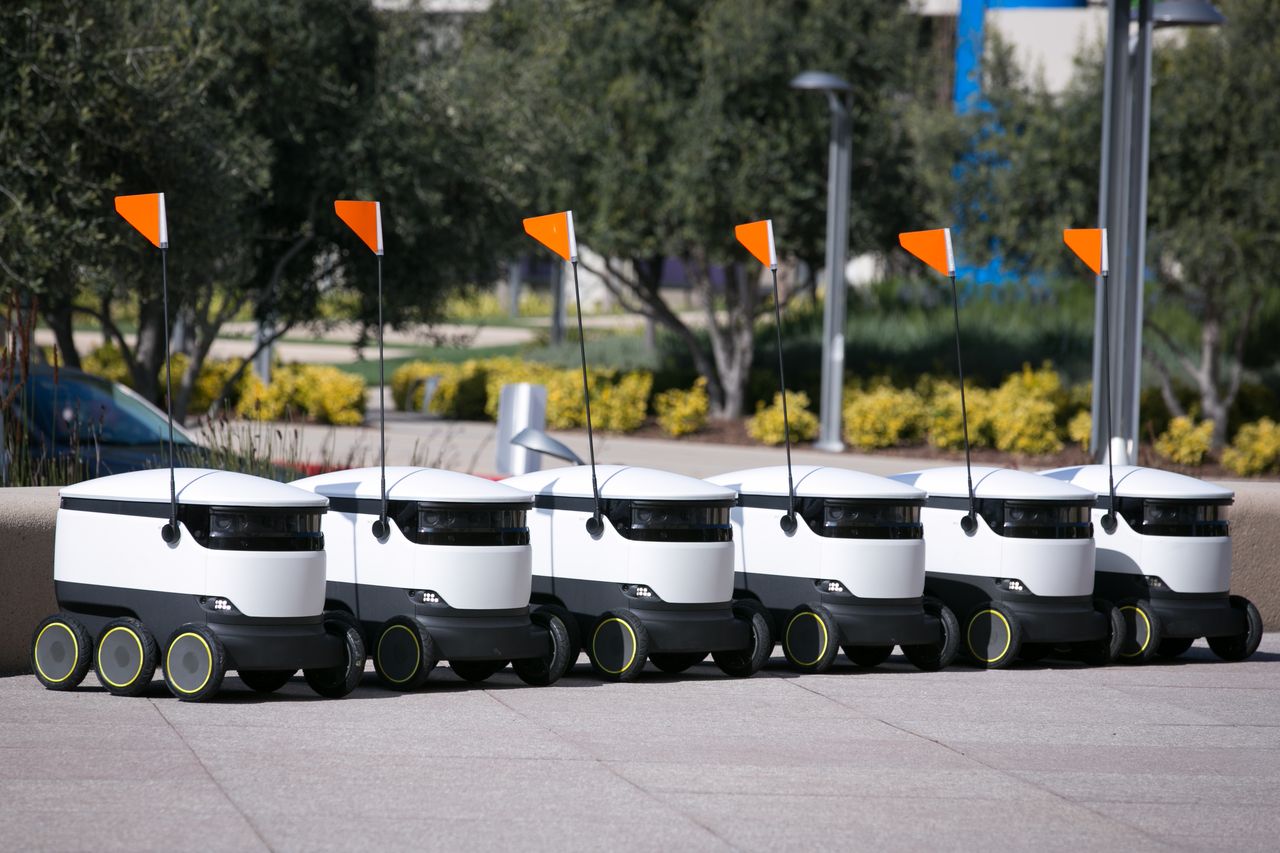
Florida University Rolls Out Autonomous Delivery Robots
The small-scale delivery robots will be in action around campus.
Florida's Polytechnic University is set to roll out autonomous delivery robots across its campus, in a new partnership with Starship Technologies.
Under the deal, Starships' small, wheeled sidewalk robots will deliver food, starting on Wednesday, to students and teachers at the university in Lakeland, with initial vendors including Einstein Bros. Bagels, Mosaic Café and Fire + Ash. More food options are expected to be added in the future.
The zero-emission robots use a combination of machine learning, AI and built-in sensors to navigate the campus, capable of mounting curbs and operating in wet weather.
"These food delivery robots offer an exciting new way for our busy students, faculty and staff to quickly and conveniently enjoy a great meal, no matter where they are," Kerri Demeri, Florida Polytechnic's director of auxiliary enterprises, said in a release. "Partnerships like this help us bring innovation directly to our students in meaningful, everyday ways."
Related:Google Partners With Agile Robots in Latest AI Robotics Push
The university is the first in the country to deploy San Francisco-based Starship's new point-of-sale system, Starship 360, which integrates in-person ordering with robot delivery, mobile pickup, and touchscreen self-service kiosks.
"We're creating a dining experience designed around how students actually live -- flexible, convenient, and always accessible," said Pepe Aaviksoo, senior vice president of operations at Starship Technologies. "This partnership brings a smarter, more connected approach to campus dining while giving students more choice and control over their meals."
Established in 2014 by two Skype co-founders, Starship Technologies has now completed more than nine million deliveries across seven countries. The latest deployment is the latest in a series of expansion projects from the company.
In the U.K., the company is scaling through partnerships with platforms such as Just Eat. It also teamed up with Uber Technologies last year to bring autonomous sidewalk delivery to multiple markets, beginning in the U.K. and expanding into Europe in 2026, and into the U.S. by 2027.
Last October, Starship also closed a $50 million funding round to expand its autonomous delivery service into U.S. cities.
About the Author
Contributing Writer
Scarlett Evans is a freelance writer with a focus on emerging technologies and the minerals industry. Previously, she served as assistant editor at IoT World Today, where she specialized in robotics and smart city technologies. Scarlett also has a background in the mining and resources sector, with experience at Mine Australia, Mine Technology and Power Technology. She joined Informa in April 2022 before transitioning to freelance work.
Sign in to highlight and annotate this article

Conversation starters
Daily AI Digest
Get the top 5 AI stories delivered to your inbox every morning.
More about
autonomous
How C-JEPA is teaching AI the physics of the physical world
By forcing AI to understand cause and effect instead of just predicting pixels, C-JEPA is laying the groundwork for smarter, more predictable autonomous systems. The post How C-JEPA is teaching AI the physics of the physical world first appeared on TechTalks .
Knowledge Map
Connected Articles — Knowledge Graph
This article is connected to other articles through shared AI topics and tags.
Discussion
Sign in to join the discussion
No comments yet — be the first to share your thoughts!