
Desktop Canary v2.1.48-canary.28
🐤 Canary Build — v2.1.48-canary.28 Automated canary build from canary branch. Commit Information Based on changes since v2.1.48-canary.27 Commit count: 3 5c17a0d652 feat: bot related common features ( #13483 ) (Rdmclin2) ec3dd471b1 👷 build(model-bank): add release workflow ( #13384 ) (Innei) 1d7a0d6bd8 👷 build(desktop): remove nightly release channel ( #13480 ) (Innei) ⚠️ Important Notes This is an automated canary build and is NOT intended for production use. Canary builds are triggered by build / fix / style commits on the canary branch. May contain unstable or incomplete changes . Use at your own risk. It is strongly recommended to back up your data before using a canary build. 📦 Installation Download the appropriate installer for your platform from the assets below. Platform File m
🐤 Canary Build — v2.1.48-canary.28
Automated canary build from canary branch.
Commit Information
-
Based on changes since v2.1.48-canary.27
-
Commit count: 3
-
5c17a0d652 feat: bot related common features (#13483) (Rdmclin2)
-
ec3dd471b1 👷 build(model-bank): add release workflow (#13384) (Innei)
-
1d7a0d6bd8 👷 build(desktop): remove nightly release channel (#13480) (Innei)
⚠️ Important Notes
-
This is an automated canary build and is NOT intended for production use.
-
Canary builds are triggered by build/fix/style commits on the canary branch.
-
May contain unstable or incomplete changes. Use at your own risk.
-
It is strongly recommended to back up your data before using a canary build.
📦 Installation
Download the appropriate installer for your platform from the assets below.
Platform File
macOS (Apple Silicon)
.dmg (arm64)
macOS (Intel)
.dmg (x64)
Windows
.exe
Linux
.AppImage / .deb
Sign in to highlight and annotate this article

Conversation starters
Daily AI Digest
Get the top 5 AI stories delivered to your inbox every morning.
More about
modelreleaseproduct
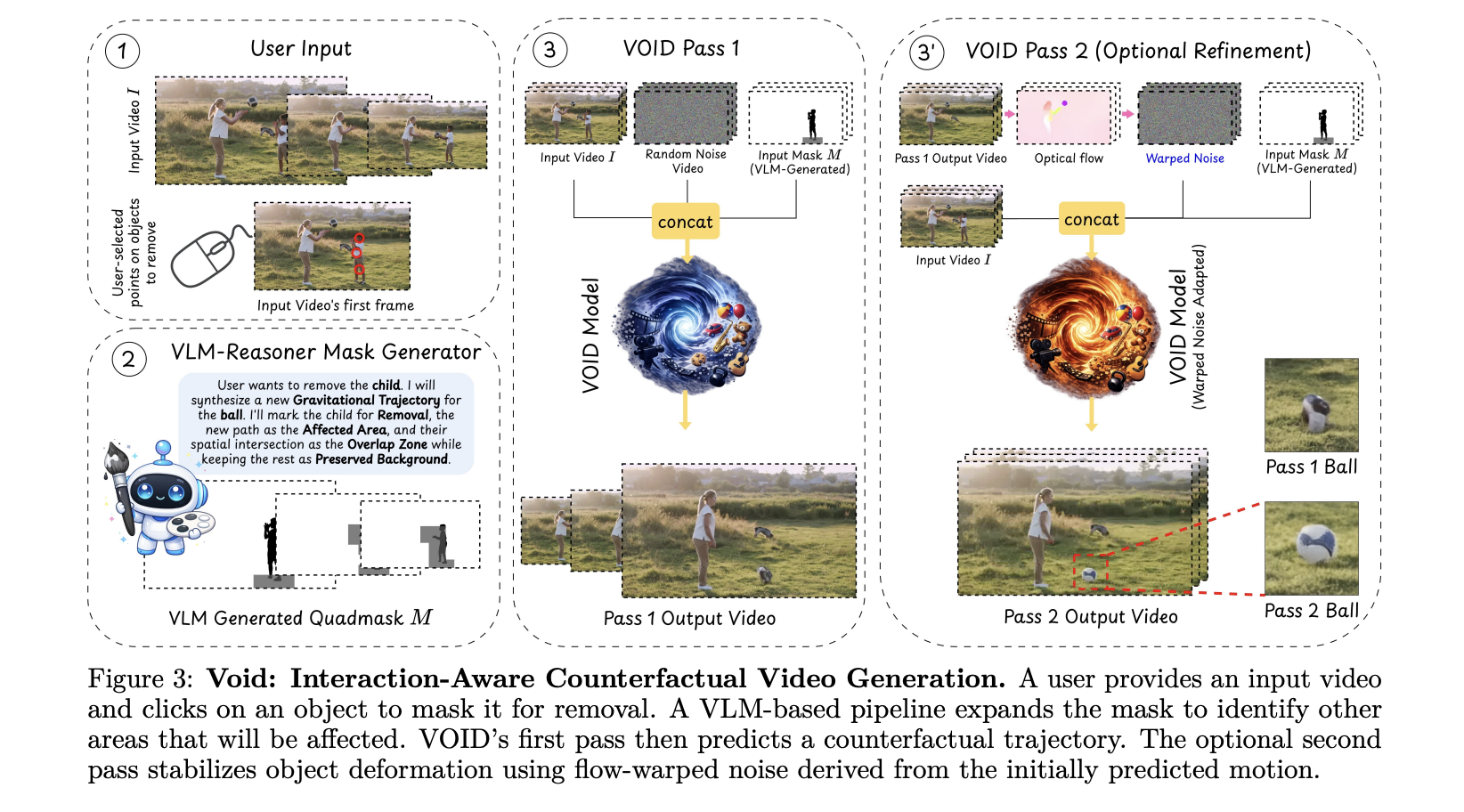
Netflix AI Team Just Open-Sourced VOID: an AI Model That Erases Objects From Videos — Physics and All
Video editing has always had a dirty secret: removing an object from footage is easy; making the scene look like it was never there is brutally hard. Take out a person holding a guitar, and you re left with a floating instrument that defies gravity. Hollywood VFX teams spend weeks fixing exactly this kind of problem. [ ] The post Netflix AI Team Just Open-Sourced VOID: an AI Model That Erases Objects From Videos — Physics and All appeared first on MarkTechPost .

Sharing Two Open-Source Projects for Local AI & Secure LLM Access 🚀
Hey everyone! I’m finally jumping into the dev.to community. To kick things off, I wanted to share two tools I’ve been developing at the University of Jaén that tackle two common headaches in the AI space: running out of VRAM, and keeping your API chats truly private. 🦥 Quansloth: TurboQuant Local AI Server The Problem: Standard LLM inference hits a "Memory Wall" with long documents. As context grows, your GPU runs out of memory (OOM) and crashes. The Solution: Quansloth is a fully private, air-gapped AI server that brings elite KV cache compression to consumer hardware. By bridging a Gradio Python frontend with a highly optimized llama.cpp CUDA backend, it prevents GPU crashes and lets you run massive contexts on a budget. Key Features: 75% VRAM Savings: Based on Google's TurboQuant (ICL
Knowledge Map
Connected Articles — Knowledge Graph
This article is connected to other articles through shared AI topics and tags.
More in Products
🦀 Rust Foundations — The Stuff That Finally Made Things Click
"Rust compiler and Clippy are the biggest tsunderes — they'll shout at you for every small mistake, but in the end… they just want your code to be perfect." Why I Even Started Rust I didn't pick Rust out of curiosity or hype. I had to. I'm working as a Rust dev at Garden Finance , where I built part of a Wallet-as-a-Service infrastructure. Along with an Axum backend, we had this core Rust crate ( standard-rs ) handling signing and broadcasting transactions across: Bitcoin EVM chains Sui Solana Starknet And suddenly… memory safety wasn't "nice to have" anymore. It was everything. Rust wasn't just a language — it was a guarantee . But yeah… in the beginning? It felt like the compiler hated me :( So I'm writing this to explain Rust foundations in the simplest way possible — from my personal n
Why Standard HTTP Libraries Are Dead for Web Scraping (And How to Fix It)
If you are building a data extraction pipeline in 2026 and your core network request looks like Ruby’s Net::HTTP.get(URI(url)) or Python's requests.get(url) , you are already blocked. The era of bypassing bot detection by rotating datacenter IPs and pasting a fake Mozilla/5.0 User-Agent string is long gone. Modern Web Application Firewalls (WAFs) like Cloudflare, Akamai, and DataDome don’t just read your headers anymore—they interrogate the cryptographic foundation of your connection. Here is a deep dive into why standard HTTP libraries actively sabotage your scraping infrastructure, and how I built a polyglot sidecar architecture to bypass Layer 4–7 fingerprinting entirely. The Fingerprint You Didn’t Know You Had When your code opens a secure connection to a server, long before the first
Tired of Zillow Blocking Scrapers — Here's What Actually Works in 2026
If you've ever tried scraping Zillow with BeautifulSoup or Selenium, you know the pain. CAPTCHAs, IP bans, constantly changing HTML selectors, headless browser detection — it's an arms race you're not going to win. I spent way too long fighting anti-bot systems before switching to an API-based approach. This post walks through how to pull Zillow property data, search listings, get Zestimates, and export everything to CSV/Excel — all with plain Python and zero browser automation. What You'll Need Python 3.7+ The requests library ( pip install requests ) A free API key from RealtyAPI That's it. No Selenium. No Playwright. No proxy rotation. Getting Started: Your First Property Lookup Let's start simple — get full property details for a single address: import requests url = " https://zillow.r

Why Gaussian Diffusion Models Fail on Discrete Data?
arXiv:2604.02028v1 Announce Type: new Abstract: Diffusion models have become a standard approach for generative modeling in continuous domains, yet their application to discrete data remains challenging. We investigate why Gaussian diffusion models with the DDPM solver struggle to sample from discrete distributions that are represented as a mixture of delta-distributions in the continuous space. Using a toy Random Hierarchy Model, we identify a critical sampling interval in which the density of noisified data becomes multimodal. In this regime, DDPM occasionally enters low-density regions between modes producing out-of-distribution inputs for the model and degrading sample quality. We show that existing heuristics, including self-conditioning and a solver we term q-sampling, help alleviate
Discussion
Sign in to join the discussion
No comments yet — be the first to share your thoughts!