
Debugging With Aura Agent
Build an AI agent and have it find the most probable error point using graph traversal tools, and analyze the event logs.
If someone had asked me five years ago if we would ever have C-3PO-like AI for real, I would probably have said no. Sure, the brain is a physical entity, and if it can do it, why wouldn’t a computer? But I still thought Google Home and Alexa was as smart as they would get (and honestly, they’re rather stupid). But then I was introduced to ChatGPT, and I was (like most of us) blown away with a real sensation of science fiction like nothing I’d seen.
And like I think many of my fellow developers, I immediately started thinking of how this new technology could be used. One of the first thoughts I had was that I could have really used this at my previous job, where I did a lot of debugging and reading long and complex log files.
The problem is that such log files are often huge, and feeding gigabytes, or even terabytes of data as context to an LLM isn’t really feasible — at least not today. But playing around with agents got me thinking that maybe I could have AI approach the problem in the same way I did when I had to consume those large files.
But first, let me set you up with the scenario we’ll use.
The Company
The company I worked at when I dwelled in those log files was in the cash handling industry, developing hardware devices and software systems for cash management. This included devices for banks, retailers, and the public to deposit, dispense, and recycle cash, along with software systems to monitor those devices, the transactions, and the movement and reconciliation of the cash.
Are those golden rings in the coin input tray?
All those hardware devices — whether public-facing ATMs, a back-office cash recycler at a bank, or a simple smart safe at a retailer — ran the same Java-based operating software. This software was event-based, so any administration software monitoring the devices didn’t have to keep track of the state of the device; the state at any time could be determined by the events up to that time. The cash content at any time was the summary of all transactions up to that point, and the operational status of the device could be determined if any error had occurred, but had not been cleared at that time.
These devices produced two types of log files. One type was formal log files that listed all those events in a well-defined format that could be easily interpreted by log-analyzing software. The other type was typical trace files generated with log4j, which many Java developers would recognize. They show the path taken through the software and information the developers deemed interesting for debugging while developing (but often on an ad-hoc basis). It’s this latter type we’ll focus on.
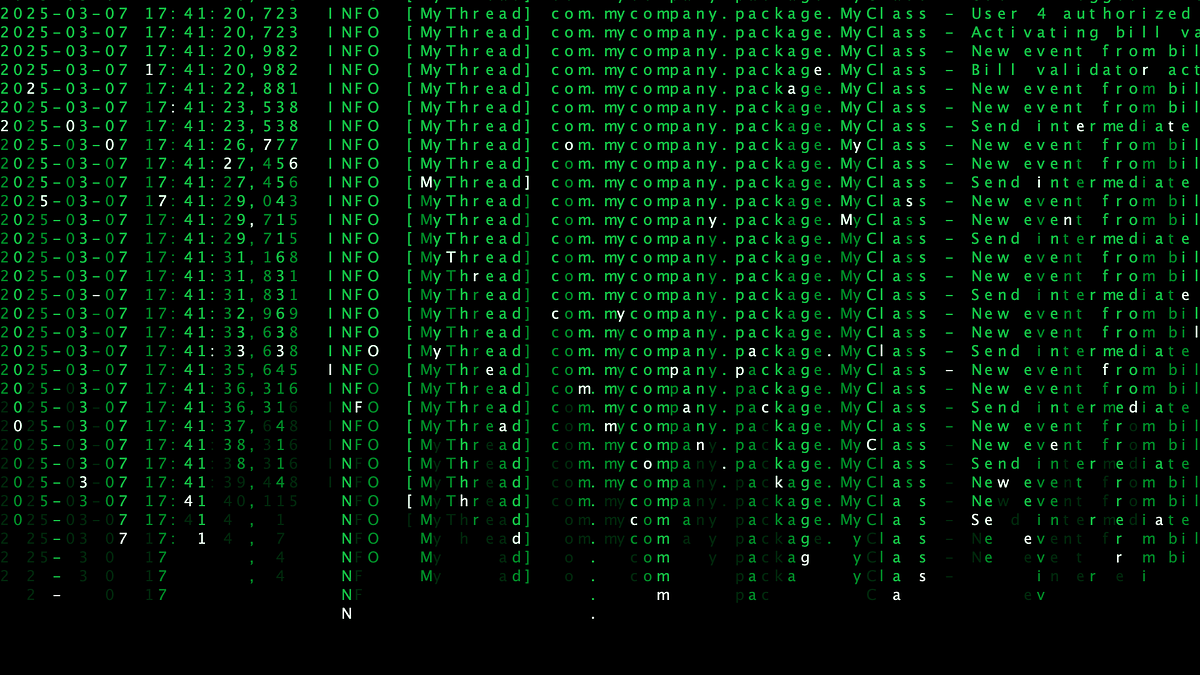
Typical output from log4j
These files were essential while debugging, but they were also hard to work with. To make the best use, you had to use them together with the source code to see where things were logged, but even then it was hard. And they were huge — it wasn’t unusual to have more than a gigabyte worth of logs from a single day and a single device. I often got the request to write an analyzer for support to be able to deduce things from them, but without any defined format, that was really hard, until now.
What I often did was to analyze the events, either in the simpler logs or in the monitoring software, to find anomalies or some clues to where to start digesting the huge trace files. So let’s give the agent that same ability.
The Data Model
First of all, just to be clear, I don’t work for that company anymore and don’t have access to any actual data or log files, so we’ll generate fake data and log files. The actual events won’t be the same as what we really had, and I wouldn’t be able to create the log files as they actually looked, but the essence is the same.
Let’s assume we already have cloud-based monitoring software, connected to all devices deployed around the world. This monitoring software captures the events of all those devices and stores them in a Neo4j graph (in an Aura instance). The model for these events would look something like the following image.
All the Event nodes have another label as well, besides :Event, to indicate what type of event it is. In our simple model, we have four event labels.
:Boot
Indicates that the device was restarted and is booting up. The state of the device should be considered reset when the boot event is seen.
:Error
Indicates that an error occurred or was cleared on the device.
Additional properties (beyond those for :Event):
-
errorid (integer): Ties the occurred and cleared events to the same error
-
message (string): The error message
-
type (string): Either “Occurred” or “Cleared”
:Transaction
Indicates that cash went into or out of the device.
Additional properties (beyond those for :Event):
-
user (integer): The ID of the user who performed the transaction
-
type (string): Either “Deposit”, “Dispense”, “Empty” or “Refill”
-
amount (integer): The total amount (in dollars) inserted (if positive) or removed (if negative)
-
USD 1: The number of USD 1 banknotes inserted/removed
-
USD 5: The number of USD 5 banknotes inserted/removed
-
USD 10: The number of USD 10 banknotes inserted/removed
-
USD 20: The number of USD 20 banknotes inserted/removed
-
USD 50: The number of USD 50 banknotes inserted/removed
-
USD 100: The number of USD 100 banknotes inserted/removed
:BoxContent
Indicates that the content of the device has changed and indicates the new amount (always sent after a transaction).
Additional properties (beyond those for :Event):
-
amount (integer): The total amount (in dollars) in the device
-
USD 1: The number of USD 1 banknotes in the device
-
USD 5: The number of USD 5 banknotes in the device
-
USD 10: The number of USD 10 banknotes in the device
-
USD 20: The number of USD 20 banknotes in the device
-
USD 50: The number of USD 50 banknotes in the device
-
USD 100: The number of USD 100 banknotes in the device
Example of six events for a device on the same date
I’ve generated made-up events for two devices from six dates (March 7-12, 2025). These devices are so-called smart safes (i.e., simple safes with a bill validator cashiers can deposit overflow banknotes into (and that validates those notes), but that doesn’t support dispensing cash back). The business model is often that the cash-in-transit (CIT) company that manages cash for the retailer owns the smart safe and gives the retailer instant credit as soon as the banknotes are deposited.
All transactions on these smart safes are either Deposit (positive) or Empty (negative).
Generated test data from two devices and six days
Zoomed view of part of the generated test data
Log Files
With that, we’ve set up the scenario of what we imagine we already had before trying to make AI help us with log file troubleshooting. All the log files we talked about earlier, all those gigabytes, are stored locally on each device. The cloud software allows the fetching of log files from the devices, and have them temporarily stored in an S3 bucket, separated from the main graph.
So to make them available for our Aura AI agent, we need to get them added to the graph. The most essential parts of the log/trace files are the parts that happen during a transaction. That’s when things happen. So I decided to break up the individual log files (normally split on a daily basis) into the parts belonging to individual transactions and store those parts as a string property (logFile) on the transaction.
There are things logged when a device is idle, although less. We could take different approaches for that. For instance, one could store it on the relationships between transactions, but for now I kept it simple and just appended it to the transaction logs from the transaction before.
A Deposit transaction with its new logFile property
The Bug
If we’re going to use this to test using Aura Agent to find bugs in our logs, we need a bug to find. So let’s plant one. This is a real bug we had in one of our devices, which we found after a lot of investigation, and I find it quite interesting.
It was one of these smart safes that used an OEM bill validator from another company. When the banknote passed the sensor, the validator reported to the software that it had seen it and the denomination, or maybe that it wasn’t deemed a real note and rejected. A second or so later, the banknote was stacked in the “cash box,” was reported again, and it was here that it was considered accepted and part of the transaction.
What happened was that we started getting reports of discrepancies in the devices. When the CIT had picked up the cash from the retailers and brought it to the cash center, it was discovered to be slightly more cash than what was reported in the transactions.
After analysis, we found that this was due to a behavior in the OEM bill validator that wasn’t expected (or documented) when it was integrated. When the bill validator was told by the software to stop accepting banknotes, it replied back when it had deactivated and stopped accepting. It was assumed this was after all events were reported and all motors had stopped moving, but it wasn’t. There could still be a banknote in the path between the sensor and the cash box, which would be reported after it had confirmed that it had stopped. Thus, that banknote wouldn’t be reported in the transaction.
So let’s modify one of the transactions to show a behavior like that. I just picked a random transaction, transaction 10214, which had a deposit of 12 one-dollar notes. Let’s make one of them go missing. I modified the logs to look like this (note that the real logs were a lot larger and more complex than these made-up logs), so that the last Bank note stored and accounted row comes after the Bill validator deactivated and no longer accepting bank notes.
2025-03-08 06:34:53,981 INFO [MyThread] com.mycompany.package.MyClass - User 7 logged in2025-03-08 06:34:53,981 INFO [MyThread] com.mycompany.package.MyClass - User 7 authorized as cashier2025-03-08 06:34:53,981 INFO [MyThread] com.mycompany.package.MyClass - Activating bill validator2025-03-08 06:34:54,257 INFO [MyThread] com.mycompany.package.MyClass - New event from bill validator: Status updated2025-03-08 06:34:54,257 INFO [MyThread] com.mycompany.package.MyClass - Bill validator activated and ready to accept bank notes2025-03-08 06:34:56,708 INFO [MyThread] com.mycompany.package.MyClass - New event from bill validator: Bank note detected - USD 12025-03-08 06:34:57,609 INFO [MyThread] com.mycompany.package.MyClass - New event from bill validator: Bank note stored and accounted - USD 12025-03-08 06:34:57,609 INFO [MyThread] com.mycompany.package.MyClass - Send intermediate update event - USD 12025-03-08 06:34:59,687 INFO [MyThread] com.mycompany.package.MyClass - New event from bill validator: Bank note detected - USD 12025-03-08 06:35:00,365 INFO [MyThread] com.mycompany.package.MyClass - New event from bill validator: Bank note stored and accounted - USD 12025-03-08 06:35:00,365 INFO [MyThread] com.mycompany.package.MyClass - Send intermediate update event - USD 12025-03-08 06:35:03,581 INFO [MyThread] com.mycompany.package.MyClass - New event from bill validator: Status updated2025-03-08 06:35:03,581 INFO [MyThread] com.mycompany.package.MyClass - New event from bill validator: Bank note rejected2025-03-08 06:35:05,661 INFO [MyThread] com.mycompany.package.MyClass - New event from bill validator: Bank note detected - USD 12025-03-08 06:35:06,337 INFO [MyThread] com.mycompany.package.MyClass - New event from bill validator: Bank note stored and accounted - USD 12025-03-08 06:35:06,337 INFO [MyThread] com.mycompany.package.MyClass - Send intermediate update event - USD 12025-03-08 06:35:07,695 INFO [MyThread] com.mycompany.package.MyClass - New event from bill validator: Bank note detected - USD 12025-03-08 06:35:08,372 INFO [MyThread] com.mycompany.package.MyClass - New event from bill validator: Bank note stored and accounted - USD 12025-03-08 06:35:08,372 INFO [MyThread] com.mycompany.package.MyClass - Send intermediate update event - USD 12025-03-08 06:35:09,747 INFO [MyThread] com.mycompany.package.MyClass - New event from bill validator: Bank note detected - USD 12025-03-08 06:35:10,422 INFO [MyThread] com.mycompany.package.MyClass - New event from bill validator: Bank note stored and accounted - USD 12025-03-08 06:35:10,422 INFO [MyThread] com.mycompany.package.MyClass - Send intermediate update event - USD 12025-03-08 06:35:11,113 INFO [MyThread] com.mycompany.package.MyClass - New event from bill validator: Bank note rejected2025-03-08 06:35:12,277 INFO [MyThread] com.mycompany.package.MyClass - New event from bill validator: Bank note rejected2025-03-08 06:35:14,324 INFO [MyThread] com.mycompany.package.MyClass - New event from bill validator: Bank note detected - USD 12025-03-08 06:35:14,996 INFO [MyThread] com.mycompany.package.MyClass - New event from bill validator: Bank note stored and accounted - USD 12025-03-08 06:35:14,996 INFO [MyThread] com.mycompany.package.MyClass - Send intermediate update event - USD 12025-03-08 06:35:16,365 INFO [MyThread] com.mycompany.package.MyClass - New event from bill validator: Bank note detected - USD 12025-03-08 06:35:17,034 INFO [MyThread] com.mycompany.package.MyClass - New event from bill validator: Bank note stored and accounted - USD 12025-03-08 06:35:17,034 INFO [MyThread] com.mycompany.package.MyClass - Send intermediate update event - USD 12025-03-08 06:35:18,155 INFO [MyThread] com.mycompany.package.MyClass - New event from bill validator: Bank note detected - USD 12025-03-08 06:35:18,816 INFO [MyThread] com.mycompany.package.MyClass - New event from bill validator: Bank note stored and accounted - USD 12025-03-08 06:35:18,816 INFO [MyThread] com.mycompany.package.MyClass - Send intermediate update event - USD 12025-03-08 06:35:19,947 INFO [MyThread] com.mycompany.package.MyClass - New event from bill validator: Bank note detected - USD 12025-03-08 06:35:20,598 INFO [MyThread] com.mycompany.package.MyClass - New event from bill validator: Bank note stored and accounted - USD 12025-03-08 06:35:20,598 INFO [MyThread] com.mycompany.package.MyClass - Send intermediate update event - USD 12025-03-08 06:35:21,957 INFO [MyThread] com.mycompany.package.MyClass - New event from bill validator: Bank note detected - USD 12025-03-08 06:35:22,641 INFO [MyThread] com.mycompany.package.MyClass - New event from bill validator: Bank note stored and accounted - USD 12025-03-08 06:35:22,641 INFO [MyThread] com.mycompany.package.MyClass - Send intermediate update event - USD 12025-03-08 06:35:25,347 INFO [MyThread] com.mycompany.package.MyClass - New event from bill validator: Bank note detected - USD 12025-03-08 06:35:26,013 INFO [MyThread] com.mycompany.package.MyClass - New event from bill validator: Bank note stored and accounted - USD 12025-03-08 06:35:26,013 INFO [MyThread] com.mycompany.package.MyClass - Send intermediate update event - USD 12025-03-08 06:35:29,208 INFO [MyThread] com.mycompany.package.MyClass - New event from bill validator: Bank note detected - USD 12025-03-08 06:35:40,666 INFO [MyThread] com.mycompany.package.MyClass - Finishing deposit and deactivating bill validator2025-03-08 06:35:40,893 INFO [MyThread] com.mycompany.package.MyClass - New event from bill validator: Status updated2025-03-08 06:35:40,893 INFO [MyThread] com.mycompany.package.MyClass - Bill validator deactivated and no longer accepting bank notes2025-03-08 06:35:41,075 INFO [MyThread] com.mycompany.package.MyClass - Transaction reported - USD 1: 11, USD 5: 0, USD 10: 0, USD 20: 0, USD 50: 0, USD 100: 02025-03-08 06:35:41,075 INFO [MyThread] com.mycompany.package.MyClass - Box content reported - USD 1: 232, USD 5: 92, USD 10: 53, USD 20: 396, USD 50: 29, USD 100: 502025-03-08 06:35:41,075 INFO [MyThread] com.mycompany.package.MyClass - User 7 logged out2025-03-08 06:35:41,371 INFO [MyThread] com.mycompany.package.MyClass - New event from bill validator: Bank note stored and accounted - USD 12025-03-08 06:35:41,371 INFO [MyThread] com.mycompany.package.MyClass - Send intermediate update event - USD 12025-03-08 06:35:41,371 INFO [MyThread] com.mycompany.package.MyClass - Box content reported - USD 1: 233, USD 5: 92, USD 10: 53, USD 20: 396, USD 50: 29, USD 100: 50
And I also modified the Transaction event in the same way.
With that in place, let’s start building our debug agents.
Aura Agent
If you wonder what AI agents are, you can read more about that in Agentic AI With Java and Neo4j.
There, we did the agent implementation in Java and made the calls to Neo4j from that Java code. Here we’ll use a new feature in Aura, the cloud-based SaaS offering of Neo4j, where you can write your agent directly within Aura without the need for any language other than Cypher. And you don’t even have to have your own API key for the LLM provider.
Note that this is not available for Aura VDC.
Creating the Agent
In the Aura console, you just have to select the Agents option in the toolbar to the left.
The Agents option in the Aura console
Click Create to create your new agent.
Creating a new agent
Now we need to define our agent. The first thing we need to do is to give it a name and description.
Name and description of our agent
In the Target instance drop-down, select the Aura instance where you have the graph you want the agent to operate on. You also have to select if it’s Internal or External. We’ll go with Internal here.
Before we can save our new agent, we have to give it a prompt and define all the tools, but we’ll go through that soon.
Prompt
In the prompt, we tell the agent something about the domain, like I did above, what it’s expected to do, and give some hints on how to use the tools we provide.
What we want is for it to start looking at the event graph (what we had before adding the log files) to find anomalies and suspicious transactions where it may want to dig further (maybe it can actually identify the problem without even looking at the log files).
I wrote the prompt for my agent like this:
You will try to find problems (software bugs or usage/configuration errors) based on a description of a problem. To help, you have all the events reported from all the connected devices, and also log files from those devices.
The software being debugged is the operating software for cash handling devices (smart deposit safes, cash recyclers, ATMs etc.). All devices report events for what happens in the device. The events can be boot events (a device starting up), error events (an error occurred or was cleared), box content updates (reporting of the cash content of the device), and transactions (cash going into or out of the device, like a deposit, a dispense, an emptying or a replenishment). The sum of the content of the transactions should always give the content of the device. The log files from the software are stored on the transaction when they were logged (logs between transactions are stored on the transaction before).
Use the event tools to try to find the problem itself or suspicious transactions. If you find suspicious transactions, ask for the log files of those and analyze them to see if you can find the problem there.
Agent prompt
Now it’s time to define our tools. First, we have the event tools we want the agent to use to locate where the problem may be for further analysis. I defined five such tools based on some things I remember doing myself when debugging these things. There could be many more added, and my idea is that it gets built out with more tools as you realize new things you do when you encounter new problems. But we’ll start with these five for now. And then we have one tool to retrieve the log rows for a specific transaction.
Adding a tool
To add a tool you click the Add tool drop-down and select Cypher Template. All tools for this agent will be Cypher templates. You give the tool a name (the subchapter headings below), a description (the guides to the AI on how to use the tool), the actual Cypher query, and the parameters used in that query. The supported data types for the parameters are string, integer, Boolean, and float. The parameters also need a name and description as instructions to the LLM. In the Cypher query, the parameters are used with the name, but prefixed with $.
events_findDuplicateDevices
One issue that seems very simple when you know the cause, but where the symptoms become very confusing, is where devices communicate with the same ID. The ID is set on the device, and every message is tagged with it. But sometimes we ended up with multiple devices with the same ID — sometimes because of repaired parts that hadn’t been properly reset or because of misconfiguration. This causes the events to end up on the same queue and, in turn, causes all sorts of strange symptoms.
One way to look at this is to look at the MAC addresses of the events. Every event is tagged with the MAC address of the sending device, so for the same device, the MAC should be the same. However, it’s not as simple as just detecting that it has changed because it may if a part (the compute unit or the network card) has been replaced. But in those cases, there would be a Boot event in between, so we can look for subsequent events that aren’t Boot events and that still have different MAC address.
CYPHER 25WITH "yyyy-MM-dd HH:mm:ss,SSS" AS dateFormatWITH dateFormat, localdatetime($from, dateFormat) AS from, localdatetime($to, dateFormat) AS toMATCH (e1:Event&!Boot)-[:NEXT]->(e2:Event&!Boot)WHERE e1.datetime >= from AND e1.datetime <= to AND e1.mac <> e2.macMATCH (d:Device)<-[:ON_DEVICE]-(e1)WITH DISTINCT(d) AS deviceRETURN device.id AS device
I put the description like this:
One problem that can sometimes occur is that two devices communicate using the same device ID. This can happen because they have been misconfigured during setup/initialization. This tool finds devices that seem to have this problem and returns the ID of those devices (if any).
As you can see, it has from and to parameters to define the time range to search between. Aura Agent doesn’t support datetime as a parameter, so we’ll set them as strings and convert in the query. This is how we’ll define them for the agent:
from string The from-date/time as a string in this format: "yyyy-MM-dd HH:mm:ss,SSS"to string The to-date/time as a string in this format: "yyyy-MM-dd HH:mm:ss,SSS"
Configuration of the events_findDuplicateDevices tool
This tool is a bit different from the other tools. If the agent finds a match here, it doesn’t really need to investigate any log files because we know what the problem is (at least if the device ID matches the problematic devices). The following tools will, instead, be entry points to find what transactions to investigate further by analyzing the log files.
events_findErrors
The first thing one normally does when getting an error report is to see where in the logs it may make sense to look is to look for errors reported by the devices.
An error is a state the device is in, and as mentioned, the state of the device can be deduced from the events. So for errors, there are two events — one when the error occurs and one when it is cleared — and they’re linked together with an errorid. Errors are also considered cleared when the device is rebooted. If the error is still present, it’ll be reported again, but with a new errorid.
So we’ll give the agent the ability to find any error that occurred within a time range. We’ll also indicate, for each of them, if they also got cleared within that time range, if they got cleared later, or if they haven’t been cleared at all (yet). The Cypher query for this is:
CYPHER 25WITH "yyyy-MM-dd HH:mm:ss,SSS" AS dateFormatWITH dateFormat, localdatetime($from, dateFormat) AS from, localdatetime($to, dateFormat) AS toMATCH (e:Error) WHERE e.datetime >= from AND e.datetime <= to AND e.type = "Occurred"CALL(e, to) { WHEN EXISTS { (e)-[:NEXT*]->(b:Boot) WHERE b.datetime <= to } OR EXISTS { (e)-[:NEXT*]->(e2:Error) WHERE e2.datetime <= to AND e2.type = "Cleared" AND e2.errorid = e.errorid } THEN RETURN "Cleared" AS status WHEN EXISTS { (e)-[:NEXT*]->(b:Boot) } OR EXISTS { (e)-[:NEXT*]->(e2:Error) WHERE e2.type = "Cleared" AND e2.errorid = e.errorid } THEN RETURN "Cleared later" AS status ELSE RETURN "Not cleared" AS status}MATCH (d:Device)<-[:ON_DEVICE]-(e)RETURN e.message AS error, format(e.datetime, dateFormat) AS time, status, d.id AS device
The prompt for this tool is:
Find any errors reported from any device in the date/time range provided. Each error is reported with the message of the error, the date/time it occurred (in this format: “yyyy-MM-dd HH:mm:ss,SSS”) and whether or not it has been resolved. If it was resolved within the time range, it says “Cleared.” If it was resolved after the time range, it says “Cleared later.” If it was not resolved at all, it says “Not cleared.”
The parameters:
from string The from-date/time as a string in this format: "yyyy-MM-dd HH:mm:ss,SSS"to string The to-date/time as a string in this format: "yyyy-MM-dd HH:mm:ss,SSS"
events_findDiscrepancy
As I described earlier, the cash content of a device at any time is the summary of all transactions leading up to that point. As I also said, the state of the device isn’t reported; it’s deduced from the events. However, for the cash content, there is an exception: It’s reported once it’s updated (which would be right after transactions). The reason is that you would otherwise have to summarize all transactions from the beginning of time.
What we could do with this is validate that the content updates match the difference between the last content update and the transaction in between (a caveat here is that if there is a discrepancy in one, it might also be in the other, so we may not find all discrepancies, but we would find some).
Ideally, we’d check the discrepancy for each denomination, but for simplicity, we’ll only do it for the total amount for now. This means that if you have two USD 5 banknotes too few and one USD 10 note too many, they will balance out and not be found, but this seems unlikely, and we’re probably good only checking the total amount.
Cypher:
CYPHER 25WITH "yyyy-MM-dd HH:mm:ss,SSS" AS dateFormatWITH dateFormat, localdatetime($from, dateFormat) AS from, localdatetime($to, dateFormat) AS toMATCH (b1:BoxContent)-[:NEXT]->(t:Transaction)-[:NEXT]->(b2:BoxContent)WHERE t.datetime >= from AND t.datetime <= to AND b1.amount + t.amount <> b2.amountMATCH (t)-[:ON_DEVICE]->(d:Device)RETURN t.id AS transaction, format(t.datetime, dateFormat) AS time, d.id AS device, "USD " + toString(b2.amount - b1.amount - t.amount) AS discrepancy
Prompt:
The cash content of a device should always be the sum of all transactions before. So the box content event after a transaction should be the sum of the box content before plus the transaction content. This tool finds discrepancies where that is not the case within a time range. It returns the ID of the transaction (transaction), the date/time of that transaction (in this format: “yyyy-MM-dd HH:mm:ss,SSS”) (time), and the discrepancy amount (with currency).
Parameters:
from string The from-date/time as a string in this format: "yyyy-MM-dd HH:mm:ss,SSS"to string The to-date/time as a string in this format: "yyyy-MM-dd HH:mm:ss,SSS"
events_findTransactionBefore
If the investigation leads to a certain transaction or a certain point in time, it may be interesting to investigate transactions before and after that as well, and this tool gives the agent the possibility to find those.
CYPHER 25WITH "yyyy-MM-dd HH:mm:ss,SSS" AS dateFormatWITH dateFormat, localdatetime($date, dateFormat) AS dateMATCH (t:Transaction)-[:ON_DEVICE]->(:Device {id: $device})WHERE t.datetime < dateWITH dateFormat, t ORDER BY duration.between(t.datetime, date) LIMIT 1RETURN t.id AS transaction, format(t.datetime, dateFormat) AS time
Prompt:
Finds the latest transaction (if any) before a certain date/time and for a specific device.
Parameters:
date string The date/time as a string in this format: "yyyy-MM-dd HH:mm:ss,SSS"device integer The device id
events_findTransactionAfter
Same as events_findTransactionBefore, but for finding dates after the supplied date instead of before, so with WHERE t.datetime > date instead.
getLogsForTransaction
This is the last tool, the one that gives the agent access to those logs (traces) that belongs to a certain transaction.
CYPHER 25MATCH (t:Transaction {id: $transaction}) RETURN t.logFile AS log
Prompt:
Fetches the logs for a certain transaction. This includes both what was logged during this transaction and everything that was logged after until the next one was started. The logs are in the standard format produced by log4j.
Parameters:
transaction integer The transaction id
Now we’ve defined the tools we’ll use for this experiment. It would be good to add some more by thinking through the experience of doing such troubleshootings and keep adding new tools as you gain more experience and find new ways of approaching the log files. But for this experiment, let’s keep it like this.
And with this, our full Aura Agent configuration looks like this now:
The full Aura Agent configuration dialog
Taking Our Agent for a Spin
Now we have our graph of events (that in our pretend scenario we already had since before), we’ve extended it with the log data, and we’ve created an Aura Agent on top of it. Let’s take it for a spin now.
By just clicking the agent we just created, we get a chat interface similar to that we recognize from ChatGPT, Gemini, and the others.
The user interface of the Aura Agent chatbot
And let’s present the problem as I remember it from when we had the similar scenario for real:
A customer reported that they had emptied some of their devices on March 9, 2025, but when counting the cash at the cash center there was 1 dollar more found than what had been reported by the devices since last time the cash was picked up (on March 1). Can you find what went wrong, if there is a bug, and if so what it could be?
You see the response from the agent below:
The agent conversation
So it found what had happened and when. It didn’t realize that it was due to a problem with how the bill validator handled the session, but that would be hard without the integration manual of that component. Still it gives us enough for us to take the last steps ourselves.
With this information, it’s rather straightforward to fix it. Ideally, you’d want an update to the firmware of the OEM component, but even without that, we can work around it on our side.
Future Ideas
If I were still working there, or somewhere similar, I would definitely attempt to build something like this. But to take it to the next level, there would be some more things we could do:
-
As stated, extend with even more graph traversal tools to find indications of where the error may be.
-
Put the logs for things that happen between transactions on the relationships between the transactions instead.
-
Make use of the :Date nodes to make the traversals in bigger data sets more efficient and add indexes to speed up the queries.
-
Connect it to the code base so it can compare the log traces to where it’s logged in the source code.
Summary
To summarize what we did:
-
We had an existing graph of all events from all devices connected.
-
We split the log files into sections matching to those events and stored it on the most relevant event.
-
We built an AI agent on top of that and instructed it to start by finding the most probable error point using some graph traversal tools, and then trying to find the actual problem by analyzing the logs of that event.
We showed this using connected cash-handling devices, but the same setup would probably work for any domain with event-based connected devices that produce logs in a similar way. Actually, it probably works for any software that has some form of events that the log files can be tied to.
Debugging With Aura Agent was originally published in Neo4j Developer Blog on Medium, where people are continuing the conversation by highlighting and responding to this story.
Essential GraphRAG
Unlock the full potential of RAG with knowledge graphs. Get the definitive guide from Manning, free for a limited time.
Sign in to highlight and annotate this article

Conversation starters
Daily AI Digest
Get the top 5 AI stories delivered to your inbox every morning.
More about
agent
How Meta Used AI to Map Tribal Knowledge in Large-Scale Data Pipelines
AI coding assistants are powerful but only as good as their understanding of your codebase. When we pointed AI agents at one of Meta s large-scale data processing pipelines – spanning four repositories, three languages, and over 4,100 files – we quickly found that they weren t making useful edits quickly enough. We fixed this by building [...] Read More... The post How Meta Used AI to Map Tribal Knowledge in Large-Scale Data Pipelines appeared first on Engineering at Meta .

Best model for 4090 as AI Coding Agent
Good day. I am looking for best local model for coding agent. I might've missed something or some model which is not that widely used so I cam here for the help. Currently I have following models I found useful in agentic coding via Google's turbo quant applied on llama.cpp: GLM 4.7 Flash Q4_K_M -> 30B 30B Nemotron 3 Q4_K_M -> 30B Qwen3 Coder Next Q4_K_M -> 80B I really was trying to get Qwen3 Coder Next to get a decent t/s for input and output as I thought it would be a killer but to my surprise...it sometimes makes so silly mistakes that I have to do lots of babysitting for agentic flow. GLM 4.7 and Nemotron are the ones I really can't decide between, both have decent t/s for agentic coding and I use both to maxed context window. The thing is that I feel there might be some model that ju
![[P] Easily provide Wandb logs as context to agents for analysis and planning.](https://d2xsxph8kpxj0f.cloudfront.net/310419663032563854/konzwo8nGf8Z4uZsMefwMr/default-img-graph-nodes-a2pnJLpyKmDnxKWLd5BEAb.webp)
[P] Easily provide Wandb logs as context to agents for analysis and planning.
It is frustrating to use the Wandb CLI and MCP tools with my agents. For one, the MCP tool basically floods the context window and frequently errors out :/ So I built a cli tool that: imports my wandb projects; uses algorithms from AlphaEvolve to index and structure my runs; is easy to use for agents; provides greater context of past experiments; does not flood the context window; and easily tune exploration-exploitation while planning Would love any feedback and critique from the community :) Repo: https://github.com/mylucaai/cadenza Along with the cli tool, the repo also contains a python SDK which allows integrating this into other custom agents. submitted by /u/hgarud [link] [comments]
Knowledge Map
Connected Articles — Knowledge Graph
This article is connected to other articles through shared AI topics and tags.
More in Products

Beware the Magical 2-Person, $1 Billion AI-Driven Startup
In early 2024, OpenAI CEO Sam Altman predicted there would be a “one-person billion dollar company, which would have been unimaginable without AI, but now it will happen.” Several media outlets recently concluded that the prediction came true (albeit with two employees). But the story looks less promising upon deeper inspection. Retain Healthy Skepticism When [ ]

The Geometry Behind the Dot Product: Unit Vectors, Projections, and Intuition
The geometric foundations you need to understand the dot product The post The Geometry Behind the Dot Product: Unit Vectors, Projections, and Intuition appeared first on Towards Data Science .

AI Is Insatiable
While browsing our website a few weeks ago, I stumbled upon “ How and When the Memory Chip Shortage Will End ” by Senior Editor Samuel K. Moore. His analysis focuses on the current DRAM shortage caused by AI hyperscalers’ ravenous appetite for memory, a major constraint on the speed at which large language models run. Moore provides a clear explanation of the shortage, particularly for high bandwidth memory (HBM). As we and the rest of the tech media have documented, AI is a resource hog. AI electricity consumption could account for up to 12 percent of all U.S. power by 2028. Generative AI queries consumed 15 terawatt-hours in 2025 and are projected to consume 347 TWh by 2030. Water consumption for cooling AI data centers is predicted to double or even quadruple by 2028 compared to 2023. B

The one piece of data that could actually shed light on your job and AI
This story originally appeared in The Algorithm, our weekly newsletter on AI. To get stories like this in your inbox first, sign up here. Within Silicon Valley’s orbit, an AI-fueled jobs apocalypse is spoken about as a given. The mood is so grim that a societal impacts researcher at Anthropic, responding Wednesday to a call for
Discussion
Sign in to join the discussion
No comments yet — be the first to share your thoughts!