
Chinese Startup Debuts Super-Bendy Robotic Arm for Orbital Repairs
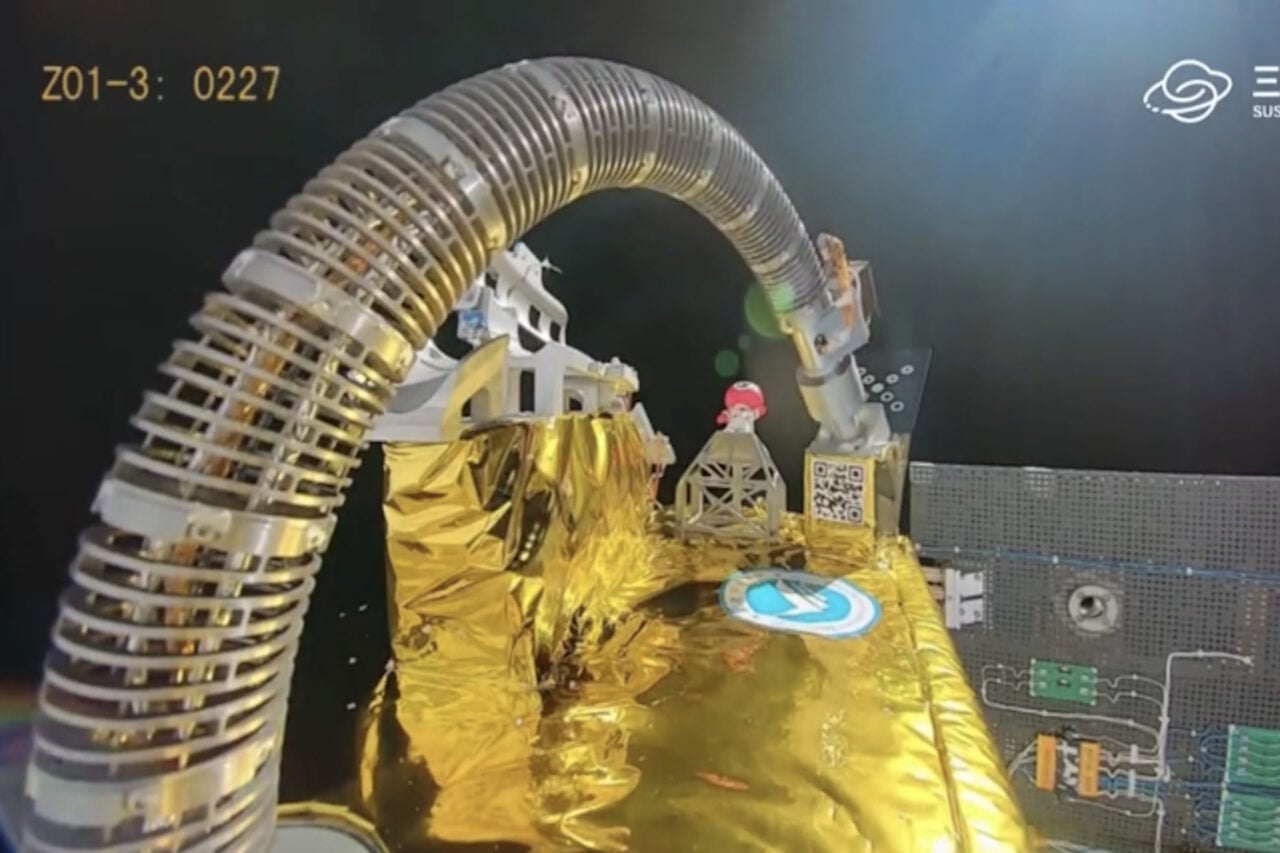
Sustain Space’s Xiyuan-0 satellite carried out its first in-orbit demonstration for satellite servicing.
A limber robot perched atop a satellite carried out a series of refueling tests in space for the first time, bringing China a step closer to in-orbit servicing capabilities that could extend the lifespan of spacecraft.
Chinese startup Sustain Space tested its flexible robotic arm through simulated orbital tasks, successfully verifying four modes of operation during the technology demonstration, according to a company statement. The relatively bendy robot is made of a series of spring-like tubes, allowing it to twist or curl in different ways to refuel and repair spacecraft, as well as move space debris out of the way.
Need an arm?
Sustain Space’s Xiyuan-0 satellite launched on March 16 on board a Kuaizhou-11 rocket from the Jiuquan Satellite Launch Center in China. The satellite is equipped with a flexible robotic arm designed to carry out complex in-orbit operations.
During its time in space, engineers put the robotic arm through the wringer. The flexible robot performed a series of simulated tasks, including ground-controlled, autonomous, and vision-guided refueling simulations, as well as force-compliant manipulation and precision control.
“The satellite has successfully completed all on-orbit operations of its flexible robotic arm, marking a solid step forward for China’s commercial aerospace industry in the field of on-orbit space services,” Sustain Space wrote in a translated statement.
The robot is designed with a hollow arm composed of a series of spring-like tubes that connect to each other, along with motors that allow it to pull on cables.
Robotic services
The space industry features a few robotic limbs that perform vital tasks in orbit, such as assembling spacecraft, assisting astronauts, and maintaining satellites.
The 57-foot-long (17-meter) Canadarm2 is attached to the International Space Station (ISS) and helps move supplies, dock spacecraft, and support work being done during spacewalks. The European Robotic Arm (ERA) is the first robot able to “walk” around the Russian segment of the ISS, designed with an elbow, shoulders, and even wrists. Japan’s Experiment Module Remote Manipulator System, also known as Kibo, assists in experiments conducted on the ISS.
China’s flexible robotic arm is the first of its kind, mainly designed for the purpose of supporting the sustainability of the space industry through in-orbit operations. Other space startups are looking to develop the same type of in-orbit servicing, albeit using different technologies. The bendy robot’s recent demonstration highlights the Chinese space industry’s advancement toward maintaining orbiting spacecraft.
Gizmodo
https://gizmodo.com/chinese-startup-debuts-super-bendy-robotic-arm-for-orbital-repairs-2000740891Sign in to highlight and annotate this article

Conversation starters
Daily AI Digest
Get the top 5 AI stories delivered to your inbox every morning.
More about
startup
Beware the Magical 2-Person, $1 Billion AI-Driven Startup
In early 2024, OpenAI CEO Sam Altman predicted there would be a “one-person billion dollar company, which would have been unimaginable without AI, but now it will happen.” Several media outlets recently concluded that the prediction came true (albeit with two employees). But the story looks less promising upon deeper inspection. Retain Healthy Skepticism When [ ]

AI Is Insatiable
While browsing our website a few weeks ago, I stumbled upon “ How and When the Memory Chip Shortage Will End ” by Senior Editor Samuel K. Moore. His analysis focuses on the current DRAM shortage caused by AI hyperscalers’ ravenous appetite for memory, a major constraint on the speed at which large language models run. Moore provides a clear explanation of the shortage, particularly for high bandwidth memory (HBM). As we and the rest of the tech media have documented, AI is a resource hog. AI electricity consumption could account for up to 12 percent of all U.S. power by 2028. Generative AI queries consumed 15 terawatt-hours in 2025 and are projected to consume 347 TWh by 2030. Water consumption for cooling AI data centers is predicted to double or even quadruple by 2028 compared to 2023. B

What is Proof of Physical AI? The Missing Layer in DePIN
When an AI agent pays for GPU compute on a decentralized network, how does it know a real V100 ran the job and not a spoofed VM claiming to be one? It can't. The receipt says "V100" but the silicon could be anything. Until now. The Problem Nobody's Solving AI inference is a black box. You send a prompt, you get tokens back. Somewhere between your API call and the response, a machine did math — but you have zero proof of which machine, or whether it was physical at all. DePIN (Decentralized Physical Infrastructure Networks) has made real progress proving that infrastructure exists : Filecoin proves storage capacity. Helium proves radio coverage. Render proves GPU compute was done. io.net proves GPU availability. But none of them prove which specific hardware did the work. A Render job could
Knowledge Map
Connected Articles — Knowledge Graph
This article is connected to other articles through shared AI topics and tags.
More in Products

Beware the Magical 2-Person, $1 Billion AI-Driven Startup
In early 2024, OpenAI CEO Sam Altman predicted there would be a “one-person billion dollar company, which would have been unimaginable without AI, but now it will happen.” Several media outlets recently concluded that the prediction came true (albeit with two employees). But the story looks less promising upon deeper inspection. Retain Healthy Skepticism When [ ]

The Geometry Behind the Dot Product: Unit Vectors, Projections, and Intuition
The geometric foundations you need to understand the dot product The post The Geometry Behind the Dot Product: Unit Vectors, Projections, and Intuition appeared first on Towards Data Science .
AI Is Insatiable
While browsing our website a few weeks ago, I stumbled upon “ How and When the Memory Chip Shortage Will End ” by Senior Editor Samuel K. Moore. His analysis focuses on the current DRAM shortage caused by AI hyperscalers’ ravenous appetite for memory, a major constraint on the speed at which large language models run. Moore provides a clear explanation of the shortage, particularly for high bandwidth memory (HBM). As we and the rest of the tech media have documented, AI is a resource hog. AI electricity consumption could account for up to 12 percent of all U.S. power by 2028. Generative AI queries consumed 15 terawatt-hours in 2025 and are projected to consume 347 TWh by 2030. Water consumption for cooling AI data centers is predicted to double or even quadruple by 2028 compared to 2023. B
Discussion
Sign in to join the discussion
No comments yet — be the first to share your thoughts!