

Sven: Singular Value Descent as a Computationally Efficient Natural Gradient Method
arXiv:2604.01279v1 Announce Type: new Abstract: We introduce Sven (Singular Value dEsceNt), a new optimization algorithm for neural networks that exploits the natural decomposition of loss functions into a sum over individual data points, rather than reducing the full loss to a single scalar before computing a parameter update. Sven treats each data point's residual as a separate condition to be satisfied simultaneously, using the Moore-Penrose pseudoinverse of the loss Jacobian to find the minimum-norm parameter update that best satisfies all conditions at once. In practice, this pseudoinvers — Samuel Bright-Thonney, Thomas R. Harvey, Andre Lukas, Jesse Thaler
View PDF HTML (experimental)
Abstract:We introduce Sven (Singular Value dEsceNt), a new optimization algorithm for neural networks that exploits the natural decomposition of loss functions into a sum over individual data points, rather than reducing the full loss to a single scalar before computing a parameter update. Sven treats each data point's residual as a separate condition to be satisfied simultaneously, using the Moore-Penrose pseudoinverse of the loss Jacobian to find the minimum-norm parameter update that best satisfies all conditions at once. In practice, this pseudoinverse is approximated via a truncated singular value decomposition, retaining only the $k$ most significant directions and incurring a computational overhead of only a factor of $k$ relative to stochastic gradient descent. This is in comparison to traditional natural gradient methods, which scale as the square of the number of parameters. We show that Sven can be understood as a natural gradient method generalized to the over-parametrized regime, recovering natural gradient descent in the under-parametrized limit. On regression tasks, Sven significantly outperforms standard first-order methods including Adam, converging faster and to a lower final loss, while remaining competitive with LBFGS at a fraction of the wall-time cost. We discuss the primary challenge to scaling, namely memory overhead, and propose mitigation strategies. Beyond standard machine learning benchmarks, we anticipate that Sven will find natural application in scientific computing settings where custom loss functions decompose into several conditions.
Subjects:
Machine Learning (cs.LG); Artificial Intelligence (cs.AI); High Energy Physics - Theory (hep-th); Optimization and Control (math.OC)
Report number: MIT-CTP/6022
Cite as: arXiv:2604.01279 [cs.LG]
(or arXiv:2604.01279v1 [cs.LG] for this version)
https://doi.org/10.48550/arXiv.2604.01279
arXiv-issued DOI via DataCite
Submission history
From: Thomas Harvey [view email] [v1] Wed, 1 Apr 2026 18:00:07 UTC (254 KB)
Sign in to highlight and annotate this article

Conversation starters
Daily AI Digest
Get the top 5 AI stories delivered to your inbox every morning.
More about
researchpaperarxiv![Ml project user give dataset and I give best model [D] [P]](https://d2xsxph8kpxj0f.cloudfront.net/310419663032563854/konzwo8nGf8Z4uZsMefwMr/default-img-graph-nodes-a2pnJLpyKmDnxKWLd5BEAb.webp)
Ml project user give dataset and I give best model [D] [P]
Tl,dr : suggest me a solution to create a ai ml project where user will give his dataset as input and the project should give best model for the given dataset for the user. so that user can just use that model and train it using the dataset he have. hey so I work as a apprentice in a company, now mentor told me to build a project where use will give his dataset and I have to suggest a best model for that dataset. now what I started with was just taking data running in on multiple ml models and then suggesting the best performance model. but yes the models were few then from only those model suggestions will.be made. I told this approach to my mentor, she told no this is bad idea that everytime training ml models that to multiple and the suggesting the best model. she told me to make a data
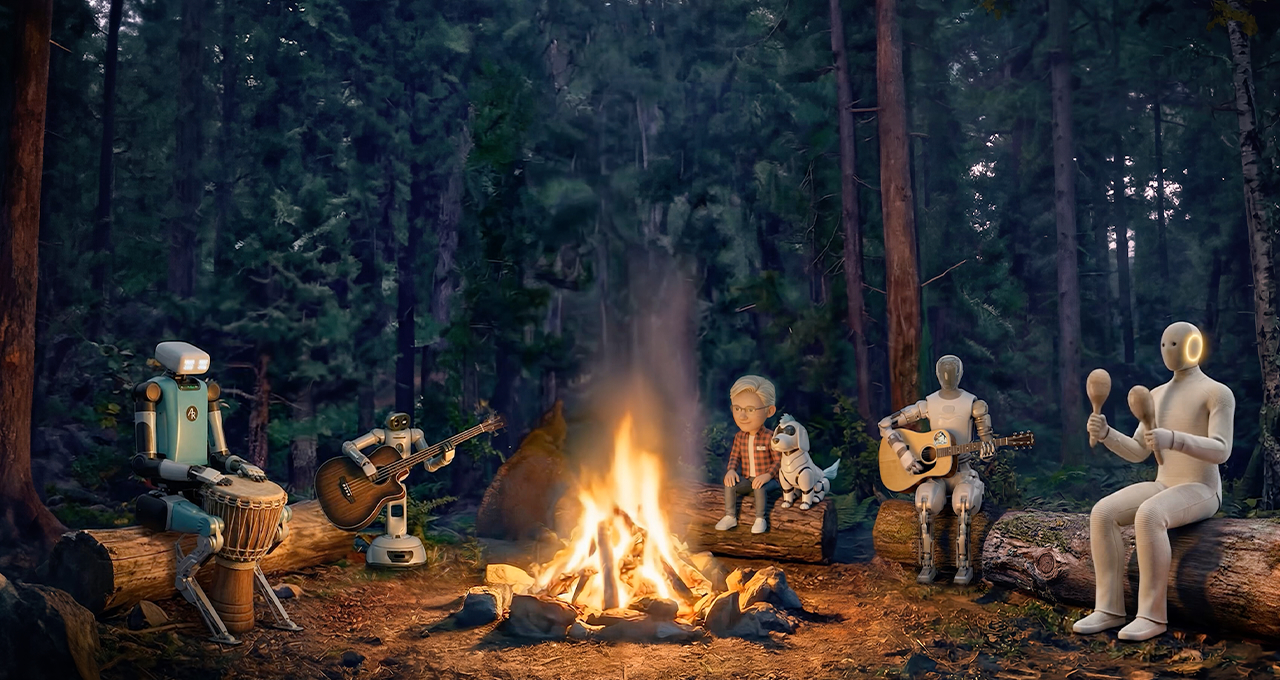
National Robotics Week — Latest Physical AI Research, Breakthroughs and Resources
This National Robotics Week, NVIDIA is highlighting the breakthroughs that are bringing AI into the physical world — as well as the growing wave of robots transforming industries, from agricultural and manufacturing to energy and beyond. Advancements in robot learning, simulation and foundation models are accelerating development, enabling robots to move from training in virtual [ ]
Knowledge Map
Connected Articles — Knowledge Graph
This article is connected to other articles through shared AI topics and tags.
More in Research Papers

The CEO Building the Most Powerful AI on Earth Just Admitted It Will Destroy Half Your Industry.
January 26, 2026. Dario Amodei published a 20,000-word essay warning that AI will displace 50% of entry-level white-collar jobs in 1–5… Continue reading on Towards AI »

New Rowhammer attack can grant kernel-level control on Nvidia workstation GPUs
A study from researchers at UNC Chapel Hill and Georgia Tech shows that GDDR6-based Rowhammer attacks can grant kernel-level access to Linux systems equipped with GPUs based on Nvidia's Ampere and Ada Lovelace architectures. The vulnerability appears significantly more severe than what was outlined in a paper last year. Read Entire Article
![[D] ICML Reviewer Acknowledgement](https://d2xsxph8kpxj0f.cloudfront.net/310419663032563854/konzwo8nGf8Z4uZsMefwMr/default-img-matrix-rain-CvjLrWJiXfamUnvj5xT9J9.webp)
[D] ICML Reviewer Acknowledgement
Hi, I'm a little confused about ICML discussion period Does the period for reviewer acknowledging responses have already ended? One of the four reviewers did not present any answer to a paper of mine. Do you know if the reviewer can still change their score before April 7th? There is a reviewer comment that I will answer on Monday. Will the reviewer be able to update the score after seeing my answer? Thanks! submitted by /u/Massive_Horror9038 [link] [comments]
Discussion
Sign in to join the discussion
No comments yet — be the first to share your thoughts!