

A tree interpretation of arc standard dependency derivation
arXiv:2603.27459v1 Announce Type: new Abstract: We show that arc-standard derivations for projective dependency trees determine a unique ordered tree representation with surface-contiguous yields and stable lexical anchoring. Each \textsc{shift}, \textsc{leftarc}, and \textsc{rightarc} transition corresponds to a deterministic tree update, and the resulting hierarchical object uniquely determines the original dependency arcs. We further show that this representation characterizes projectivity: a single-headed dependency tree admits such a contiguous ordered representation if and only if it is — Zihao Huang, Ai Ka Lee, Jungyeul Park
View PDF
Abstract:We show that arc-standard derivations for projective dependency trees determine a unique ordered tree representation with surface-contiguous yields and stable lexical anchoring. Each \textsc{shift}, \textsc{leftarc}, and \textsc{rightarc} transition corresponds to a deterministic tree update, and the resulting hierarchical object uniquely determines the original dependency arcs. We further show that this representation characterizes projectivity: a single-headed dependency tree admits such a contiguous ordered representation if and only if it is projective. The proposal is derivational rather than convertive. It interprets arc-standard transition sequences directly as ordered tree construction, rather than transforming a completed dependency graph into a phrase-structure output. For non-projective inputs, the same interpretation can be used in practice via pseudo-projective lifting before derivation and inverse decoding after recovery. A proof-of-concept implementation in a standard neural transition-based parser shows that the mapped derivations are executable and support stable dependency recovery.
Subjects:
Computation and Language (cs.CL)
Cite as: arXiv:2603.27459 [cs.CL]
(or arXiv:2603.27459v1 [cs.CL] for this version)
https://doi.org/10.48550/arXiv.2603.27459
arXiv-issued DOI via DataCite
Submission history
From: Jungyeul Park [view email] [v1] Sun, 29 Mar 2026 00:45:43 UTC (17 KB)
Sign in to highlight and annotate this article

Conversation starters
Daily AI Digest
Get the top 5 AI stories delivered to your inbox every morning.
More about
researchpaperarxiv

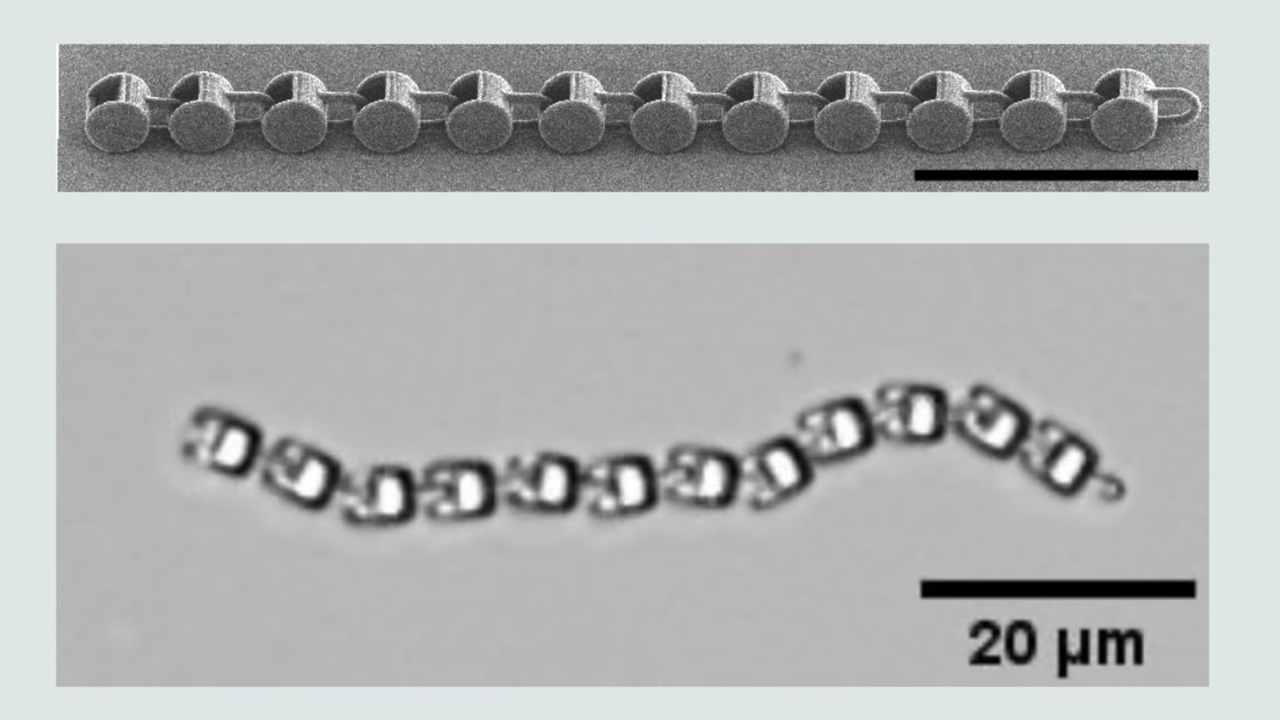
Researchers 3D print robot the size of a single-cell organism — devices move and navigate even without a ‘brain,’ uses their shape and the environment to get going
Researchers 3D print robot the size of a single-cell organism — devices move and navigate even without a ‘brain,’ uses their shape and the environment to get going
Knowledge Map
Connected Articles — Knowledge Graph
This article is connected to other articles through shared AI topics and tags.
More in Research Papers
Researchers 3D print robot the size of a single-cell organism — devices move and navigate even without a ‘brain,’ uses their shape and the environment to get going
Researchers 3D print robot the size of a single-cell organism — devices move and navigate even without a ‘brain,’ uses their shape and the environment to get going

Developing psychosocial phenotypes to understand engagement with digital health technologies for heart failure
npj Digital Medicine, Published online: 04 April 2026; doi:10.1038/s41746-026-02571-z Developing psychosocial phenotypes to understand engagement with digital health technologies for heart failure
Discussion
Sign in to join the discussion
No comments yet — be the first to share your thoughts!