

Fair Benchmarking of Emerging One-Step Generative Models Against Multistep Diffusion and Flow Models
arXiv:2603.14186v2 Announce Type: replace Abstract: State-of-the-art text-to-image models produce high-quality images, but inference remains expensive as generation requires several sequential ODE or denoising steps. Native one-step models aim to reduce this cost by mapping noise to an image in a single step, yet fair comparisons to multi-step systems are difficult because studies use mismatched sampling steps and different classifier-free guidance (CFG) settings, where CFG can shift FID, Inception Score, and CLIP-based alignment in opposing directions. It is also unclear how well one-step mod — Advaith Ravishankar, Serena Liu, Mingyang Wang, Todd Zhou, Jeffrey Zhou, Arnav Sharma, Ziling Hu, L\'eopold Das, Abdulaziz Sobirov, Faizaan Siddique, Freddy Yu, Seungjoo Baek, Yan Luo, Mengyu Wang
Authors:Advaith Ravishankar, Serena Liu, Mingyang Wang, Todd Zhou, Jeffrey Zhou, Arnav Sharma, Ziling Hu, Léopold Das, Abdulaziz Sobirov, Faizaan Siddique, Freddy Yu, Seungjoo Baek, Yan Luo, Mengyu Wang
View PDF HTML (experimental)
Abstract:State-of-the-art text-to-image models produce high-quality images, but inference remains expensive as generation requires several sequential ODE or denoising steps. Native one-step models aim to reduce this cost by mapping noise to an image in a single step, yet fair comparisons to multi-step systems are difficult because studies use mismatched sampling steps and different classifier-free guidance (CFG) settings, where CFG can shift FID, Inception Score, and CLIP-based alignment in opposing directions. It is also unclear how well one-step models scale to multi-step inference, and there is limited standardized out-of-distribution evaluation for label-ID-conditioned generators beyond ImageNet. To address this, We benchmark eight models spanning one-step flows (MeanFlow, Improved MeanFlow, SoFlow), multi-step baselines (RAE, Scale-RAE), and established systems (SiT, Stable Diffusion 3.5, FLUX.1) under a controlled class-conditional protocol on ImageNet validation, ImageNetV2, and reLAIONet, our new proofread out-of-distribution dataset aligned to ImageNet label IDs. Using FID, Inception Score, CLIP Score, and Pick Score, we show that FID-focused model development and CFG selection can be misleading in few-step regimes, where guidance changes can improve FID while degrading text-image alignment and human preference signals and worsening perceived quality. We further show that leading one-step models benefit from step scaling and become substantially more competitive under multi-step inference, although they still exhibit characteristic local distortions. To capture these tradeoffs, we introduce MinMax Harmonic Mean (MMHM), a composite proxy over all four metrics that stabilizes hyperparameter selection across guidance and step sweeps.
Subjects:
Computer Vision and Pattern Recognition (cs.CV)
Cite as: arXiv:2603.14186 [cs.CV]
(or arXiv:2603.14186v2 [cs.CV] for this version)
https://doi.org/10.48550/arXiv.2603.14186
arXiv-issued DOI via DataCite
Submission history
From: Advaith Ravishankar [view email] [v1] Sun, 15 Mar 2026 02:22:27 UTC (27,100 KB) [v2] Sat, 28 Mar 2026 23:42:15 UTC (27,100 KB)
Sign in to highlight and annotate this article

Conversation starters
Daily AI Digest
Get the top 5 AI stories delivered to your inbox every morning.
More about
researchpaperarxiv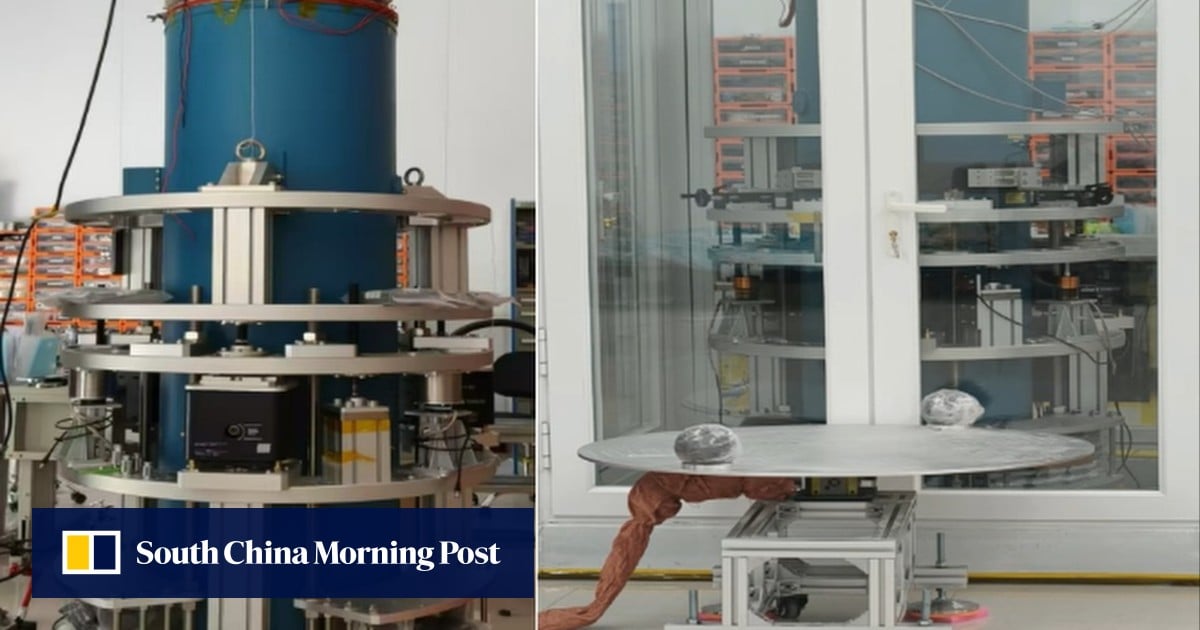
China’s gravity-detecting SQUID gets closer to spotting US nuclear submarines
Chinese researchers unveiled a gravity detector with world-leading precision last month, potentially expanding the military applications of the technology. It uses a superconducting quantum interference device (SQUID) to detect objects by measuring tiny changes in gravity. The team that developed the instrument says it can be used for scientific research and finding underground resources. It also brings the country one step closer to being able to spot patrolling nuclear submarines. According to...

Knowledge Map
Connected Articles — Knowledge Graph
This article is connected to other articles through shared AI topics and tags.


Discussion
Sign in to join the discussion
No comments yet — be the first to share your thoughts!