
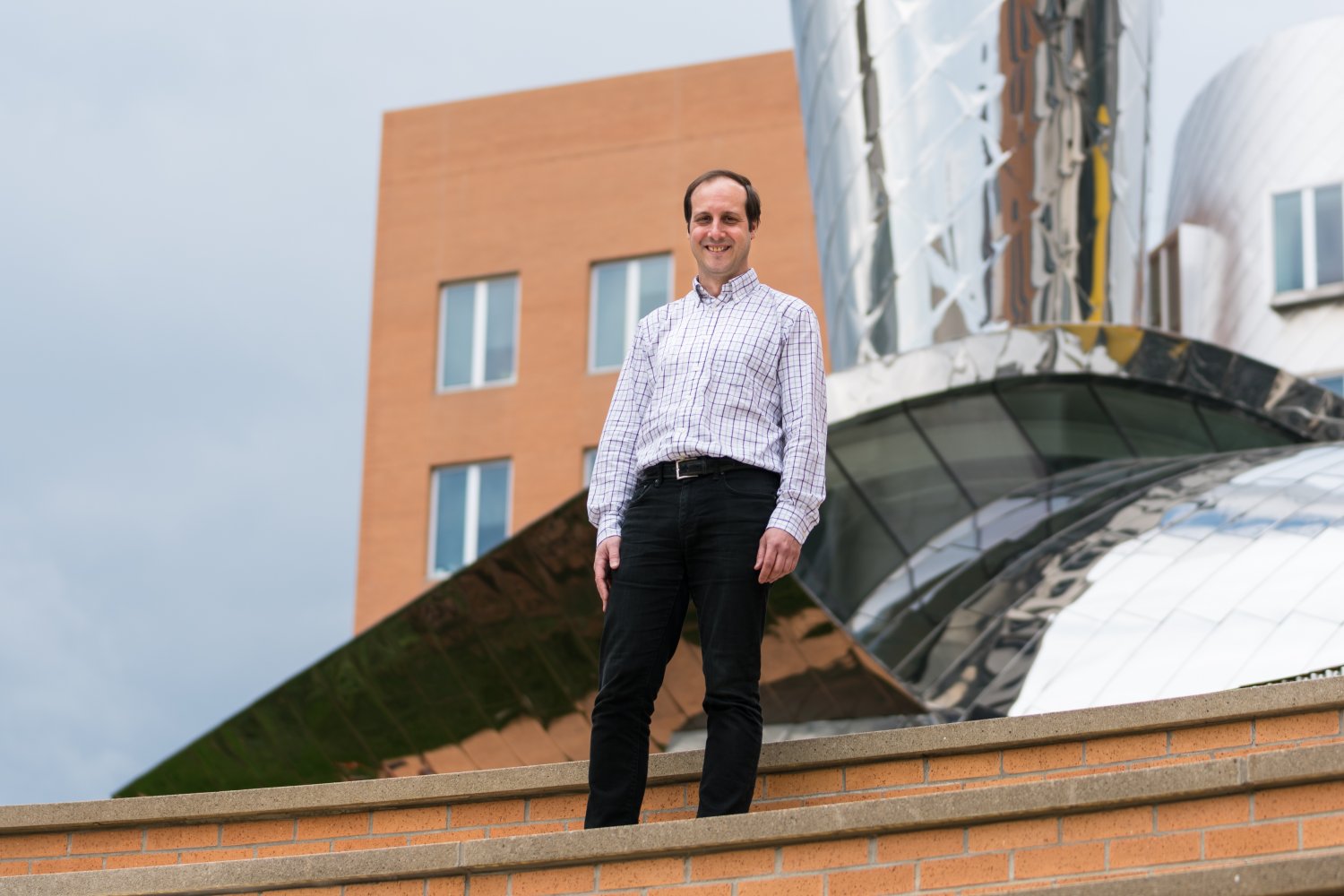
Antonio Torralba, three MIT alumni named 2025 ACM fellows
Hi little friend! Imagine you have a superhero friend named Antonio. 🎉
Antonio loves to teach computers how to see things, just like you see your favorite toys! He helps computers learn what a dog looks like, or a yummy cookie. 🍪
He's so good at it, that some grown-ups who are also super smart gave him a special shiny star award! 🌟 It's like getting a gold medal for being the best at teaching computers to see and think.
Antonio and some of his friends from a super cool school called MIT got this award because they are helping computers understand our world better, just like a smart robot helper! Isn't that neat? 🤖✨
Torralba’s research focuses on computer vision, machine learning, and human visual perception.
Antonio Torralba, Delta Electronics Professor of Electrical Engineering and Computer Science and faculty head of artificial intelligence and decision-making at MIT, has been named to the 2025 cohort of Association for Computing Machinery (ACM) Fellows. He shares the honor of an ACM Fellowship with three MIT alumni: Eytan Adar ’97, MEng ’98; George Candea ’97, MEng ’98; and Gookwon Edward Suh SM ’01, PhD ’05.
A principal investigator within the Computer Science and Artificial Intelligence Laboratory, Torralba received his BS in telecommunications engineering from the Universitat Politècnica de Catalunya, in Spain, in 1994, and a PhD in signal, image, and speech processing from the Institut National Polytechnique de Grenoble, in France, in 2000. At different points in his MIT career, he has been director of both the MIT Quest for Intelligence (now the MIT Siegel Family Quest for Intelligence) and the MIT-IBM Watson AI Lab.
Torralba’s research focuses on computer vision, machine learning, and human visual perception; as he puts it, “I am interested in building systems that can perceive the world like humans do.” Alongside Phillip Isola and William Freeman, he recently co-authored “Foundations of Computer Vision,” an 800-plus page textbook exploring the foundations and core principles of the field.
Among other awards and recognitions, he is the recipient of the 2008 National Science Foundation Career award; the 2010 J. K. Aggarwal Prize from the International Association for Pattern Recognition; the 2017 Frank Quick Faculty Research Innovation Fellowship; the Louis D. Smullin (’39) Award for Teaching Excellence; and the 2020 PAMI Mark Everingham Prize. In 2021, he was awarded the inaugural Thomas Huang Memorial Prize by the Pattern Analysis and Machine Intelligence Technical Committee and was named a fellow of the Association for the Advancement of Artificial Intelligence. In 2022, he received an honorary doctoral degree from the Universitat Politècnica de Catalunya.
ACM fellows, the highest honor bestowed by the professional organization, are registered members of the society selected by their peers for outstanding accomplishments in computing and information technology and/or outstanding service to ACM and the larger computing community.
Sign in to highlight and annotate this article

Conversation starters
Daily AI Digest
Get the top 5 AI stories delivered to your inbox every morning.
More about
research
China Is Willing to Coordinate on AI Governance
View the official memo here. China has consistently signaled a willingness to engage on global AI governance since at least 2017. This memo compiles key statements from the Chinese government and prominent figures demonstrating their desire to coordinate on the problem of AI. Chinese Vice Premier Ding Xuexiang, at the 2025 World Economic Forum, said: [ ] The post China Is Willing to Coordinate on AI Governance appeared first on Machine Intelligence Research Institute .

Knowledge Map
Connected Articles — Knowledge Graph
This article is connected to other articles through shared AI topics and tags.
More in Research Papers


VLMs Need Words: Vision Language Models Ignore Visual Detail In Favor of Semantic Anchors
Vision Language Models struggle with fine-grained visual perception tasks due to their language-centric training approach, performing poorly on unnamed visual entities despite having relevant information in their representations. (1 upvotes on HuggingFace)

Discussion
Sign in to join the discussion
No comments yet — be the first to share your thoughts!