

Adaptive Fully Dynamic $k$-Center Clustering with (Near-)Optimal Worst-Case Guarantees
arXiv:2604.01726v1 Announce Type: new Abstract: Given a sequence of adversarial point insertions and point deletions, is it possible to simultaneously optimize the approximation ratio, update time, and recourse for a $k$-clustering problem? If so, can this be achieved with worst-case guarantees against an adaptive adversary? These questions have garnered significant attention in recent years. Prior works by Bhattacharya, Costa, Garg, Lattanzi, and Parotsidis [FOCS '24] and by Bhattacharya, Costa, and Farokhnejad [STOC '25] have taken significant steps toward this direction for the $k$-median clustering problem and its generalization, the $(k, z)$-clustering problem. In this paper, we study the $k$-center clustering problem, which is one of the most classical and well-studied $k$-clustering
View PDF
Abstract:Given a sequence of adversarial point insertions and point deletions, is it possible to simultaneously optimize the approximation ratio, update time, and recourse for a $k$-clustering problem? If so, can this be achieved with worst-case guarantees against an adaptive adversary? These questions have garnered significant attention in recent years. Prior works by Bhattacharya, Costa, Garg, Lattanzi, and Parotsidis [FOCS '24] and by Bhattacharya, Costa, and Farokhnejad [STOC '25] have taken significant steps toward this direction for the $k$-median clustering problem and its generalization, the $(k, z)$-clustering problem. In this paper, we study the $k$-center clustering problem, which is one of the most classical and well-studied $k$-clustering problems. Recently, Bhattacharya, Costa, Farokhnejad, Lattanzi, and Parotsidis [ICML '25] provided an affirmative answer to the first question for the $k$-center clustering problem. However, their work did not resolve the second question, as their result provides only expected amortized guarantees against an oblivious adversary. In this work, we make significant progress and close the gap by answering both questions in the affirmative. Specifically, we show that the fully dynamic $k$-center clustering problem admits a constant-factor approximation, near-optimal worst-case update time, and constant worst-case recourse, even against an adaptive adversary. This is achieved by first developing a fully dynamic bicriteria approximation algorithm with (near-)optimal worst-case bounds, and then designing a suitable fully dynamic $k$-center algorithm with near-linear update time. For the fully dynamic bicriteria approximation algorithm, we establish the worst-case recourse and worst-case update time guarantees separately, and then merge them into a single algorithm through a simple yet elegant process.
Subjects:
Data Structures and Algorithms (cs.DS)
Cite as: arXiv:2604.01726 [cs.DS]
(or arXiv:2604.01726v1 [cs.DS] for this version)
https://doi.org/10.48550/arXiv.2604.01726
arXiv-issued DOI via DataCite (pending registration)
Submission history
From: Antonis Skarlatos [view email] [v1] Thu, 2 Apr 2026 07:45:33 UTC (388 KB)
Sign in to highlight and annotate this article

Conversation starters
Daily AI Digest
Get the top 5 AI stories delivered to your inbox every morning.
More about
announceupdatestudy

LangChain Just Released Deep Agents — And It Changes How You Build AI Systems
Most people are still hand-crafting agent loops in LangGraph. Deep Agents is a higher-level answer to that — and it’s more opinionated than you’d expect. 1.1 Deep agents in action There’s a pattern I’ve watched repeat itself across almost every team that gets serious about building agents. First, they try LangChain chains. Works fine for simple pipelines. Then the task gets complex — needs tool calls, needs to loop, needs to handle variable-length outputs — and chains stop being enough. So they reach for LangGraph, and suddenly they’re writing state schemas, conditional edges, and graph compilation logic before they’ve even gotten to the actual problem. It’s not that LangGraph is bad. It’s extremely powerful. But it’s a runtime — a low-level primitive — and most people are using it as if i

Knowledge Map
Connected Articles — Knowledge Graph
This article is connected to other articles through shared AI topics and tags.
More in Research Papers
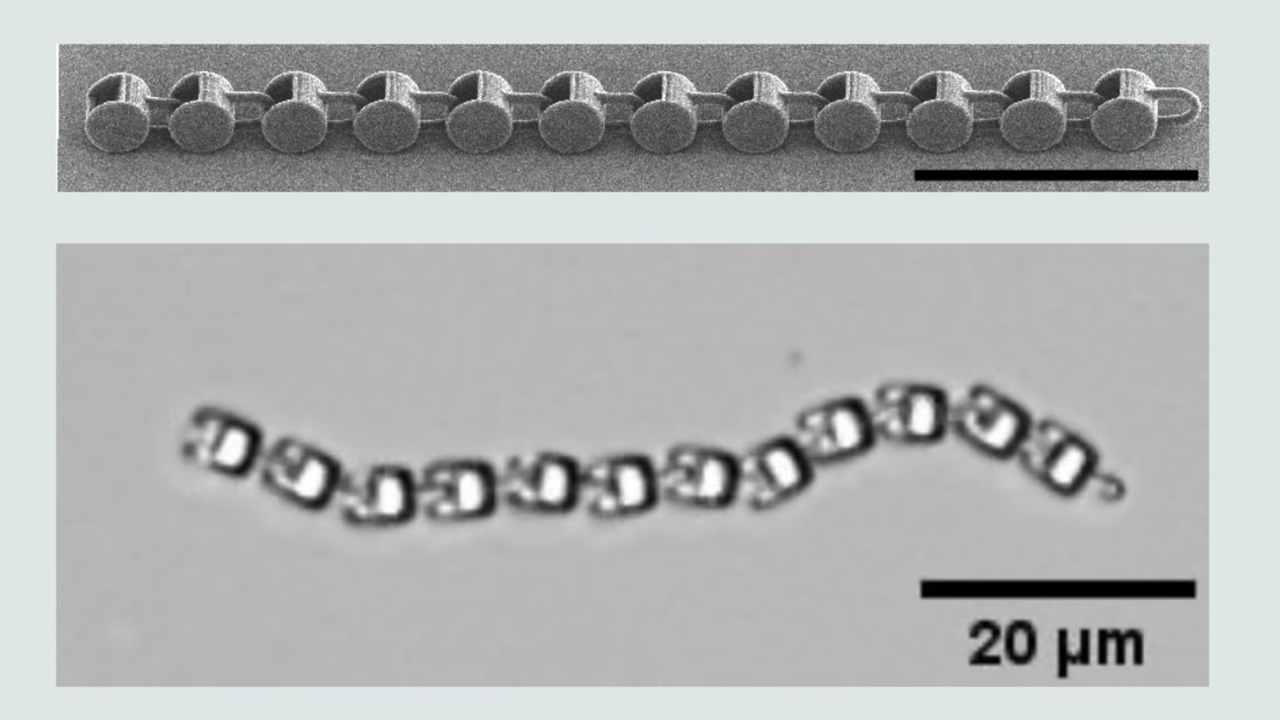
Researchers 3D print robot the size of a single-cell organism — devices move and navigate even without a ‘brain,’ uses their shape and the environment to get going
Researchers 3D print robot the size of a single-cell organism — devices move and navigate even without a ‘brain,’ uses their shape and the environment to get going

Developing psychosocial phenotypes to understand engagement with digital health technologies for heart failure
npj Digital Medicine, Published online: 04 April 2026; doi:10.1038/s41746-026-02571-z Developing psychosocial phenotypes to understand engagement with digital health technologies for heart failure
Discussion
Sign in to join the discussion
No comments yet — be the first to share your thoughts!