
#AAAI2026 invited talk: machine learning for particle physics
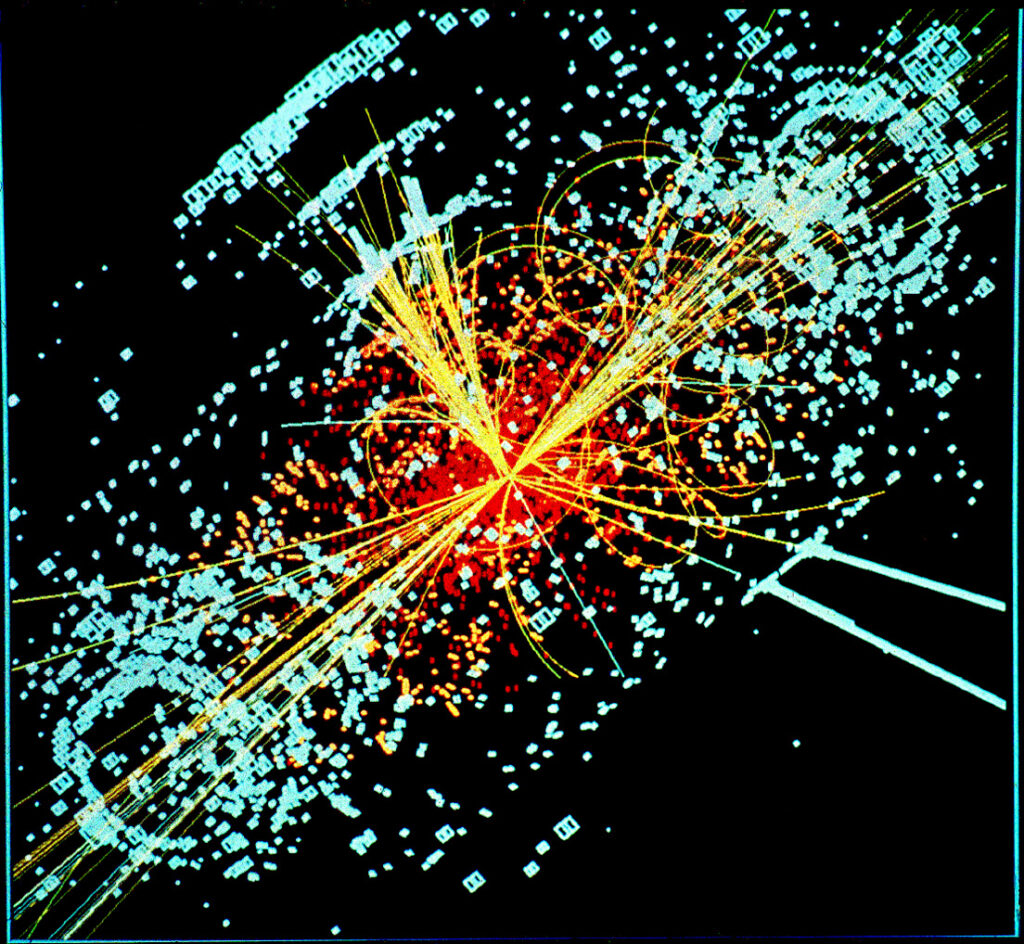
Simulated Large Hadron Collider CMS particle detector data depicting a Higgs boson produced by colliding protons decaying into hadron jets and electrons. Reproduced under a CC BY-SA 3.0 licence. Daniel Whiteson is a particle physicist, who uses machine learning and statistical tools to analyze high-energy particle collisions. He is also a dedicated science communicator, having […]
by
01 April 2026
share this:
Simulated Large Hadron Collider CMS particle detector data depicting a Higgs boson produced by colliding protons decaying into hadron jets and electrons. Reproduced under a CC BY-SA 3.0 licence.
Daniel Whiteson is a particle physicist, who uses machine learning and statistical tools to analyze high-energy particle collisions. He is also a dedicated science communicator, having published books and comics, and is co-host of a science podcast. In his invited talk at the Fortieth AAAI Conference on Artificial Intelligence (AAAI-26), Daniel shared insights on both these aspects of his career.
Daniel works at the Large Hadron Collider (LHC) at CERN, primarily looking at proton-proton collisions, which occur at 13 TeV, a massive 13,000 times the energy stored in a single proton. The majority of collisions result in known particles, such as electrons or muons. However, very occasionally, evidence of a new particle is found. Particles are never observed directly, instead researchers analyse readings from the collider detectors to try to deduce what happened in the collisions. From this information they can infer which particles were involved.
So where does machine learning come in? In fact, particle physicists have been using machine learning for a long time, many years before the deep learning revolution. In the earlier days, during the 1990s, this took the form of shallow networks that were mostly used for reducing the dimensionality of a problem to feed into simulations. In 2012, deep neural networks were applied in the discovery of the Higgs boson. Now machine learning is ubiquitous in particle physics, being used routinely to classify data and to generate simulated data. Researchers also create graph networks to represent structured data. Other use cases include machine learning to optimize the design of the experiments themselves, and in particle theory.
Tracking the paths that particles have taken within the collider is a very challenging problem. The particles leave traces in the layers of detectors which the physicists then have to reconstruct to deduce the pathway. Each detector could be measuring tens of thousands of traces coming from thousands of particles, and the task is to find out which traces belong to which particle. This is clearly near impossible to do using brute force, so researchers have simplified the problem. They assume that the particle in question began where a collision happened and that it moved in a helical path (helical because they are charged particles traveling through a magnetic field). However, Daniel pointed out that these assumptions limit our ability to discover things that violate said assumptions. For example, particle physicists have realised that particles don’t always originate at the collision point.
What Daniel is most interested in, however, is the other assumption – that particles have to move in helices. This is deeply embedded in the current algorithms – the particle path is assumed, there are a few candidate hits, and the trajectory is fitted to that. That trajectory is then propagated forward where there is a search for the next hit. This is a powerful method because, if you have an idea of where the particle went, it narrows down your search significantly. On the other hand, it means the trajectory is assumed to be a helix. But what if it isn’t? There could be all kinds of discoveries already in the data, but because the processing only allows for helical paths these are being missed.
Daniel is hoping that machine learning can help with data analysis of non-helical paths, and believes that graph neural networks are the way forward. Colleagues at CERN have developed a method that separates the finding of a particle and the fitting of that particle to a certain path. The network learns a mapping from the physical space of the hits to a latent space, with particles from the same track being near each other in that latent space. The network can fit to a particular path (be that helical or otherwise) by being trained on examples of those path types.
So which particles don’t move in a helical path? One example are quirks, which are theoretical particles predicted to have an oscillating path. Daniel has worked on a theoretical project to use the tracking method described above and trained it on quirks, rather than standard model helices. In simulations that the team ran, they did indeed find quirks. They then generalised their model to identify any kind of smooth path. The ultimate goal is to find something new and unexpected that has not even been theorised before. It will be fascinating to see how developments play out and if machine learning will help unlock the discovery of new particles.
tags: AAAI, AAAI2026
Lucy Smith is Senior Managing Editor for AIhub.
Sign in to highlight and annotate this article

Conversation starters
Daily AI Digest
Get the top 5 AI stories delivered to your inbox every morning.
Knowledge Map
Connected Articles — Knowledge Graph
This article is connected to other articles through shared AI topics and tags.
More in AI Tools



Researchers build Wi-Fi chip that can operate inside a nuclear reactor — receiver uses special materials and design to withstand high doses of radiation for at least six months
Researchers build Wi-Fi chip that can operate inside a nuclear reactor — receiver uses special materials and design to withstand high doses of radiation for at least six months

Discussion
Sign in to join the discussion
No comments yet — be the first to share your thoughts!